
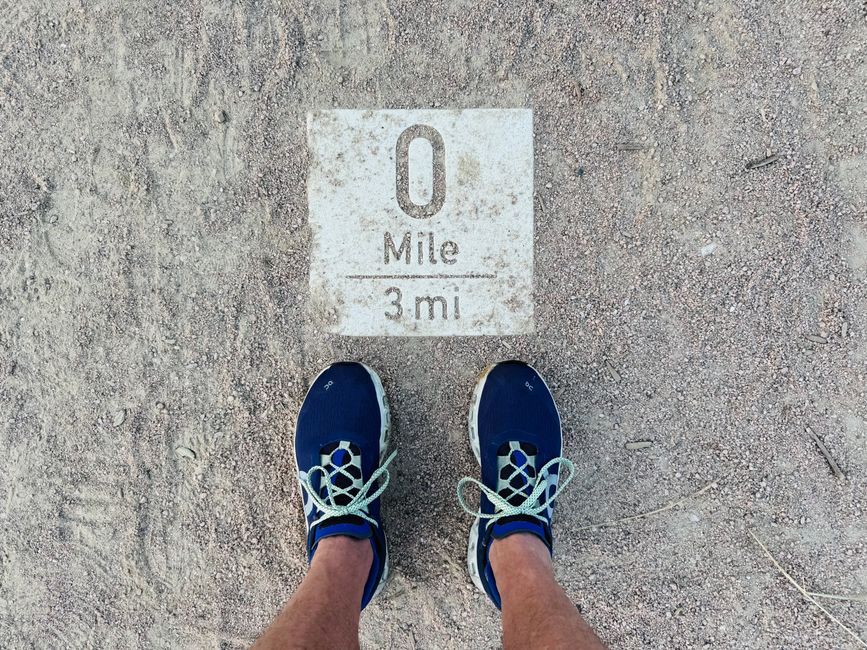
Ten thousand steps is roughly five miles for most people. The exact distance depends on your stride length, which is influenced by your height, leg length, and walking speed. For a typical adult with an average stride of about 2.1 to 2.5 feet, 10,000 steps lands between 4 and 5 miles.
How Far Is 10000 Steps In Miles?
The standard conversion is that 10,000 steps equals about 5 miles. This estimate assumes an average stride length of 2.5 feet per step. Since there are 5,280 feet in a mile, the math works out to 10,000 steps multiplied by 2.5 feet, which equals 25,000 feet, or roughly 4.7 miles.
Most fitness trackers and pedometers use this general estimate. They do not measure your personal stride. That is why your device might say you walked 5 miles while a friend with the same step count gets a different number. Both readings can be correct for each person.
How Stride Length Changes Your Step Distance
Stride length is the distance from the heel strike of one foot to the heel strike of the same foot. It is not the same as step length, which measures one foot to the other. Most people have a stride that is roughly 2.1 to 2.5 feet when walking at a normal pace.
Height plays a major role. Taller people naturally have longer legs and longer strides. A person who is 6 feet tall may cover 5.5 miles in 10,000 steps. A person who is 5 feet 2 inches may cover only 4.2 miles with the same step count. Neither is wrong.
Walking speed also matters. When you walk faster, your stride tends to lengthen. A brisk walk of 3.5 miles per hour produces a longer stride than a casual stroll at 2 miles per hour. Running changes the numbers even more, because running strides are significantly longer than walking strides.
How to Calculate Your Own Step Distance
You can measure your stride length at home with nothing more than a tape measure and a flat surface. Mark a starting point on the floor. Walk 10 normal steps, then measure the total distance from your starting point to where your front foot landed. Divide that number by 10 to get your average step length.
Once you have your step length in feet, multiply it by 10,000. Then divide that number by 5,280 to get your personal miles for 10,000 steps. For example, if your step length is 2.3 feet, the calculation is 10,000 times 2.3 equals 23,000 feet. Divide 23,000 by 5,280 and you get about 4.36 miles.
Many fitness trackers let you enter your height, which improves accuracy. Some newer devices use GPS to measure distance directly, which removes the guesswork entirely. If you want a precise number, walking a known distance on a track while wearing your tracker is the most reliable way to calibrate it.





Is 10,000 Steps a Good Daily Goal?
The 10,000-step goal did not come from a medical study. It originated as a marketing campaign for a Japanese pedometer in the 1960s. The number was catchy and easy to remember, so it stuck. That does not mean it is useless, but it is not a magic threshold.
Research on step counts and health outcomes generally shows that more steps are associated with better health, but the benefits do not require hitting 10,000. Some studies suggest that significant health improvements occur well below that number, with additional benefits leveling off at higher counts. The exact optimal number varies by age and health status.
For many people, 10,000 steps is a reasonable target that encourages regular movement throughout the day. But if 10,000 steps feels overwhelming, a lower goal like 7,000 or 8,000 steps still provides meaningful physical activity. The most important factor is consistency, not hitting a specific number.
How Long Does It Take to Walk 10,000 Steps?
At a moderate walking pace of about 3 miles per hour, most people walk 10,000 steps in roughly 90 minutes to 2 hours. This time breaks down to about 30 to 40 minutes of walking, three times a day, or one longer walk plus incidental movement.
Walking pace varies widely. A brisk walker covering 4 miles per hour might finish 10,000 steps in about 75 minutes. A slower walker at 2 miles per hour could take closer to 2.5 hours. Fitness trackers count all steps, including those taken while doing household chores, shopping, or moving between rooms, so most people accumulate steps throughout the day rather than in one continuous walk.
Breaking up walking into shorter sessions is just as effective as one long walk for meeting step goals. Research consistently shows that total daily movement matters more than how the movement is distributed.
Steps vs. Time: Which Metric Should You Use?
Health guidelines traditionally recommend 150 minutes of moderate-intensity aerobic activity per week. This is a time-based recommendation, not a step-based one. Step counts are a convenient proxy for activity, but they do not capture intensity.
Walking 10,000 steps at a leisurely pace is not the same as walking 7,000 steps at a brisk pace in terms of cardiovascular benefit. Intensity matters for heart health, blood sugar control, and fitness improvements. If your goal is cardiovascular fitness, pay attention to pace, not just step count.
That said, step counts have advantages. They are easy to track, require no special equipment beyond a phone or wearable, and encourage overall movement. Many people find step goals more motivating than time-based goals because they integrate naturally into daily life.
Does Walking 10,000 Steps Help With Weight Loss?
Walking burns calories, and 10,000 steps burns roughly 300 to 500 calories for most people, depending on weight and pace. A heavier person burns more calories than a lighter person at the same pace. This is not a substitute for a structured exercise program, but it is meaningful daily activity.
Weight loss ultimately depends on calorie balance. Walking 10,000 steps daily can contribute to a calorie deficit, but it will not produce weight loss if calorie intake exceeds expenditure. Combining increased steps with dietary changes is the approach most consistently supported by evidence.
Walking also has benefits beyond weight. Regular walking improves cardiovascular health, lowers blood pressure, improves mood, and supports joint health. These benefits occur regardless of whether the scale moves.
Common Myths About Step Counts
A common myth is that you must reach 10,000 steps or your day is wasted. This is false. Any amount of walking above your baseline provides health benefits. Research does not show a cliff edge where benefits suddenly begin at 10,000 steps.
Another myth is that step counters are perfectly accurate. Consumer wearables can be off by 10 to 20 percent depending on where they are worn and how you move. Arm movement without actual walking can register as steps, and slow walking sometimes goes uncounted. The number on your wrist is an estimate, not a precise measurement.
Some people believe walking is inferior to running for health. Studies consistently show that walking and running provide similar health benefits when total energy expenditure is equal. Walking is lower impact and easier on the joints, making it a sustainable option for most adults.
Frequently Asked Questions
How many miles is 10,000 steps?
For most people, 10,000 steps is about 5 miles. Your exact distance depends on your stride length, which is influenced by your height and walking speed.
How long does it take to walk 10,000 steps?
Most people complete 10,000 steps in about 90 minutes to 2 hours of total walking time. This time is usually spread throughout the day rather than done in one session.
Is walking 10,000 steps a day enough exercise?
It is a good amount of daily movement for most adults. Health guidelines recommend 150 minutes of moderate activity weekly, and 10,000 steps typically exceeds that when walked at a moderate pace.
Does running 10,000 steps cover more miles than walking?
Yes. Running strides are longer than walking strides, so 10,000 running steps covers more distance than 10,000 walking steps. The difference can be a mile or more.
