
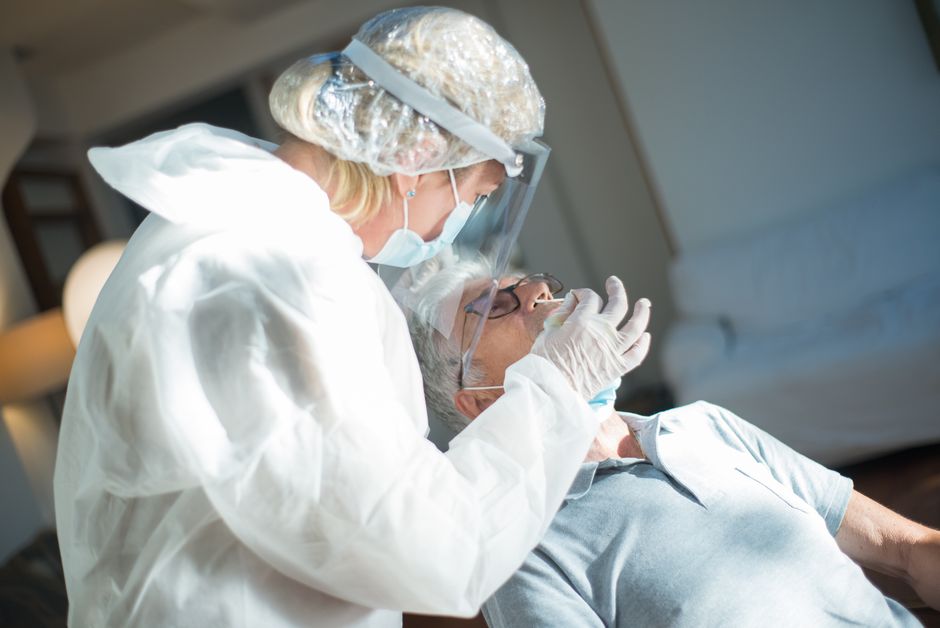
A mouth swab drug test usually detects drugs used within the past few hours to about 48 hours. In most cases, the window is shorter than a urine test. For heavy, long-term users, some drugs may remain detectable for up to a few days, but that is the exception rather than the rule.
This short detection window is the single most important thing to understand about oral fluid testing. It is why these tests are common in workplaces and roadside checks, and why the timing of your last use matters so much.
How Does A Mouth Swab Drug Test Actually Work?
A mouth swab test collects oral fluid, also called saliva, from inside your cheek and under your tongue. The swab is placed in a small device or tube, and the sample is screened for drug compounds or their breakdown products.
The key point is what oral fluid actually contains. When you use a drug, it enters your bloodstream. Some of it passes from blood into the saliva-producing glands and mixes into oral fluid. A smaller amount can also linger in your mouth directly from smoking, snorting, or swallowing a substance.
This is different from a urine test. Urine collects drug metabolites that the body has already processed and concentrated over time. That is a big reason urine tests have longer detection windows. Oral fluid reflects what is circulating in your blood closer to the moment of collection.
Most lab-based oral fluid tests use a cutoff level to decide whether a sample counts as positive. Results below that cutoff are reported as negative. This matters because trace amounts can be present without crossing the threshold.
How Far Back Will A Mouth Swab Drug Test Go For Common Drugs?
Detection windows vary by drug. The ranges below reflect general patterns reported in toxicology literature and test manufacturer data. They are estimates, not guarantees.
- Marijuana (THC): Often detectable for up to about 24 hours after use. Some heavy users may show positive results somewhat longer, but oral fluid clears THC faster than urine does.
- Cocaine: Typically detectable for roughly 12 to 24 hours. Cocaine and its metabolites clear from oral fluid relatively quickly.
- Amphetamines and methamphetamine: Generally around 24 to 48 hours.
- Opioids: Commonly around 24 to 48 hours, depending on the specific drug.
- Benzodiazepines: Often around 24 to 48 hours, though this class varies widely.
- Alcohol: Only detectable for a few hours, sometimes less, depending on the test.
These are broad ranges. Individual results depend on dose, how often someone uses, how the drug was taken, and how the sample was collected.
Why Is The Detection Window Shorter Than A Urine Test?
Urine testing detects metabolites that the body has been filtering and concentrating. Those compounds can stay in urine for days or even weeks for some drugs, especially marijuana in regular users.
Oral fluid works differently. It reflects drugs that are currently in your bloodstream or recently in your mouth. Once blood levels drop, oral fluid levels drop too. There is no storage reservoir the way there is with urine in the bladder.
This is why a person can test negative on a mouth swab but positive on a urine test collected the same day. The two tests are measuring different things over different timeframes.
One non-obvious point: oral fluid testing is generally better at catching very recent use, while urine testing is better at catching use from several days ago. Neither test is simply “more accurate.” They answer different questions.



What Affects How Long Drugs Stay Detectable In Oral Fluid?
Several factors shift the detection window. None of them are precise enough to predict an individual result with certainty.
- Frequency of use: Regular, heavy use tends to extend detection compared to a single use.
- Dose: Larger amounts generally take longer to clear.
- Route of use: Smoking or snorting can leave residue in the mouth, which may briefly raise oral fluid levels.
- Body chemistry: Metabolism, body weight, and liver function vary between people.
- Hydration and oral hygiene: These can affect sample quality, though they do not reliably “beat” a test.
- Test sensitivity: Different tests use different cutoff levels, so the same sample could read differently across devices.
Because these factors interact, no one can tell you exactly how long a drug will stay detectable in your specific case. Any source that gives a single precise number is oversimplifying.
Can You Fail A Mouth Swab Test From Secondhand Exposure?
Secondhand marijuana smoke exposure is a real concern people raise, but the evidence here is limited and mixed. Some studies suggest that being in a closed space with heavy smoke can produce detectable levels, while other research finds that casual exposure rarely crosses the cutoff threshold.
What is clearer is that direct oral contact matters more than airborne exposure. Sharing a pipe, kissing someone who just used, or handling a substance and then touching your mouth can introduce drug residue directly into oral fluid.
Passive exposure is generally less likely to cause a positive result than direct use. But it is not impossible, and the science does not allow a firm yes or no for every situation.
How Accurate Are Mouth Swab Drug Tests?
Oral fluid tests are considered reliable for detecting recent use when used correctly. Many are used in workplace and law enforcement settings, and some are cleared by regulators for that purpose.
Accuracy depends on the drug, the test, and the collection method. Screening tests can produce false positives, which is why a positive result is usually confirmed with a more precise lab method such as mass spectrometry.
False negatives can also happen, especially if enough time has passed since use. A negative result does not always prove someone never used a drug. It may simply mean the drug had already cleared.
It is also worth separating two ideas that often get confused. A test detecting a substance is not the same as proving impairment. Oral fluid can show a drug is present without showing how much it is affecting a person’s thinking or coordination.
How Long Does It Take To Get Results?
Rapid oral fluid tests used on-site can give a result in minutes. These are screening tests.
If a sample is sent to a laboratory for confirmation, results typically take a few days. The exact turnaround depends on the lab and how the sample was shipped.
A positive screening result is not final until it is confirmed. This step exists to reduce the chance of a false positive being acted on.
What Should You Know Before A Mouth Swab Test?
The most useful thing to understand is the timing. Because oral fluid clears quickly, the test is best at catching recent use and poor at catching use from a week ago.
Trying to mask or dilute a sample is unreliable and, in many testing programs, is itself treated as a violation. There is no proven method to reliably change an oral fluid result.
If you are being tested for a workplace, legal, or medical reason, the most accurate information comes from the testing lab or the organization running the program. They can tell you which drugs are screened and what cutoff levels apply.
Frequently Asked Questions
How far back does a mouth swab drug test detect marijuana?
Marijuana is usually detectable in oral fluid for up to about 24 hours after use. Some heavy, long-term users may test positive somewhat longer, but oral fluid clears THC faster than urine does.
Can a mouth swab test detect drugs from a week ago?
Generally no. Most drugs clear from oral fluid within about 48 hours, so a mouth swab is not a reliable way to detect use from a week earlier.
Is a mouth swab test more accurate than a urine test?
Neither is simply more accurate. A mouth swab is better at catching very recent use, while a urine test can detect use from several days earlier.
How long do mouth swab results take?
On-site rapid tests can give results in minutes, while lab-confirmed results usually take a few days. A positive screening result is not final until it is confirmed.
