
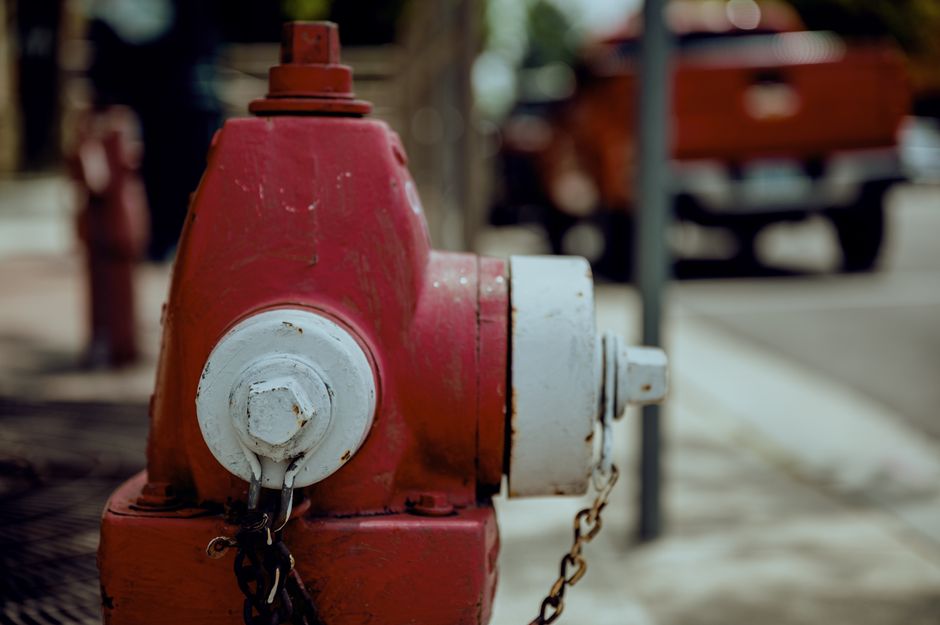
A fire hydrant is a valve connected to a buried water main, and it does nothing until a firefighter or utility worker attaches a wrench and turns the operating nut on top. That turn opens a valve inside the barrel and lets pressurized water flow up and out through one of the outlets. The water is already there, sitting under pressure in the city main below the street. The hydrant is simply the door.
That is the whole idea in three sentences. What makes hydrants interesting is everything built around that simple idea: how they keep water from freezing in winter, how they drain themselves after use, and why a car shears one off and sends a tower of water into the air. Those details explain why hydrants look the way they do.
What Is Inside a Fire Hydrant?
A dry-barrel hydrant has four main parts: the barrel, the operating stem, the main valve at the bottom, and the drain mechanism. The barrel is the tall cast iron body you see above ground. It is empty most of the time.
The operating stem is a long metal rod that runs from the nut on top all the way down to the main valve at the base. The main valve sits below the frost line, the depth where soil never freezes. In cold parts of the United States that can be several feet down. When the valve opens, water travels up the barrel to the outlets.
The drain mechanism is the clever part. When the valve closes, a small drain port opens and lets the water left in the barrel escape into the ground through gravel at the base. That keeps the barrel dry between uses, which is why this design is called a dry-barrel hydrant.
Wet-barrel hydrants
In warm climates that never freeze, some systems use wet-barrel hydrants. These stay full of water all the time and rely on the valve being at the top rather than the bottom. The trade-off is simple: a wet-barrel hydrant cannot survive a hard freeze, so it is limited to frost-free regions.
How Does a Fire Hydrant Work Step by Step?
The sequence from wrench to water is short and mechanical.
- Connect. A firefighter removes the cap from the outlet and attaches a hose or a pump connection. Caps are threaded and often require a hydrant wrench.
- Turn the operating nut. The wrench turns the pentagonal nut on top. The nut is a non-standard shape so that ordinary household tools cannot open it.
- The stem rotates and lifts the valve. Turning the nut rotates the stem, which raises the main valve off its seat at the bottom of the barrel.
- Water rises. Pressure from the main pushes water up the barrel and out the open outlet.
- Close and drain. Turning the nut the other way lowers the valve back onto its seat. The drain port reopens and the barrel empties into the gravel bed below.
The operating nut is a security feature, not an accident. The pentagon shape means a random passerby cannot open a hydrant with a pair of pliers. Utility workers and firefighters carry the matching wrench.
Where Does the Water Pressure Come From?
The pressure comes from the municipal water system, not from the hydrant. Water utilities maintain pressure in the distribution mains using pumps, elevated storage tanks, and the natural elevation of the terrain. A hydrant taps into that existing pressure.
Hydrant outlets are typically 2.5 inches for standard hose connections, with larger steamer ports on some hydrants for high-volume supply. The size of the outlet matters because flow depends on both pressure and pipe diameter. A narrow connection limits how much water can move no matter how much pressure sits behind it.
Fire departments sometimes test hydrants to measure available flow. This is called a flow test, and the results tell firefighters how much water a given hydrant can deliver. A hydrant that looks fine can still perform poorly if the main feeding it is small or if mineral buildup has narrowed the barrel.
Why Do Hydrants Have Different Colored Caps?
Cap colors usually indicate the flow capacity of the hydrant, though the exact color scheme varies by jurisdiction. The idea is that a firefighter arriving on scene can glance at a hydrant and know roughly how much water to expect before hooking up.
Because the codes are local, a blue cap in one city may mean something different in another. There is no single national color standard that every department follows. Some departments paint the body of the hydrant one color and the caps another, and some use reflective bands instead.
In some cities, hydrants are also fitted with a device that prevents unauthorized opening, or with a marker flag so crews can find them under snow. These are practical local adaptations rather than universal features.
Why Does Water Shoot Into the Air When a Hydrant Is Hit?
When a vehicle strikes a hydrant, the barrel can shear off at a breakaway flange near ground level. The main valve stays below, still closed, but the barrel above it is gone. Water then escapes from the open top of the broken pipe and shoots upward.
The breakaway design is intentional. It allows the hydrant to separate cleanly rather than tearing up the water main underneath. A sheared hydrant is a nuisance and a hazard, but a ruptured main would be far worse. The escaping water is coming from the pressurized main, not from a reservoir inside the hydrant.
This is also why a struck hydrant can be dangerous beyond the water itself. The force of the escaping stream and the risk of the hydrant moving can injure people nearby. Utility crews shut off the flow by closing a valve on the main, which may require digging.
How Do Hydrants Keep From Freezing?
Dry-barrel hydrants keep from freezing because there is no water in the barrel above the frost line. The main valve sits below the frost line, and the drain port empties the barrel after each use.
This design depends on the drain working. If the drain port clogs with dirt, gravel, or debris, water stays in the barrel and can freeze and crack the casting. That is one reason hydrants are inspected and maintained on a schedule.
Some hydrants in very cold regions are fitted with additional features, such as insulated barrels or a circulating design, but the dry-barrel principle covers most of the country. The frost line depth varies widely by region, and the valve is set below it accordingly.
Who Maintains Fire Hydrants?
The local water utility or the fire department usually maintains hydrants, depending on the city. Maintenance includes checking that the valve opens and closes, that the drain works, that caps are present, and that the hydrant is visible and accessible.
A hydrant that has been painted over, buried by landscaping, or blocked by parked cars is a real problem. Firefighters need clear access and a known water supply. Some departments mark hydrants with flags or reflective paint for that reason.
If you notice a hydrant leaking from the top or the base, that is worth reporting to the local water utility. A steady leak can indicate a valve that is not seating properly, and it can waste a large volume of treated water over time.
Frequently Asked Questions
How does a fire hydrant get its water?
It connects to a pressurized municipal water main buried below the street. The hydrant itself holds no water above ground until the valve is opened.
Can anyone open a fire hydrant?
Not easily. The operating nut is a pentagon shape that requires a special wrench, which is a deliberate design to prevent unauthorized use.
Why is there no water in a fire hydrant most of the time?
Most hydrants are dry-barrel designs that stay empty above the frost line to prevent freezing. The main valve sits below the frost line and the barrel drains after each use.
What happens if a fire hydrant freezes?
If the drain port clogs and water stays in the barrel, it can freeze and crack the casting. That is why hydrants are inspected and maintained on a regular schedule.
