
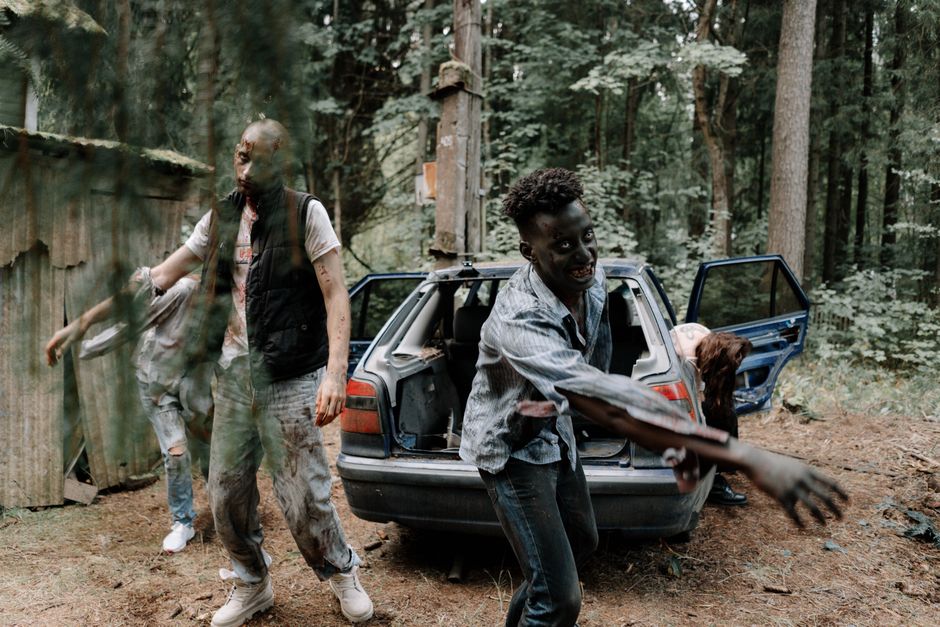
A zombie, in the popular sense, is a human body that has died and then reanimated — and no, that does not happen. The real science behind zombies is not about the dead rising. It is about how the human brain can make a living person behave in ways that look zombie-like: driven by urges, stripped of judgment, sometimes violent. That is a real and well-documented phenomenon, and it explains why the zombie idea keeps returning in different forms.
There is also a second, more literal answer. Some infections and drugs can damage the brain so severely that a person loses personality, initiative, and self-control. The body keeps moving. The person you knew is gone. Understanding how that happens tells you far more about zombies than any horror film does.
Where Did the Zombie Idea Come From?
The modern zombie has roots in Haitian folklore, where the word “zombi” referred to a person under magical control, not a flesh-eating corpse. That version was about slavery and loss of will — a living person turned into a laborer with no mind of their own. The flesh-eating monster is a twentieth-century invention, largely shaped by film.
The folklore version is closer to what medicine actually describes. A person can be alive, breathing, and physically capable, yet unable to think or act independently. That is a neurological reality. The reanimated corpse is not.
Can a Dead Body Really Come Back to Life?
No. Death is not a switch that can be flipped back once the brain has lost its blood supply for long enough. Brain cells begin to die within minutes of oxygen loss, and that damage is permanent. There is no known mechanism by which a body could restart itself after true death.
Defibrillators confuse people here. A defibrillator does not bring the dead back. It delivers an electric shock to a heart that is beating in a chaotic rhythm, to reset it to a normal one. If the heart has stopped entirely, a shock does nothing. The device works only when there is still electrical activity to correct.
Cardiopulmonary resuscitation (CPR) is sometimes described as bringing people back from the dead. It does not. CPR buys time by keeping some blood moving to the brain until a defibrillator or hospital care is available. Survival depends on how quickly the heart is restarted and how long the brain went without oxygen. It is not reanimation. It is a bridge.
What Makes a Living Person Act Like a Zombie?
Several real conditions can strip away the qualities that make someone recognizably themselves — judgment, initiative, emotional control, and awareness of others. When those are damaged, the body can keep functioning while the person seems hollowed out.
This is where the zombie metaphor earns its keep. The brain regions most involved in planning, self-control, and social behavior are the frontal lobes, and they are vulnerable to injury, infection, and chemical disruption. When they fail, the result can look disturbingly like the movie version.
- Severe brain injury. Damage to the frontal lobes can leave a person impulsive, emotionally flat, or unable to plan. They may walk and eat but show little of their former personality.
- Advanced dementia. Conditions such as Alzheimer’s disease progressively destroy brain tissue. In late stages, people can lose speech, recognition of loved ones, and the ability to care for themselves.
- Certain infections. Some infections attack the brain directly and can cause confusion, aggression, or loss of function. Rabies is the best-known example, and it is nearly always fatal once symptoms appear.
- Severe intoxication or withdrawal. Some drugs and alcohol can produce states of confusion, agitation, and loss of normal behavior.
None of these turn a person into a reanimated corpse. All of them show that “human behavior” depends on a working brain, and that when specific parts break down, the behavior changes in predictable ways.




Is There a Real Parasite That Controls the Brain?
Some parasites do manipulate the behavior of their hosts, and that is real biology. The best-known example is Toxoplasma gondii, a single-celled parasite that reproduces in cats. In rodents, infection can reduce fear of cats, which makes the rodent easier to catch — good for the parasite, bad for the rodent.
People sometimes ask whether this parasite controls human behavior. The evidence is far weaker than the headlines suggest. Some studies have reported associations between Toxoplasma infection and changes in personality or reaction time, but results vary and the effects are small. No clinical evidence currently confirms that the parasite turns people into puppets. It is a genuine example of parasite behavior manipulation in animals, not a human zombie mechanism.
Fungal infections get similar treatment online, usually because of a fungus that alters the behavior of ants. The biology is real in insects. The leap to humans is not supported. Human fungal infections of the brain are serious medical emergencies, but they cause illness and neurological damage — not behavioral control.
How Do Zombies Work The Real Science Explained Through Disease Spread?
Zombie movies are, at their core, outbreak movies. The way a fictional infection spreads follows rules that real infectious diseases also follow, and that is where the science gets genuinely interesting.
An infection that spreads easily usually has a trade-off. Pathogens that kill their hosts quickly have less time to spread to new hosts. Pathogens that spread efficiently tend to keep hosts alive and mobile. This is a real evolutionary pressure, and it helps explain why the most dangerous diseases are not always the most contagious ones.
Real outbreaks also depend on how a pathogen travels. Respiratory infections spread through the air and can move fast through a population. Bloodborne infections spread far more slowly because they require specific contact. A fictional zombie virus spread by bites would, by the same logic, move slowly — which is one reason the movie version needs a fast incubation period to work.
Public health measures — isolating the sick, tracking contacts, and limiting exposure — are what actually slow real outbreaks. That is well established. The dramatic version skips these steps because they are effective, not because they are useless.
Why Does the Zombie Idea Persist?
The zombie story gives people a way to think about real fears: losing control, losing identity, and being overtaken by something they cannot see. Those fears are not irrational. They map onto genuine conditions that affect millions of people, including dementia and severe brain injury.
That is the most useful takeaway. The zombie is a story about what happens when the brain stops working as it should. Medicine understands a great deal about that, and it is far more sober than the movies. It is also more relevant to real life.
If someone you know shows sudden confusion, personality change, or loss of function, that is a medical situation, not a story. Sudden changes in thinking or behavior can signal stroke, infection, or another urgent problem and warrant prompt medical evaluation. The fictional zombie is harmless. The real neurological conditions behind the metaphor are not, and they are treatable when caught early.
Frequently Asked Questions
Can a human become a zombie in real life?
No. There is no known biological mechanism that reanimates a dead human body. Real conditions can cause zombie-like behavior in living people, but those are neurological or infectious diseases, not reanimation.
Is the zombie fungus real?
Fungi that alter the behavior of insects are real, but no fungus is known to control human behavior. Human fungal brain infections cause serious illness, not behavioral control.
Can a parasite make you act like a zombie?
Some parasites manipulate animal behavior, and Toxoplasma gondii is a well-documented example in rodents. Evidence for similar effects in humans is limited and mixed, and no clinical evidence confirms parasite-driven control of human behavior.
What real condition looks most like a zombie?
Advanced dementia and severe frontal lobe injury can strip away personality, judgment, and independence while the body keeps functioning. These are serious medical conditions, not reanimation, and they require medical care.
