
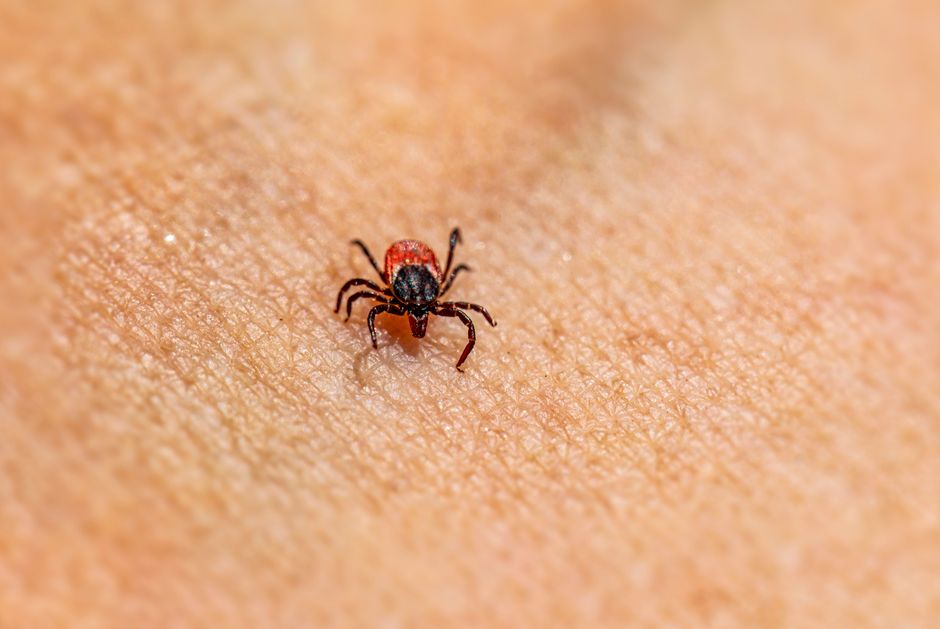
Grab the tick as close to your skin as you can with fine-tipped tweezers. Pull straight up with steady, even pressure until it lets go. Do not twist, jerk, or crush it, and do not put petroleum jelly, nail polish, alcohol, or a lit match on it — those methods don’t work and can make the tick release more saliva into your skin.
That’s the short answer. The rest of this article explains why those steps matter, what to do if the tick’s mouthparts stay behind, which removal methods actually fail, and when a bite needs medical attention.
What Is the Correct Way to Remove a Tick?
Fine-tipped tweezers and a slow, steady pull are the whole method. Here is the sequence the Centers for Disease Control and Prevention recommends:
- Use fine-tipped tweezers. Grasp the tick as close to the surface of your skin as possible.
- Pull upward with steady, even pressure. Don’t twist or jerk — that can cause the mouthparts to break off and stay in your skin.
- If the mouthparts break off and remain in the skin, remove them with tweezers if you can do so easily. If not, leave them alone and let the skin heal.
- Clean the bite area and your hands with rubbing alcohol, an iodine scrub, or soap and water.
- Dispose of the live tick by putting it in alcohol, placing it in a sealed bag or container, wrapping it tightly in tape, or flushing it down the toilet. Never crush a tick with your fingers.
Steady pressure matters more than speed. A tick’s mouthparts are anchored into your skin with a structure called the hypostome, and some species also produce a cement-like substance that helps them stay attached. Pulling slowly gives the tick’s grip a chance to release. Ripping it out sideways is what breaks the mouthparts off.
If you want to keep the tick for testing, put it in a sealed container or a small plastic bag with a slightly damp paper towel. Some state health departments and commercial labs accept ticks for identification and pathogen testing. It’s not required for treatment decisions, but it can be useful information.
Why Do Home Remedies Like Vaseline or Matches Not Work?
There is no evidence that smothering, burning, or poisoning a tick makes it let go faster or reduces your risk of disease. The opposite concern is more plausible.
Methods like petroleum jelly, nail polish, rubbing alcohol, or a hot match are sometimes described as making the tick “back out.” What they more reliably do is irritate the tick. An irritated tick may regurgitate its stomach contents into the bite wound, and that is the last thing you want, because that’s where disease-causing organisms live.
Some of these methods also carry their own risk. A lit match near the skin can cause a burn. Nail polish and petroleum jelly create a mess that makes it harder to see whether the tick is actually gone.
There’s a second reason these remedies fail: they don’t address the anchor. The tick isn’t holding on with its mouth clamped shut in a way that loosens when it’s uncomfortable. It’s physically embedded. The only reliable way to remove it is mechanical.
What Happens If the Tick’s Head Stays in Your Skin?
It’s common, and it’s usually not an emergency. The piece left behind is typically part of the mouthparts, not the whole head.
The CDC’s guidance is straightforward: if you can remove the remaining mouthparts easily with clean tweezers, do it. If you can’t, leave them alone and let the skin heal. Digging around in your skin with a needle or tweezers tends to cause more tissue damage and a higher risk of infection than the fragment itself.
Your body will generally work the fragment out over days to weeks, similar to a splinter. Keep the area clean and watch it.
See a doctor if you develop signs of a skin infection — increasing redness, swelling, warmth, pain, or pus — or if the bite area develops a spreading rash. A small red bump or mild itching at the bite site for a few days is common and doesn’t by itself mean anything is wrong.





How Long Does a Tick Need to Be Attached to Transmit Disease?
Transmission isn’t instant, and the timing differs by the disease. For Lyme disease, the best available evidence indicates that an infected tick generally needs to be attached for more than 24 hours, and often considerably longer, before the bacteria are transmitted. That’s why prompt removal matters — it can genuinely prevent infection.
This is not true across the board. Some tick-borne illnesses can be transmitted much faster. For example, the organism that causes Rocky Mountain spotted fever can be transmitted within hours of attachment in some cases, and some other tick-borne diseases behave similarly. Powassan virus, which is rare but serious, can also be transmitted relatively quickly.
So the practical takeaway isn’t “you have a day to spare.” It’s that faster removal is better, and that a tick found and removed quickly is a much lower concern than one that’s been feeding for days.
One clarification that gets lost in a lot of online advice: not every tick carries disease, and not every bite from an infected tick causes illness. A bite is a reason to pay attention, not a reason to panic.
What Are the Signs You Should See a Doctor After a Tick Bite?
Most tick bites cause nothing more than a local reaction. Watch for these signs over the weeks after a bite, and contact a healthcare provider if any appear:
- A rash that expands over days, including the classic “bull’s-eye” pattern, but also any expanding rash. Not everyone with Lyme disease gets a bull’s-eye rash, and some people get a solid red expanding patch instead.
- Fever, chills, or fatigue that starts days to weeks after the bite.
- Muscle aches, joint pain, or joint swelling.
- Headache, especially with neck stiffness.
- Facial drooping or weakness on one side of the face.
Different tick-borne diseases produce different symptoms, and some overlap with common viral illnesses. That’s a reason to mention the tick bite to your doctor rather than waiting for a clear pattern to emerge.
Prompt treatment matters for several tick-borne illnesses. If you develop symptoms after a known or suspected tick bite, don’t wait to see whether they resolve on their own.
How Do You Prevent Tick Bites in the First Place?
Prevention is more reliable than removal, though neither is perfect. The CDC recommends using EPA-registered insect repellents, treating clothing and gear with products containing 0.5% permethrin, and checking yourself, your children, and your pets after time outdoors.
Some practical points that are easy to miss:
- Ticks are often found in grassy, brushy, or wooded areas, and also in leaf litter. They can be present in your own yard.
- Showering within two hours of coming indoors can help you find and wash off ticks that haven’t attached yet.
- Putting clothes in a dryer on high heat for about 10 minutes can kill ticks on dry clothing. If clothing is damp, it may need longer.
- Check under the arms, in and around the ears, inside the belly button, behind the knees, between the legs, around the waist, and in the hair.
- Pets can carry ticks into the house. Talk to your veterinarian about tick prevention for animals.
Permethrin-treated clothing is one of the more effective prevention tools, but permethrin should not be applied directly to skin. Follow the product label.
Frequently Asked Questions
Can I use my fingers to pull a tick off?
No — using bare fingers increases the chance you’ll crush the tick and squeeze its contents into the bite wound. Use fine-tipped tweezers and grasp the tick as close to your skin as possible.
What if I can’t get the tick’s head out?
Leave it alone and let the skin heal, unless you can remove the remaining piece easily with clean tweezers. Digging at it with a needle or your fingernails causes more damage than the fragment itself.
How long does a tick have to be attached to make you sick?
For Lyme disease, evidence indicates an infected tick generally needs to be attached for more than 24 hours before transmission. Some other tick-borne diseases can be transmitted within hours, so prompt removal is always the goal.
Should I get tested for Lyme disease after a tick bite?
Testing is generally not useful right after a bite, because it takes time for the body to produce detectable antibodies. Talk to a healthcare provider about whether testing or preventive treatment is appropriate for your situation.
