
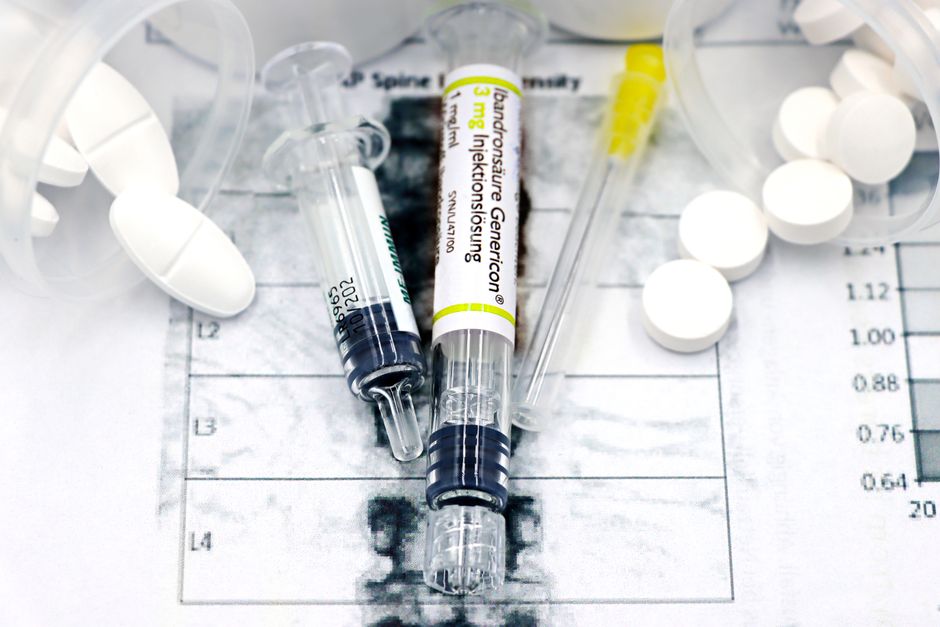
Osteoporosis is diagnosed with a bone mineral density test called a DXA scan, which measures how much mineral is packed into your bones. The result is reported as a T-score, and a T-score of -2.5 or lower at the hip or spine means osteoporosis. A second path to diagnosis exists too: a low-trauma broken bone, especially in the hip or spine, can confirm the disease even when bone density looks better than that cutoff.
That is the short answer. The longer answer involves who should be tested, what the numbers actually mean, and why a normal scan does not always settle the question.
What Is a DXA Scan and How Does It Work?
A DXA scan — dual-energy X-ray absorptiometry — is the standard test for measuring bone mineral density. It uses two low-dose X-ray beams that pass through the body at different energy levels. Bone absorbs more of the beams than soft tissue does. A computer compares the two signals and calculates how much mineral is present in the bone.
The scan is quick and painless. You lie fully clothed on a padded table for roughly 10 to 15 minutes while an arm passes over you. The radiation dose is very small — a fraction of a standard chest X-ray — though it is still radiation, and pregnancy should be discussed with the ordering clinician beforehand.
DXA typically measures the hip (the femoral neck and total hip) and the lumbar spine. The forearm may be scanned in certain situations, such as very high body weight or overactive parathyroid disease. The hip and spine are preferred because they are the sites where fractures matter most and where the evidence base for treatment decisions is strongest.
How Do You Diagnose Osteoporosis Using T-Scores and Z-Scores?
Two numbers come out of a DXA report, and they answer different questions.
The T-score compares your bone density to the average peak bone mass of a healthy young adult of the same sex. It is expressed in standard deviations — how many “steps” above or below that young-adult average you sit. The World Health Organization defines the diagnostic categories this way:
- Normal: T-score of -1.0 or above
- Low bone mass (osteopenia): T-score between -1.0 and -2.5
- Osteoporosis: T-score of -2.5 or lower
- Severe (established) osteoporosis: osteoporosis plus one or more fragility fractures
The Z-score is different. It compares you to other people your own age and sex. A Z-score of -2.0 or lower is considered below the expected range for your age. This matters most in younger patients, because a low Z-score can point to a secondary cause — a medication, a hormone problem, a malabsorption issue — rather than age-related bone loss. In premenopausal women and in men under 50, the Z-score is often the more informative number.
One clarification that gets lost in the noise: osteopenia is not a disease. It is a statistical range. Plenty of people with a T-score of -1.5 never fracture, and some people with a “normal” score do. The score is a risk marker, not a verdict.
Who Should Get Tested for Osteoporosis?
Bone density testing is recommended for women aged 65 and older and men aged 70 and older. Younger people with risk factors should also be evaluated. The major professional guidelines agree on this general framework, though specific recommendations vary somewhat between organizations.
Risk factors that justify earlier testing include:
- A previous fragility fracture (a break from a fall from standing height or less)
- Long-term use of glucocorticoid medications such as prednisone
- Early menopause, or menopause before age 45
- Low body weight or a history of an eating disorder
- Family history of hip fracture
- Current smoking and heavy alcohol use
- Conditions that impair nutrient absorption, such as celiac disease or inflammatory bowel disease
- Certain hormonal disorders, including hyperthyroidism and hyperparathyroidism
Some clinicians also use a risk calculator — the FRAX tool is the most widely used — which estimates 10-year fracture probability from clinical factors, with or without bone density. FRAX is a decision aid, not a diagnostic test, and it has limitations. It does not capture dose of steroid exposure well and does not include fall history.
Can You Have Osteoporosis Without a Low T-Score?
Yes. This is one of the most important things to understand about diagnosis.
A fragility fracture — a break that would not have happened to a healthy bone — can establish the diagnosis of osteoporosis regardless of what the T-score says. If you break your hip falling from standing height, or you develop a vertebral compression fracture without significant trauma, that event is itself evidence of bone fragility. Treatment decisions can be made on that basis alone.
Vertebral fractures are often missed because they may cause no obvious symptoms. Some cause back pain; many do not. A height loss of several centimeters over time, or an increasing curve in the upper back, can be a sign of silent vertebral fractures. Lateral spine imaging — sometimes done at the same time as DXA — can detect them.
The reverse is also true. A low T-score without a fracture is a risk factor, not a guarantee. Many people with osteoporosis on paper never break a bone. That is why clinicians weigh the score alongside age, fracture history, fall risk, and other conditions.
What Other Tests Help Confirm or Explain Osteoporosis?
Once bone density is low, the next question is why. A DXA result does not tell you the cause. For many people — especially postmenopausal women — bone loss is primarily related to age and estrogen decline. For others, an underlying condition is driving it.
Tests a clinician may order to look for secondary causes include:
- Blood calcium and vitamin D — to rule out deficiencies and check parathyroid function
- Parathyroid hormone (PTH) — elevated levels suggest hyperparathyroidism
- Thyroid function tests — overactive thyroid accelerates bone loss
- Complete blood count and metabolic panel — to screen for conditions that affect bone
- Testosterone level in men — low testosterone contributes to bone loss
- Celiac disease screening — malabsorption can quietly erode bone
Some clinicians also order markers of bone turnover — blood or urine tests that reflect how fast bone is being broken down and rebuilt. These are not used to diagnose osteoporosis. Their role in monitoring treatment response is an area where practice varies, and the evidence for routine use is not settled.
How Often Should Bone Density Be Repeated?
Repeat testing is not needed every year. In most people with normal or near-normal bone density, repeating a DXA every several years is reasonable, and the interval depends on the initial result and clinical circumstances. People with osteoporosis or those on treatment may be monitored more closely, though even then, repeating too often rarely changes management.
Bone density changes slowly. A meaningful change on a repeat scan usually takes at least a couple of years to appear, and differences between machines can create apparent changes that are not real. Whenever possible, repeat scans should be done on the same machine at the same facility so the numbers can be compared reliably.
What Happens After a Diagnosis?
A diagnosis of osteoporosis is not a sentence — it is a starting point. The conversation that follows usually covers three areas: reducing fall risk, ensuring adequate calcium and vitamin D intake, and discussing medication.
On medication, the evidence is genuinely strong for several drug classes in reducing fracture risk in people with confirmed osteoporosis. That said, which drug, for whom, and for how long is a clinical decision that depends on fracture history, other health conditions, and patient preference. This is not a decision to make from a magazine article — it belongs with a clinician who can review your full picture.
What you can do is come to that conversation informed. Know your T-score. Know whether you have had a fragility fracture. Know your other risk factors. Ask what your 10-year fracture risk is estimated to be, and ask what the plan is if medication is not started right away.
Frequently Asked Questions
What T-score means you have osteoporosis?
A T-score of -2.5 or lower at the hip or spine meets the World Health Organization definition of osteoporosis. A score between -1.0 and -2.5 is called low bone mass, or osteopenia.
Can osteoporosis be diagnosed without a DXA scan?
Yes, a fragility fracture — a break from a fall from standing height or less — can confirm the diagnosis without a bone density result. Imaging such as a spine X-ray can also reveal vertebral fractures that establish the diagnosis.
Is a DXA scan the same as a bone density test?
Yes, DXA (dual-energy X-ray absorptiometry) is the standard bone density test. It measures bone mineral density at the hip and spine and is the test used to generate T-scores.
How long does a DXA scan take?
The scan itself usually takes about 10 to 15 minutes. You lie clothed on a padded table, and the radiation dose is very small.
