
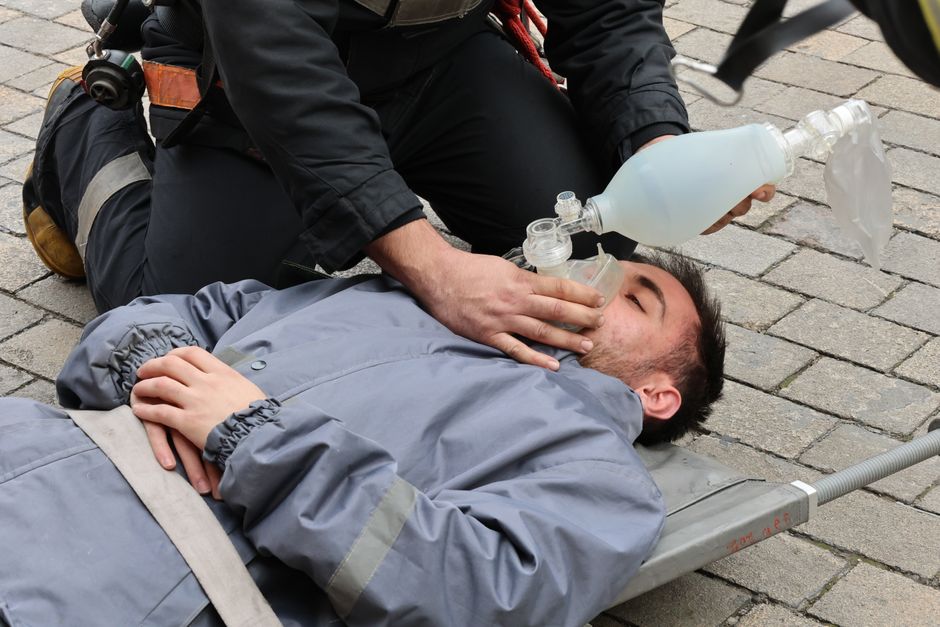
Rescue breaths are the breaths you give someone during CPR to get oxygen into their lungs. To deliver rescue breaths, first tilt the person’s head back, lift their chin, pinch their nose shut, and seal your mouth over theirs. Give one breath over one second, watching for their chest to rise. If the chest does not rise, reposition the head and try again. Give two rescue breaths after every 30 chest compressions.
What Is the Correct Head Position for Rescue Breaths?
The head-tilt, chin-lift maneuver is how you open the airway. Place one hand on the person’s forehead and push gently to tilt the head back. Place the fingers of your other hand under the bony part of the chin and lift it upward. This pulls the tongue away from the back of the throat.
Without this tilt, the airway stays blocked. The tongue is the most common cause of airway obstruction in an unconscious person. A good head tilt is about the same angle as someone looking up at the sky. If you suspect a neck injury, use the jaw-thrust maneuver instead — pull the jaw forward without tilting the head.
How Do You Deliver Rescue Breaths In Cpr Without a Barrier Device?
If you do not have a pocket mask or face shield, you can give rescue breaths mouth-to-mouth. Pinch the person’s nose shut with your thumb and index finger. Take a normal breath, not a deep one, and seal your mouth over theirs. Blow for one second. Watch for the chest to rise like a normal breath would cause.
Giving too much air or blowing too hard can force air into the stomach. This can cause vomiting, which makes the situation worse. The American Heart Association recommends each breath be just enough to make the chest rise visibly. Give the second breath the same way. If the chest does not rise on the first attempt, retilt the head and try again.
Some people worry about disease transmission during mouth-to-mouth. The actual risk of getting an infection from giving rescue breaths is extremely low. No documented case of HIV transmission through mouth-to-mouth CPR exists. If you are still uncomfortable, hands-only CPR — chest compressions without breaths — is better than doing nothing.
How Many Rescue Breaths Should You Give During CPR?
The standard ratio for adult CPR is 30 chest compressions followed by 2 rescue breaths. This applies whether you are one rescuer or two. After you give the two breaths, go back to chest compressions immediately. Do not pause longer than 10 seconds for the breaths.
| Patient Type | Compression-to-Breath Ratio | Breath Duration |
|---|---|---|
| Adult | 30:2 | 1 second each |
| Child (age 1 to puberty) | 30:2 (single rescuer) or 15:2 (two rescuers) | 1 second each |
| Infant (under 1 year) | 30:2 (single rescuer) or 15:2 (two rescuers) | 1 second each |
For infants and children, rescue breaths are more critical because cardiac arrest is usually caused by a breathing problem, not a heart problem. For adults, the first few minutes of cardiac arrest from a heart attack still have oxygen in the blood, so chest compressions alone can work. After about 4 to 6 minutes, rescue breaths become more important.





What Does Research on Rescue Breath Techniques Show?
Studies published in Circulation and Resuscitation have found that the quality of rescue breaths directly affects survival. A 2019 study in Resuscitation showed that rescuers who gave breaths that actually made the chest rise had patients with significantly better oxygen levels than those whose breaths were ineffective.
The research is clear on one point: slow, gentle breaths work better than fast, hard ones. A breath delivered over one second allows the air to enter the lungs without forcing it into the stomach. The same studies found that rescuers often give breaths too quickly — in under half a second — which reduces how much air reaches the lungs.
Evidence also supports using a bag-valve-mask device when trained rescuers are available. But the CDC notes that in real-world emergencies, even healthcare workers often fail to get a good seal with a bag-valve-mask. Two-person bagging — one person holds the mask seal while the other squeezes the bag — is more effective than one person trying to do both.
What Are the Most Common Mistakes People Make With Rescue Breaths?
The biggest mistake is not tilting the head back far enough. Many people tilt the head only slightly, which leaves the airway partially blocked. A proper head tilt is more than most people think it is. The chin should point upward at nearly a 90-degree angle from the floor if the person is lying flat.
- Giving breaths too fast — under one second — forces air into the stomach instead of the lungs
- Not pinching the nose completely shut, letting air escape out the nose
- Blowing too hard, which causes gastric inflation and vomiting
- Taking too long between compressions and breaths, which drops blood flow
- Checking for breathing for too long instead of starting CPR immediately
Another common mistake is stopping compressions for more than 10 seconds to give breaths. Every second without chest compressions means blood stops flowing to the brain. The goal is to minimize interruptions. Practice the rhythm: 30 compressions, pause briefly for two breaths, then back to compressions.
When Should You Skip Rescue Breaths Entirely?
Hands-only CPR — chest compressions without rescue breaths — is recommended for untrained bystanders who witness an adult collapse suddenly. This is common in cardiac arrest caused by a heart attack. The blood still has oxygen for several minutes, and compressions keep that oxygenated blood moving to the brain and heart.
The American Heart Association states that hands-only CPR is as effective as conventional CPR for the first few minutes of adult cardiac arrest. This makes it easier for people who are afraid of mouth-to-mouth or who have not been trained. For children, infants, drowning victims, or anyone who has been unconscious for several minutes, rescue breaths are necessary because oxygen levels have dropped.
If you are alone and find an unresponsive child or infant, give 2 minutes of CPR — compressions and breaths — before calling 911. For adults, call 911 first, then start CPR. These guidelines come from the International Liaison Committee on Resuscitation and are used by major health organizations worldwide.
How Do Rescue Breaths Differ for Infants and Children?
For infants under one year, you cover both the mouth and nose with your mouth to create a seal. The head position is slightly different — a neutral position rather than a full tilt, because an infant’s airway is more flexible. Over-tilting can actually block the airway in an infant.
For children from age one to puberty, use the same head-tilt chin-lift as adults but with gentler force. Give breaths just enough to make the chest rise. A child’s lungs are smaller, so you need less air volume. If you are a two-rescuer team, the ratio changes to 15 compressions to 2 breaths for both children and infants.
It is widely claimed that children’s ribs break easily during CPR, but strong evidence for this is limited. Research published in Resuscitation found that rib fractures in children from CPR are rare and should not stop you from giving compressions or breaths. The priority is oxygen and blood flow, not fear of injury.
Frequently Asked Questions
Do you give rescue breaths before chest compressions?
No. Start with chest compressions first, then give 2 rescue breaths after 30 compressions. The only exception is a drowning victim, where you give 2 rescue breaths first.
How long should each rescue breath last?
Each breath should last about one second. Just long enough to see the chest rise. Faster breaths force air into the stomach instead of the lungs.
Can you do CPR without rescue breaths?
Yes. Hands-only CPR with chest compressions alone is recommended for untrained bystanders who see an adult collapse suddenly. It works well for the first few minutes.
What if the chest does not rise when giving a rescue breath?
Re-tilt the head and try again. If the chest still does not rise, the airway may be blocked by food or an object. Look inside the mouth and sweep out any visible object before trying again.
