
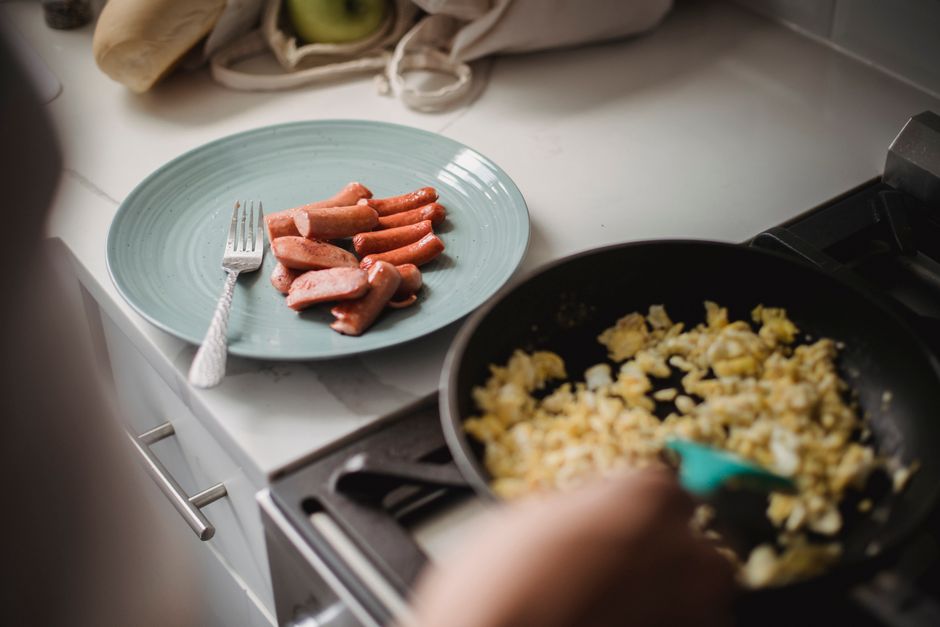
Breakfast sausage is a raw ground meat product, so it has to be cooked all the way through before you eat it. You can pan-fry it, bake it in the oven, cook it in an air fryer, or simmer it in liquid first and then brown it. Whichever method you choose, the goal is the same: a browned outside, a fully cooked center, and an internal temperature of 160°F.
Most links and patties take about 10 to 15 minutes on the stovetop or 15 to 20 minutes in a 400°F oven. The exact time depends on how thick the sausage is and whether it is raw or pre-cooked.
How Do You Cook Breakfast Sausage on the Stovetop?
Pan-frying is the most common method. It gives you a browned crust and lets you watch the sausage closely.
Put a skillet over medium heat. You can add a small amount of oil, but most pork sausage has enough fat to cook in its own rendered grease. Add the links or patties in a single layer with space between them. Crowding the pan traps steam and the sausage will gray instead of brown.
Cook for about 4 to 5 minutes per side for links, turning occasionally so they brown evenly. Patties are thinner and usually need 3 to 4 minutes per side. The sausage is done when the center reaches 160°F on a meat thermometer.
One mistake home cooks make is using heat that is too high. The casing browns fast while the inside stays raw. Medium or medium-low heat cooks the center before the outside burns.
If the pan gets too greasy, pour off some of the fat. Keep a little in the pan so the sausage keeps browning rather than steaming.
How Do You Cook Breakfast Sausage in the Oven?
Oven baking is the easiest way to cook a large batch at once, and it needs almost no attention.
Heat the oven to 400°F. Line a rimmed baking sheet with foil or parchment for easier cleanup. Arrange the sausage in a single layer with a little space between each piece. Bake for about 15 to 20 minutes, turning once at the halfway point.
Links and patties cook in roughly the same time because they are similar in thickness. Very thin patties may finish sooner, and thick or large links may take a few minutes longer. The thermometer is the deciding factor, not the clock.
Some people place the sausage on a wire rack set inside the baking sheet. This lets the fat drip away and keeps the bottom from sitting in grease. It is a reasonable option, though it does not change the cooking time much.
How Do You Cook Breakfast Sausage in an Air Fryer?
An air fryer works well for breakfast sausage because moving hot air browns the outside quickly.
Set the air fryer to 380°F to 400°F. Arrange the sausage in a single layer without stacking. Cook for about 10 to 12 minutes, flipping halfway through.
Air fryer models vary a lot in how much heat they actually deliver, so your first batch may run faster or slower than the recipe suggests. Check the internal temperature rather than relying on the timer alone. If your air fryer runs hot, drop the temperature slightly so the casing does not split before the center cooks.




Why Does the Internal Temperature Matter?
Breakfast sausage is made from raw ground meat, and ground meat carries a different risk than whole cuts.
When meat is ground, bacteria that were on the surface get mixed throughout the entire batch. That is why a steak can be seared on the outside and served pink, but ground meat has to be cooked through. The USDA sets 160°F as the safe minimum internal temperature for ground meats, including pork and beef.
Color is not a reliable doneness test. Ground pork can look grayish or brownish before it is actually safe, and some cured sausages stay pink even when fully cooked. A digital meat thermometer inserted into the center of the thickest part is the only dependable check.
For links, slide the probe in from the end toward the middle. For patties, go in through the side. Avoid touching bone or the pan, which can give a false high reading.
What Is the Difference Between Raw and Pre-Cooked Sausage?
Not all breakfast sausage in the store is the same, and the label changes how you cook it.
Fresh raw sausage is the most common type. It must be cooked to 160°F. Fully cooked sausage, sometimes sold as “brown and serve,” has already been cooked at the plant and only needs reheating. Read the package to see which one you have.
There is also a category of cured and fermented sausages that are ready to eat without cooking, but those are not typical breakfast links. If a package says “ready to eat” or “fully cooked,” you are reheating, not cooking from raw.
Frozen raw sausage should be thawed in the refrigerator before cooking, or cooked from frozen with added time. Cooking from frozen on the stovetop tends to brown the outside before the center thaws and cooks, so the oven or air fryer handles frozen sausage more evenly.
Common Mistakes That Lead to Undercooked Sausage
Most problems come down to heat and crowding, not the recipe.
- Crowding the pan. Sausage releases moisture, and trapped steam keeps the surface from browning.
- Cooking on high heat. The outside burns while the center stays raw.
- Trusting color. Pink or gray is not a reliable sign of doneness.
- Skipping the thermometer. This is the single most common cause of guessing wrong.
- Stacking in the air fryer. Overlapping pieces cook unevenly.
Let the cooked sausage rest for a minute or two before serving. It firms up slightly and is easier to handle.
How Should You Store and Reheat Leftovers?
Cooked breakfast sausage keeps in the refrigerator for about 3 to 4 days when stored in a covered container. That timing follows general food safety guidance for cooked meat.
Reheat in a skillet over medium heat, in the microwave, or in the oven until the sausage is hot throughout. You do not need to bring it back to 160°F for safety the way you do with raw meat, but it should be steaming hot.
For longer storage, cooked sausage freezes well for about 2 to 3 months. Wrap it tightly or seal it in a freezer bag to limit freezer burn. Thaw in the refrigerator overnight before reheating.
One thing worth knowing: the fat in sausage can turn rancid over long periods in the freezer, so very old frozen sausage may taste off even if it was safe when frozen.
Does Cooking Method Change the Nutrition?
Breakfast sausage is high in fat and sodium regardless of how you cook it, but the method shifts the numbers a little.
Pan-frying and oven baking on a rack let some fat drain away. Cooking in a skillet without draining leaves more of the rendered fat on the plate. Air frying tends to leave less added fat because the sausage is not sitting in grease.
These differences are modest. The base nutrition of the sausage matters far more than the cooking method. A typical pork breakfast link has roughly 80 to 100 calories, with a large share of those calories from fat, and a meaningful amount of sodium. If you are watching sodium or saturated fat, portion size and the type of sausage you buy will affect your intake more than how you cook it.
Frequently Asked Questions
What temperature should breakfast sausage be cooked to?
Cook breakfast sausage to an internal temperature of 160°F. This is the USDA safe minimum for ground meats, including pork.
How long do you cook breakfast sausage in the oven?
Bake at 400°F for about 15 to 20 minutes, turning once halfway through. Thickness varies, so confirm doneness with a meat thermometer rather than the timer.
Can you cook breakfast sausage in an air fryer?
Yes. Cook at 380°F to 400°F for about 10 to 12 minutes, flipping halfway. Air fryer models differ, so check the internal temperature reaches 160°F.
Do you have to cook pre-cooked breakfast sausage?
No, fully cooked sausage only needs reheating until hot. Check the package label, because raw and pre-cooked sausage look similar in the store.
