
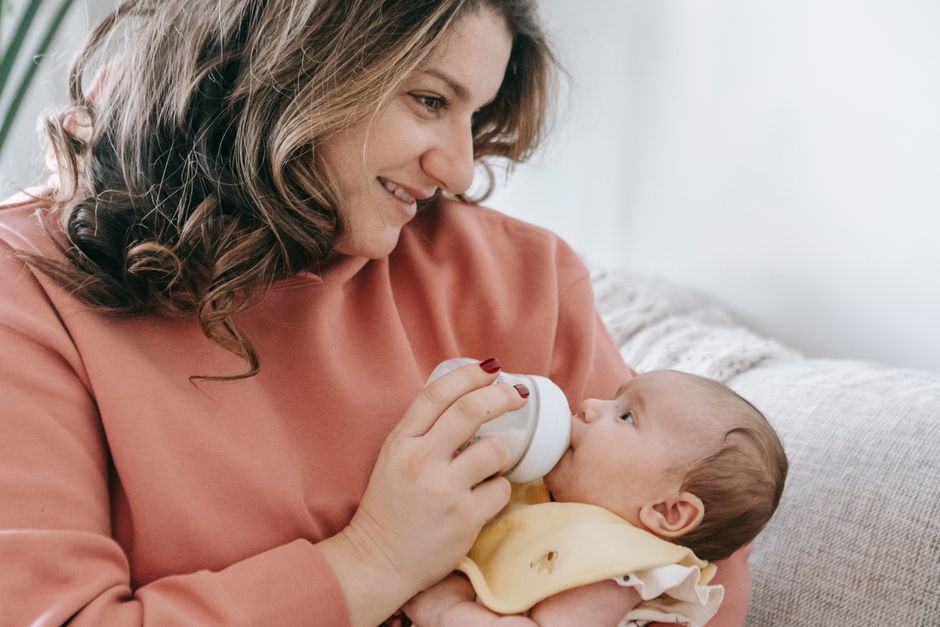
Bottle feeding a newborn comes down to a few key steps: hold your baby semi-upright, tilt the bottle so the nipple stays full of milk, and let your baby set the pace. You do not need to prop the bottle, and you should never leave a baby alone with a bottle. The goal is a calm, responsive feed that lets your baby stop when full.
What Do You Need Before You Start?
Gather your supplies before you sit down. You need a clean bottle, a nipple that matches your baby’s age, and prepared formula or expressed breast milk. Wash your hands thoroughly with soap and water before handling anything.
Bottles and nipples should be cleaned after every use. Wash them in hot, soapy water with a dedicated bottle brush, or run them through the dishwasher on a hot cycle. Sterilizing is most important for babies under three months, premature babies, or babies with weakened immune systems. For older, healthy babies, thorough washing is generally sufficient.
Check the nipple flow. A newborn needs a slow-flow nipple. Turn the bottle upside down — a few drops should come out, not a steady stream. If milk pours out, the flow is too fast and your baby may choke or gulp air.
How Do You Hold a Baby for Bottle Feeding?
Hold your baby in a semi-upright position, not lying flat. Support the head and neck with your arm so your baby’s head is higher than the stomach. This position helps milk go down the right way and reduces the risk of ear infections, which are more common when babies drink lying down.
Never prop the bottle. Hold it yourself for the entire feed. Propping a bottle lets milk pool in the baby’s mouth, which increases the risk of choking, ear infections, and tooth decay once teeth appear. It also takes away the closeness that makes feeding a bonding time.
Hold your baby close, skin-to-skin if possible. Babies feed better when they feel safe and warm. This closeness also helps you notice your baby’s hunger and fullness cues more easily.
How Do You Bottle Feed a Newborn? Step by Step
Here is the full bottle feeding sequence, from start to finish.
- Step 1: Fill the bottle with the right amount of prepared formula or expressed breast milk. Never heat formula in the microwave — it heats unevenly and can create hot spots that burn your baby’s mouth.
- Step 2: Warm the bottle if you wish. Place it in a bowl of warm water for a few minutes, or use a bottle warmer. Test the temperature by shaking a few drops onto the inside of your wrist. It should feel lukewarm, not hot. Room-temperature milk is also fine.
- Step 3: Sit down in a comfortable chair. Hold your baby semi-upright in the crook of your arm, head supported and slightly higher than the stomach.
- Step 4: Gently touch the nipple to your baby’s lips. Your baby will open the mouth wide. Let your baby draw the nipple in, not the other way around.
- Step 5: Tilt the bottle so the nipple is completely full of milk. This prevents your baby from swallowing air, which causes gas and fussiness.
- Step 6: Let your baby suck and swallow at their own pace. Pause every few minutes or when your baby takes a break. Burp your baby mid-feed and again at the end.
- Step 7: Stop when your baby shows signs of fullness. Turning the head away, closing the mouth, slowing down, or falling asleep all mean the feed is over. Do not force your baby to finish the bottle.
The whole feed usually takes 15 to 20 minutes. A faster feed may mean the nipple flow is too fast. A much slower feed may mean the flow is too slow or your baby needs a break.





How Much Formula or Milk Does a Newborn Need?
Newborns have small stomachs and need frequent feeds. In the first weeks, most babies drink about 1.5 to 3 ounces (45 to 90 milliliters) per feeding. They typically feed every 2 to 3 hours, which adds up to 8 to 12 feeds in 24 hours.
These numbers are general ranges, not strict rules. Every baby is different. Some newborns want less per feed and feed more often. Others take more per feed and go longer between feeds.
Watch your baby, not the clock. Cues like rooting, sucking on hands, and smacking lips mean hunger. Crying is a late hunger sign — try to feed before your baby gets that upset. A baby who is gaining weight steadily and producing enough wet diapers is getting enough milk.
A good rule of thumb: in the first month, a baby who has at least 6 wet diapers a day and regular bowel movements is likely well hydrated. Your pediatrician will track weight gain at well visits to confirm growth is on track.
How Do You Burp a Bottle-Fed Baby?
Bottle-fed babies swallow more air than breastfed babies, so burping matters. Burp your baby after every 2 to 3 ounces, or every 5 to 10 minutes during a feed. If your baby seems fussy or pulls away mid-feed, try burping sooner.
Three positions work well for burping:
- Over your shoulder: Hold your baby upright against your chest, chin resting on your shoulder. Gently pat or rub the back.
- Sitting up: Sit your baby on your lap, supporting the chest and head with one hand. Lean your baby slightly forward and pat the back.
- Lying across your lap: Lay your baby face-down across your thighs, head slightly higher than the chest. Pat the back gently.
Some babies burp quickly. Others need a few minutes of gentle patting. If no burp comes after a few minutes, continue the feed and try again at the end. Not every feed ends with a burp, and that is normal.
Can You Mix Breastfeeding and Bottle Feeding?
Yes. Many families combine breastfeeding and bottle feeding, whether with expressed breast milk or formula. This is sometimes called mixed feeding or combination feeding.
If you are breastfeeding, it is often best to wait until breastfeeding is well established — usually around 3 to 4 weeks — before introducing a bottle. This helps avoid nipple confusion, where a baby prefers the faster flow of a bottle and struggles to latch at the breast.
When you do introduce a bottle, use a slow-flow nipple and try paced bottle feeding. Paced feeding means holding the bottle nearly horizontal and letting your baby pull the milk in with their own sucking rhythm. This mimics breastfeeding and gives your baby more control over the flow.
If you are feeding expressed breast milk, use it within 4 hours at room temperature, or refrigerate it and use within 4 days. Thaw frozen milk in the refrigerator or in warm water — never in the microwave.
What Should You Never Do When Bottle Feeding?
Some bottle feeding practices are dangerous and should always be avoided.
Never prop the bottle. Leaving a baby alone with a propped bottle is a choking hazard and increases the risk of ear infections and tooth decay. It also removes the human contact that babies need during feeding.
Never put a baby to bed with a bottle. Milk pooling in the mouth overnight causes severe tooth decay, a condition called baby bottle tooth decay. It also raises the risk of ear infections and choking.
Never microwave bottles. Microwaves heat unevenly. The milk can feel cool on the outside while being hot enough to scald your baby’s mouth in the middle.
Never add cereal to a bottle unless a doctor specifically tells you to. Adding rice cereal or other solids to a bottle does not help babies sleep longer and can be a choking hazard. It also adds unnecessary calories and can interfere with nutrient absorption.
Never reuse leftover milk. If your baby does not finish a bottle, throw out the remaining milk after 1 to 2 hours. Bacteria from your baby’s mouth can grow in the leftover milk and cause illness.
How Do You Know If Bottle Feeding Is Going Well?
Watch your baby’s output and behavior. A well-fed newborn has at least 6 wet diapers a day by day 5 or 6 of life. Stools should transition from dark and sticky to yellow and seedy within the first week.
Your baby should seem satisfied after feeds, not still frantic or crying. Steady weight gain is the most reliable sign. Newborns typically lose a little weight in the first days after birth, then regain it by about 2 weeks of age.
Trust your instincts. If something feels off — your baby seems constantly hungry, is not producing wet diapers, is unusually sleepy, or you are struggling with feeding — contact your pediatrician. Feeding problems are common in the early weeks, and help is available.
Frequently Asked Questions
How often should I feed my newborn a bottle?
Newborns typically need to feed every 2 to 3 hours, which means 8 to 12 feeds in 24 hours. Feed on demand when your baby shows hunger cues rather than waiting for a strict schedule.
Should I wake my newborn to feed?
Yes, in the first few weeks you may need to wake a sleepy baby to feed, especially if they are not waking on their own. Your pediatrician can advise on how long your baby can go between feeds based on their weight and health.
How do I know if the bottle nipple flow is right?
Tilt the bottle upside down — a few drops should come out, not a stream. If milk pours out, the flow is too fast; if nothing comes out, the flow may be too slow for your baby.
Can I prepare bottles in advance?
You can prepare formula bottles ahead and refrigerate them for up to 24 hours, but prepared bottles should be used within 2 hours once feeding begins. Never store leftover milk from a partially finished bottle.
