
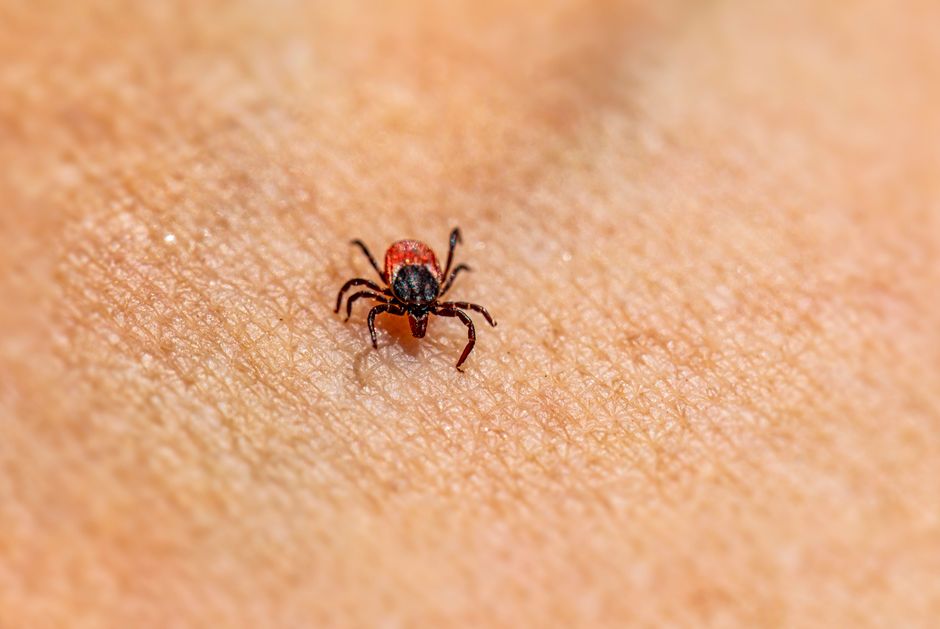
Ticks do not jump, fly, or fall from trees. They climb up low vegetation like grass, bushes, and leaf piles and wait with their front legs outstretched in a behavior called “questing.” When you brush past that plant, the tick grabs onto your clothing or skin and crawls upward looking for a place to feed. That is how ticks get on you in almost every case. Understanding this simple fact changes how you prevent tick bites entirely.
How Do Ticks Get On You During a Walk in the Woods?
Ticks live in the “leaf litter layer” — the area where grass meets soil and fallen leaves accumulate. They do not live in trees. Research from the CDC confirms that most tick encounters happen when people walk along trails or sit on logs and stumps. The tick senses your approach through vibrations, body heat, and the carbon dioxide you exhale.
When you brush against a blade of grass or a low-hanging fern, the tick transfers to you in under a second. It does not bite immediately. Most ticks crawl around on your body for 30 minutes to several hours before selecting a feeding spot. This delay is why tick checks work — you have time to find and remove them before they bite.
Studies published in the Journal of Medical Entomology have found that ticks are most active when relative humidity is above 80 percent. They dry out quickly in direct sunlight. This is why ticks are most common in shaded, damp areas along trail edges and not in open sunny fields.
What Are the Most Common Ways Ticks Transfer to Humans?
There are four main ways ticks get on people. The first is direct contact with tall grass or brush during hiking, gardening, or hunting. The second is sitting or lying on the ground without a barrier. The third is handling pets that have been in tick habitat — dogs and cats bring ticks into your home and car. The fourth is less known: ticks can transfer from clothing or gear stored in garages or mudrooms days after exposure.
A 2019 study in Ticks and Tick-borne Diseases found that nearly 30 percent of tick exposures happened in yards, not forests. Ticks are carried into residential areas by deer, rodents, and birds. Mowing your lawn short and creating a 3-foot barrier of wood chips or gravel between your yard and wooded areas reduces tick encounters significantly.
How Do Ticks Get On You if You Stay on the Trail?
Staying on the center of a cleared trail reduces your risk but does not eliminate it. Ticks can extend their front legs several inches from a blade of grass. If the trail is narrow or overgrown, grass blades can touch your pant legs even when you stay on the path. The CDC recommends walking in the center of trails and avoiding brushing against vegetation.
What many people do not realize is that ticks can also get on you from sitting on logs, stone walls, or picnic tables in wooded areas. Ticks climb onto these surfaces from the surrounding vegetation. A 2020 survey in the Journal of Outdoor Recreation found that 22 percent of tick bites occurred during seated rest stops, not during active hiking.





What Actually Works to Prevent Ticks From Getting on You?
Evidence supports three prevention methods. The first is treating clothing with permethrin. Permethrin is an insecticide that binds to fabric fibers and kills ticks on contact. The CDC reports that clothing treated with permethrin remains effective through multiple washes. You can buy pre-treated clothing or spray your own.
The second method is wearing light-colored long pants tucked into socks. Light colors make ticks visible before they crawl to your skin. Tucking pants into socks creates a physical barrier that ticks must cross. This is not fashionable but it is effective.
The third method is doing a full-body tick check within two hours of coming indoors. Use a mirror or ask someone to check your back, scalp, behind your ears, and in your armpits and groin area. Ticks prefer warm, dark, moist areas of the body. A study in the American Journal of Tropical Medicine found that people who checked for ticks within 36 hours of exposure had a 95 percent lower risk of Lyme disease transmission.
What Are Common Myths About How Ticks Get on People?
The most persistent myth is that ticks fall from trees. This is false. Ticks cannot fly or jump. They do not climb trees and drop onto people. If you find a tick on your head or neck, it crawled there from your lower body. Ticks climb upward instinctively.
Another myth is that ticks only come out in summer. Blacklegged ticks (deer ticks) are active whenever temperatures are above freezing. In many parts of the United States, adult ticks are most active in the fall and early spring. The CDC reports that Lyme disease cases peak in June and July because that is when nymph-stage ticks are active — they are tiny and hard to see.
A third myth is that showering immediately removes ticks not yet attached. Showering helps because you can feel ticks crawling on your skin. But water alone does not dislodge them. You still need to do a visual check.
How Do Ticks Get On You Through Pets and Clothing?
Pets are a major route for ticks entering homes. Dogs pick up ticks during walks in wooded or grassy areas. Once inside, ticks drop off the dog and crawl onto furniture, carpets, or directly onto people. The Companion Animal Parasite Council recommends year-round tick prevention for pets in all 50 states, even in winter.
Clothing and gear can carry ticks for days. Ticks can survive a full cycle in a washing machine if the water is not hot. The CDC advises putting clothes in a dryer on high heat for 10 minutes before washing. Dry heat kills ticks. Wet heat in a washing machine may not, especially in cold or warm water cycles.
Backpacks, camping chairs, and tents stored in garages or sheds can harbor ticks for weeks. Inspect gear after every outdoor trip. Do not bring outdoor gear into bedrooms or living areas without checking it first.
Comparison of Tick Prevention Methods
| Method | Effectiveness | Evidence Strength | Ease of Use |
|---|---|---|---|
| Permethrin-treated clothing | High | Strong — multiple CDC studies | Moderate — requires pre-treatment |
| Tucked-in long pants | Moderate to High | Moderate — observational studies | Easy |
| DEET repellent on skin | Moderate | Strong — EPA-registered | Easy |
| Daily tick checks | High for prevention of disease | Strong — clinical evidence | Requires habit |
| Showering after outdoor time | Low for removal | Weak — helps detection only | Easy |
What to Do if You Find a Tick Attached
Use fine-tipped tweezers to grasp the tick as close to your skin as possible. Pull upward with steady, even pressure. Do not twist or jerk. Twisting can break the mouthparts off and leave them in your skin. Do not use petroleum jelly, nail polish, heat, or alcohol to try to make the tick detach. These methods do not work and may cause the tick to regurgitate fluids into your bite, increasing infection risk.
After removal, clean the bite area with rubbing alcohol or soap and water. Save the tick in a sealed bag or container. Write down the date. If you develop a rash, fever, or flu-like symptoms within 30 days, see a healthcare provider and bring the tick if possible. The CDC recommends prophylactic antibiotics for certain high-risk tick bites, especially if the tick was attached for more than 36 hours.
Frequently Asked Questions
Do ticks jump from trees onto people?
No. Ticks cannot jump or fly. They climb onto people from low vegetation like grass and bushes.
Can ticks get on you in your own backyard?
Yes. Studies show nearly 30 percent of tick exposures happen in residential yards, especially near wooded edges.
How long does a tick need to be on you to transmit disease?
For Lyme disease, transmission usually requires at least 24 to 36 hours of attachment. Other diseases can transmit faster.
Does showering remove ticks that are crawling on you?
Showering helps you feel ticks crawling on your skin but does not remove attached ticks. You still need to do a visual check.
