
Thermal sensors measure temperature in one of two basic ways. Contact sensors touch the object and reach thermal equilibrium with it. Infrared sensors measure the invisible heat radiation an object gives off, without ever touching it. That single difference — physical contact versus reading emitted energy — explains almost everything else about how each type performs, where it fails, and what it is good for.
Most people meet these sensors without knowing it. A digital thermometer under the tongue is a contact sensor. A forehead thermometer held a few inches away is an infrared sensor. An oven probe and a no-touch thermometer use completely different physics, and understanding that helps you interpret the number on the screen.
How Do Thermal Sensors Work Contact Vs Infrared?
Contact sensors rely on heat flowing between the object and the sensor until both reach the same temperature. Infrared sensors rely on detecting the infrared radiation that every object above absolute zero emits, then converting that signal into a temperature reading.
These are fundamentally different measurement strategies. A contact sensor reports its own temperature once it has settled. An infrared sensor estimates the object’s temperature from the radiation it receives. That distinction matters because each method has its own strengths and failure modes.
Contact sensing is generally more accurate for solids and liquids that the probe can actually touch. Infrared sensing is faster and safer when contact is impractical — a moving conveyor belt, a live electrical panel, or a person you do not want to disturb.
How Does a Contact Temperature Sensor Work?
A contact sensor works by allowing heat to flow between the object and the sensor until the two reach the same temperature. Engineers call this thermal equilibrium. Once equilibrium is reached, the sensor’s reading reflects the object’s temperature.
The physics is simple conduction. Heat always moves from the warmer body to the cooler one. A probe placed against a warm surface absorbs heat until the temperature difference disappears. The sensor then reports that shared temperature.
Common types of contact sensors
- Thermocouples — two joined wires of different metals generate a small voltage that changes with temperature. They are durable and cover wide temperature ranges.
- Resistance temperature detectors (RTDs) — a metal element, often platinum, whose electrical resistance rises predictably as it warms. They are known for stability and accuracy.
- Thermistors — semiconductor elements whose resistance changes sharply with temperature. They are common in consumer devices and clinical thermometers.
The main limitation is time. A contact sensor cannot report a temperature until heat has had time to flow and the reading has settled. That settling time depends on the sensor’s mass, the material it touches, and how well it makes contact. A thick probe on a poor conductor can take a while to stabilize.
Contact quality is the other weak point. Air gaps, dirt, or a loose fit slow heat transfer and can produce a reading that is off. This is why clinical thermometers are designed to sit snugly in a closed space, like under the tongue or in the ear canal.
How Does an Infrared Sensor Measure Temperature Without Touching?
An infrared sensor measures temperature by detecting the infrared radiation an object emits. Every object warmer than absolute zero radiates energy, and the amount and wavelength of that radiation rise with temperature. The sensor reads this radiation and calculates the surface temperature.
This is why infrared thermometers are sometimes called non-contact thermometers. They never touch the target, so there is no heat flow to wait for. The reading is nearly instant.
The core component is a detector that responds to infrared wavelengths. A lens or optical system focuses the incoming radiation onto that detector. Electronics then convert the signal into a temperature value, using the object’s emissivity as a correction factor.
What Is Emissivity and Why Does It Matter?
Emissivity is a measure of how efficiently a surface radiates infrared energy, expressed on a scale from 0 to 1. A perfect radiator has an emissivity of 1. Most organic materials, water, and human skin sit fairly high on that scale. Shiny metals sit very low.
This is where infrared sensors can go wrong. A polished metal surface with low emissivity does not radiate much infrared energy, so an infrared thermometer can read it as cooler than it really is. The same object measured with a contact probe can give a very different number.
For clinical use, this mostly does not matter, because skin behaves like a fairly reliable radiator. For industrial use, it matters a lot. Technicians often apply a matte tape or coating to shiny surfaces before taking an infrared reading, so the sensor sees a surface with known emissivity.
Here is a point many people miss: an infrared thermometer reads surface temperature, not internal temperature. A forehead reading reflects skin temperature, which can be affected by sweat, drafts, or direct sun. That is a physical reality of the method, not a defect in a particular device.
Contact vs Infrared Sensors: How Do They Compare?
The two methods trade accuracy, speed, and safety against each other. Neither is universally better. The right choice depends on what you are measuring and why.
| Feature | Contact Sensor | Infrared Sensor |
|---|---|---|
| Measurement method | Heat conduction to equilibrium | Detects emitted infrared radiation |
| Speed | Slower; needs settling time | Near-instant |
| Accuracy on solids and liquids | Generally high when contact is good | Depends on emissivity |
| Effect of shiny surfaces | Minimal | Can cause significant error |
| Safety with moving or live objects | Requires contact; can be unsafe | Safe; no contact needed |
| What it measures | Temperature where it touches | Surface temperature at a distance |
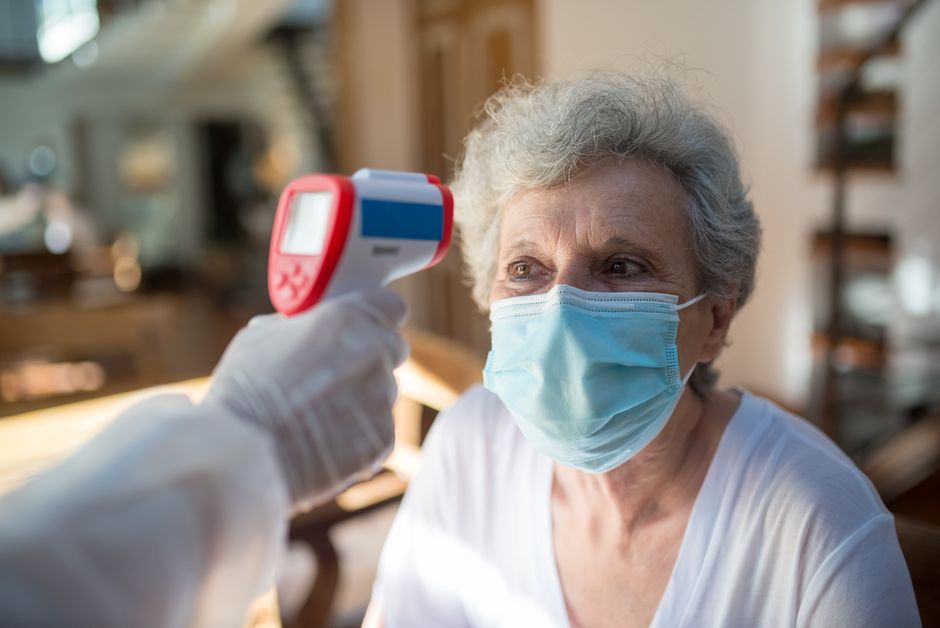
In clinical settings, both types are used. Contact thermometers — oral, rectal, or tympanic — are common in medical care. No-touch infrared thermometers became widely used for screening during the COVID-19 pandemic, and their limitations for that purpose are well documented. Skin temperature does not always track core body temperature closely, and screening accuracy depends heavily on technique and environment.
That does not make infrared thermometers bad. It means they measure something slightly different, and interpreting the number requires knowing which method produced it.
When Should You Use Each Type?
Use a contact sensor when you need a reliable reading on a solid or liquid you can safely touch, and when a short wait is acceptable. Use an infrared sensor when speed matters, when the object is moving, hot, electrically live, or hard to reach, or when contact would be unsafe or unhygienic.
Practical examples help. A home cook checking meat doneness uses a contact probe because internal temperature is what matters, and a probe inserted into the food reads it directly. An electrician checking a breaker panel uses an infrared sensor because touching live equipment is dangerous.
For body temperature at home, both approaches exist. A digital oral thermometer is a contact device. A forehead or ear thermometer uses infrared detection. Both can be useful, and following the device’s instructions matters more than the category.
What Are the Main Sources of Error?
Contact sensors err when heat transfer is incomplete or uneven. A probe that has not settled, poor contact, or a cold probe on a small sample can all skew the reading. Waiting for the reading to stabilize and ensuring good contact reduce these errors.
Infrared sensors err when emissivity is misjudged, when the sensor is too far from the target, or when something between the sensor and the object interferes. Distance matters because the sensor averages over a spot size that grows with range. Steam, dust, and even a dirty lens can distort the reading.
Ambient conditions affect both. A very cold room can cool a contact probe before it settles. Direct sunlight or a nearby heat source can confuse an infrared sensor. In both cases, the fix is usually better technique rather than a different device.
Frequently Asked Questions
Are infrared thermometers as accurate as contact thermometers?
For measuring surface temperature at a distance, infrared thermometers can be accurate when emissivity and technique are handled correctly. For core body temperature, contact methods are generally considered more reliable, which is why clinical guidance often favors them.
Why does an infrared thermometer give a different reading than a contact one?
Infrared sensors read surface temperature from emitted radiation, while contact sensors read the temperature they reach through direct heat flow. Differences in emissivity, distance, and what part of an object is measured can all produce different numbers.
Can an infrared thermometer measure internal temperature?
No. Infrared sensors measure surface temperature, not the temperature deep inside an object. Internal temperature requires a probe inserted into the material, such as a meat thermometer.
Do contact thermometers need time to give a reading?
Yes. A contact sensor must reach thermal equilibrium with the object before its reading is reliable, which takes time that varies with the sensor and material. Infrared sensors respond almost instantly because they do not wait for heat flow.
