
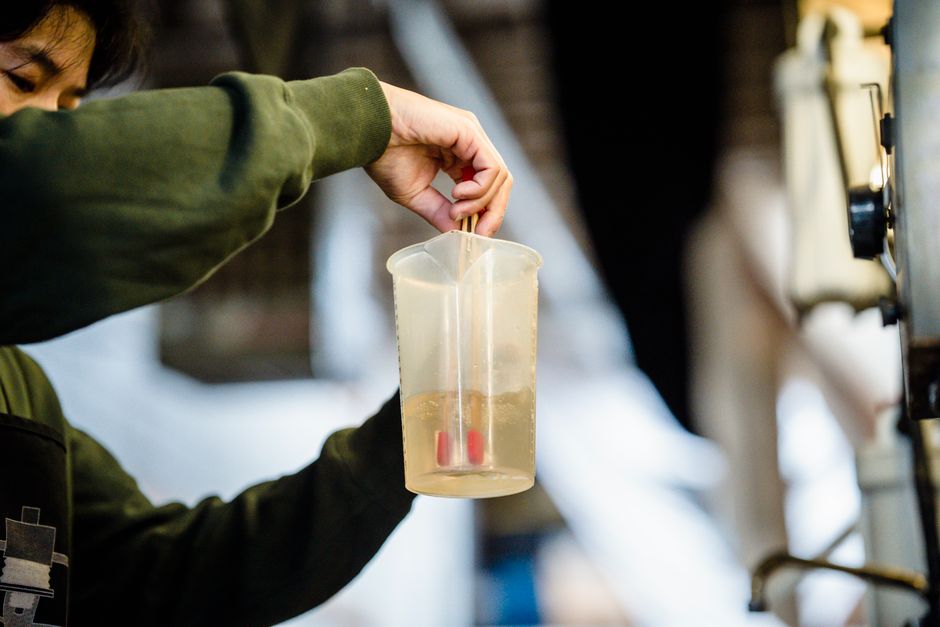
A stir bar is a small magnetic capsule dropped into a liquid, and it spins because a rotating magnet underneath the container drags it around. The bar itself has no motor and no power source. It contains a sealed magnet, usually coated in inert plastic or glass, and it turns when the magnetic field beneath it moves. This is the core of how do stir bars work science behind the spin: a spinning magnetic field outside the vessel drives a magnetic object inside it, and the motion of that object stirs the liquid.
What Is a Stir Bar and How Does It Spin?
A stir bar is a magnet encased in a chemically resistant shell. The shell is typically PTFE, a fluoropolymer sold under the brand name Teflon, though glass and other plastics are also used. The magnet inside is often a strong rare-earth type such as neodymium, shaped as a bar or a ring.
The spinning comes from a separate device called a magnetic stirrer. Under its flat top plate sits another magnet, or a set of magnets, attached to a small motor. When the motor turns, that hidden magnet turns with it. The magnetic field above the plate rotates, and the stir bar inside the vessel tries to stay aligned with it.
If you have ever held two magnets near each other, you have felt this effect. Opposite poles attract, like poles repel, and the pair wants to line up a certain way. As the stirrer’s magnet rotates, the field it produces rotates too. The stir bar keeps chasing that alignment, so it spins at the same rate. No physical connection exists between the two magnets. The drive is entirely through the wall of the glass or plastic container.
This is why the container does not need to be opened, and why the liquid stays sealed off from the motor and any lubricants or metal parts in the base.
Why Does the Stir Bar Sometimes Not Spin?
A stir bar that refuses to turn, or that jumps and rattles instead of spinning smoothly, is one of the most common frustrations in a lab. The cause is almost always a mismatch between how hard the field is pushing and how much resistance the bar is meeting.
When the motor starts, the stir bar has to break free from rest and overcome friction against the bottom of the vessel. If the motor’s starting speed is too high, the rotating field sweeps past the bar faster than the bar can follow. The bar cannot keep up, loses lock, and starts bouncing. The usual fix is to start slow and increase speed gradually, letting the bar lock onto the field before turning it up.
Other common causes include:
- Too much liquid or too thick a liquid. A viscous solution resists stirring, and a small bar may not have enough magnetic grip to push through it.
- A bar that is too small for the vessel. A short bar in a wide beaker may not span enough of the rotating field to stay aligned.
- A worn or weak magnet. Heat and age can reduce a magnet’s strength over time.
- Uneven or rough vessel bottoms. A bar needs a smooth, flat surface to spin against.
- The wrong stirrer setting. Some units have a slow-start feature precisely to prevent the bounce described above.
The rattle you hear is the bar losing its magnetic lock and striking the vessel wall. It is not damaging the magnet, but it can chip glass over time, so it is worth correcting.
How Do Stir Bars Work Science Behind the Spin: Magnetism and Torque
The physics rests on two ideas: magnetic alignment and torque. A magnet placed in an external magnetic field experiences a force that tries to rotate it into alignment with that field. This rotational force is called torque.
In a magnetic stirrer, the external field is produced by a magnet spinning on a motor shaft. As that field rotates, it continuously applies torque to the stir bar, which is why the bar keeps turning rather than snapping into one position and stopping. The bar is always slightly lagging behind the drive magnet, and that lag is what keeps the torque applied.
Two factors govern how well this works. The first is magnetic field strength, which falls off quickly with distance. Doubling the gap between the drive magnet and the stir bar weakens the field substantially, which is why thick-walled vessels and tall liquid columns are harder to stir. The second is the drag from the liquid, which rises with viscosity and with the size and shape of the bar.
The stir bar and the drive magnet do not need to be the same shape, and they do not touch. The glass or plastic wall between them is magnetically invisible. This is the same principle behind magnetic couplings used in pumps, where a motor drives fluid through a sealed wall without any shaft passing through it.





Does a Stir Bar Actually Mix the Liquid Well?
A stir bar creates a vortex and a circulating flow. It mixes well in the region near the bar and along the path of the circulation, and it is excellent for keeping particles suspended and for blending liquids of similar density and viscosity.
It is not a perfect mixer. In a tall vessel, the liquid near the top can move much less than the liquid near the bottom, so a stir bar may leave regions that are poorly mixed. For reactions where uniform concentration matters throughout a large volume, an overhead mechanical stirrer or a different mixing approach may be needed. Stir bars are convenient and clean, but convenience is not the same as complete mixing.
Temperature matters too. Warming a liquid usually lowers its viscosity, making it easier to stir. Cooling it does the opposite. A bar that spins freely in a warm solution may stall in the same solution when cold.
Why Are Stir Bars Coated in PTFE or Glass?
The coating exists because the bare magnet would react with the liquid. Many magnets contain iron, which rusts, and rare-earth magnets corrode readily. A PTFE or glass shell isolates the magnet from whatever is being stirred.
PTFE is chosen because it resists attack by most acids, bases, and solvents, and it has a very low friction surface, so the bar slides easily. It is also chemically inert under most lab conditions. Glass is used when the application calls for it, though glass can chip if the bar bounces.
The coating is not indestructible. PTFE can be damaged by certain conditions, and a cracked or worn coating exposes the magnet underneath. Once that happens, the bar can contaminate the liquid with rust or corroded metal. A damaged stir bar should be replaced, not reused, especially in any application where the liquid will be consumed or analyzed.
What Are the Different Types of Stir Bars?
Stir bars come in several shapes, each suited to a different job. The shape affects how the bar interacts with the rotating field and with the liquid.
| Type | Shape | Typical Use |
|---|---|---|
| Plain cylindrical | Smooth bar, often with a pivot ring | General mixing in flat-bottomed vessels |
| Egg-shaped (oval) | Rounded, spindle-like | Round-bottom flasks, where a flat bar would not sit well |
| Spin vane | Vertical blade or fin | Vessels with a curved or irregular bottom |
| Cross or triangular | Angled arms | Stronger agitation, harder-to-mix liquids |
Some bars include a small raised ring, called a pivot ring, in the middle. The ring reduces the contact area between the bar and the vessel, cutting friction so the bar spins more freely. This is a small design detail that makes a real difference in how easily the bar starts and keeps turning.
Are Magnetic Stirrers Used Outside the Lab?
Yes. The same principle appears in several everyday and industrial settings. Magnetic stirrers are used in home brewing and in some coffee setups, in aquarium and hydroponic systems, and in industrial mixing where a sealed vessel must not be opened.
In food and beverage production, magnetic mixing can help keep a process closed off from outside contamination. In water treatment and chemical processing, it allows mixing inside sealed tanks. The appeal is always the same: no shaft passes through the wall, so there is no seal to leak and no opening to contaminate.
One limitation carries across all these uses. Magnetic drive only works through non-magnetic materials. A steel container blocks the field, and the bar will not spin. Glass, most plastics, and non-magnetic stainless steel allow it to work.
Frequently Asked Questions
How does a stir bar spin without a motor?
It spins because a rotating magnet in the stirrer base creates a rotating magnetic field, and the magnet inside the bar turns to stay aligned with it. The bar itself has no motor or power source.
Why does my stir bar keep jumping and not spinning?
The bar is losing its magnetic lock, usually because the starting speed is too high or the liquid is too viscous for the bar to follow the field. Start at a low speed and increase gradually.
Can a stir bar mix thick liquids?
It can, but poorly. High viscosity increases drag, and a small bar may not have enough magnetic grip to keep turning, so a larger bar or a different mixer is often needed.
Do stir bars wear out?
Yes. The magnet can weaken with heat and age, and the PTFE or glass coating can crack. A damaged coating exposes the magnet and can contaminate the liquid, so the bar should be replaced.
