
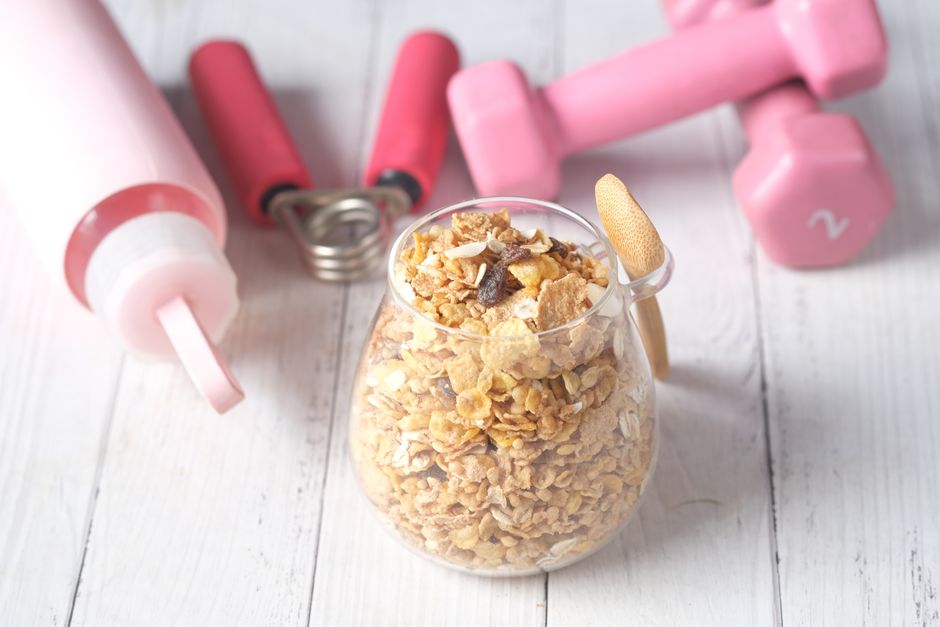
Muscle size grows when resistance training creates mechanical tension in a muscle and protein provides the amino acids needed to build and repair that tissue. Neither works well alone. Exercise without adequate protein limits growth, and protein without training does not meaningfully increase muscle size. Together, they trigger a repair process called muscle protein synthesis, which is the biological engine behind muscle growth.
This process is well understood. What is less clear is how much protein you actually need, whether timing matters, and which training variables drive growth most. Here is what the evidence supports.
How Do Protein And Exercise Affect Muscle Size?
Muscle tissue is in constant turnover. Proteins are broken down and rebuilt every day, and muscle size reflects the balance between these two processes. When breakdown outpaces synthesis, muscle shrinks. When synthesis outpaces breakdown over time, muscle grows.
Resistance exercise disrupts this balance in a productive way. Lifting weights causes microscopic damage to muscle fibers and activates signaling pathways that tell the body to reinforce those fibers. This is why muscle soreness follows unfamiliar training. The body responds by rebuilding stronger and, with repeated stimulus, larger.
Protein supplies the raw material for that rebuilding. Dietary protein is broken into amino acids, which circulate in the blood and become available for muscle repair. One amino acid in particular, leucine, acts as a signal that helps switch on muscle protein synthesis.
This is why the two factors are inseparable. Exercise creates the demand. Protein meets it. Without training, extra protein does not build muscle — the body has no signal telling it to. Without adequate protein, training creates a demand the body cannot fully meet.
How Much Protein Do You Need To Build Muscle?
Most people who lift weights need more protein than the general population, but not as much as supplement marketing suggests. The general recommended dietary allowance for adults is 0.8 grams per kilogram of body weight per day, which is the amount needed to prevent deficiency, not to maximize muscle growth.
For people doing regular resistance training, research generally supports intakes in the range of roughly 1.4 to 2.0 grams per kilogram of body weight per day. Reviews of the evidence have found that intakes above this range do not appear to add further benefit for muscle growth in most trained individuals.
For a 165-pound (75 kg) person, that works out to roughly 105 to 150 grams of protein per day. For a 200-pound (91 kg) person, roughly 127 to 182 grams.
Two practical points matter here:
- Total daily protein matters more than any single meal or shake.
- Protein from whole foods — meat, fish, eggs, dairy, legumes, soy — counts the same as protein from supplements.
Protein supplements are convenient, not superior. They are useful when whole foods are impractical, but they offer no special muscle-building advantage over food.
Does Protein Timing Matter For Muscle Growth?
Timing matters less than most gym advice suggests. For years, the idea of an “anabolic window” — a narrow period after training when protein must be consumed or gains are lost — was treated as near-certain. The evidence does not support such a narrow window.
What the research does support is a more modest version of the idea. Muscle protein synthesis stays elevated for hours after resistance exercise, and consuming protein in that broader window supports recovery. Total daily protein intake, spread reasonably across meals, appears to matter more than precise timing around workouts.
For most people eating three or more protein-containing meals per day, the post-workout window takes care of itself. A shake immediately after training is not harmful, but skipping it is unlikely to cost meaningful muscle.
A more useful focus is distributing protein across the day. Some evidence suggests that including a moderate amount of protein at each meal — rather than loading nearly all of it into dinner — supports muscle protein synthesis more consistently. The exact optimal per-meal amount is still debated, but roughly 20 to 40 grams per meal is a commonly cited range in the research literature.


What Type Of Exercise Builds Muscle Size?
Resistance training is the only exercise type with strong evidence for increasing muscle size. Aerobic exercise such as running or cycling improves cardiovascular fitness and can support overall health, but it does not meaningfully build muscle mass on its own.
Within resistance training, several variables influence growth:
- Mechanical tension — lifting challenging loads, typically in the range of roughly 6 to 20 repetitions to near-failure, drives the growth signal.
- Progressive overload — gradually increasing weight, reps, or sets over time is the core principle. Without it, muscle adaptation stalls.
- Training volume — more sets per muscle group per week generally produce more growth, up to a point of diminishing returns and recovery limits.
- Consistency — regular training over months and years, not weeks, produces visible size changes.
One clarification worth making: muscle “pump” during a workout and soreness afterward are not reliable measures of whether a session built muscle. Growth is driven by progressive overload and adequate recovery, not by how a workout feels in the moment.
How Long Does It Take To See Muscle Growth?
Strength gains often appear within a few weeks of starting resistance training. Visible muscle size changes typically take longer — commonly several weeks to a few months of consistent training before noticeable growth, with more substantial changes over six months to a year.
Early strength gains are partly neurological. The nervous system becomes more efficient at recruiting muscle fibers before the fibers themselves grow much. This is why someone can lift noticeably more weight in the first month without looking different.
Rate of growth varies widely based on training experience, genetics, age, nutrition, sleep, and consistency. New lifters generally gain muscle faster than experienced ones. There is no universal timeline, and individual results vary considerably.
Can You Build Muscle Without Enough Protein?
Muscle growth is blunted when protein intake is too low, even with good training. The body cannot build tissue it lacks the raw materials to construct. This is one of the more consistent findings in exercise nutrition research.
That said, the threshold is lower than many people assume. Most people eating a normal mixed diet already consume enough protein to support some muscle growth. The gap between “adequate” and “optimal” for muscle growth is real but modest, and it matters most for people training hard, eating in a calorie deficit, or following restrictive diets.
Older adults deserve specific mention. Age-related loss of muscle mass, called sarcopenia, is a well-documented process, and research suggests older adults may need somewhat more protein than younger adults to support muscle maintenance and growth. Some researchers have proposed higher intake targets for this group, though optimal amounts remain an active area of study.
What Else Affects Muscle Size Besides Protein And Exercise?
Protein and training are the two biggest controllable factors, but they are not the only ones. Sleep, total calorie intake, and hormones all influence muscle growth.
Muscle growth requires energy. Eating in a sustained calorie deficit makes building muscle difficult, because the body is prioritizing energy conservation over tissue construction. This does not make muscle growth impossible during fat loss, particularly for newer lifters, but it slows the process.
Sleep matters more than many people realize. Growth hormone release and tissue repair processes are tied to sleep, and chronic sleep restriction has been associated with reduced muscle protein synthesis and impaired recovery in some studies.
Genetics, age, sex, and training history all shape how quickly and how much muscle a person can build. These are not fully controllable, but they help explain why two people following the same program can see different results.
Frequently Asked Questions
How much protein should I eat per day to build muscle?
Research generally supports roughly 1.4 to 2.0 grams of protein per kilogram of body weight per day for people doing regular resistance training. Intakes above this range do not appear to add further muscle-building benefit in most people.
Can I build muscle with protein alone without exercise?
No. Protein without resistance training does not meaningfully increase muscle size, because the body has no signal telling it to build muscle. Exercise creates the demand that protein then supports.
Is it better to drink a protein shake right after a workout?
Not necessarily. Total daily protein intake matters more than precise timing, and muscle protein synthesis stays elevated for hours after training. A shake is convenient but offers no special advantage over protein from food.
How long does it take to see muscle growth from lifting?
Strength gains often appear within a few weeks, but visible muscle size changes typically take several weeks to a few months of consistent training. Early strength gains are partly due to improved nerve-muscle coordination rather than actual muscle growth.
