
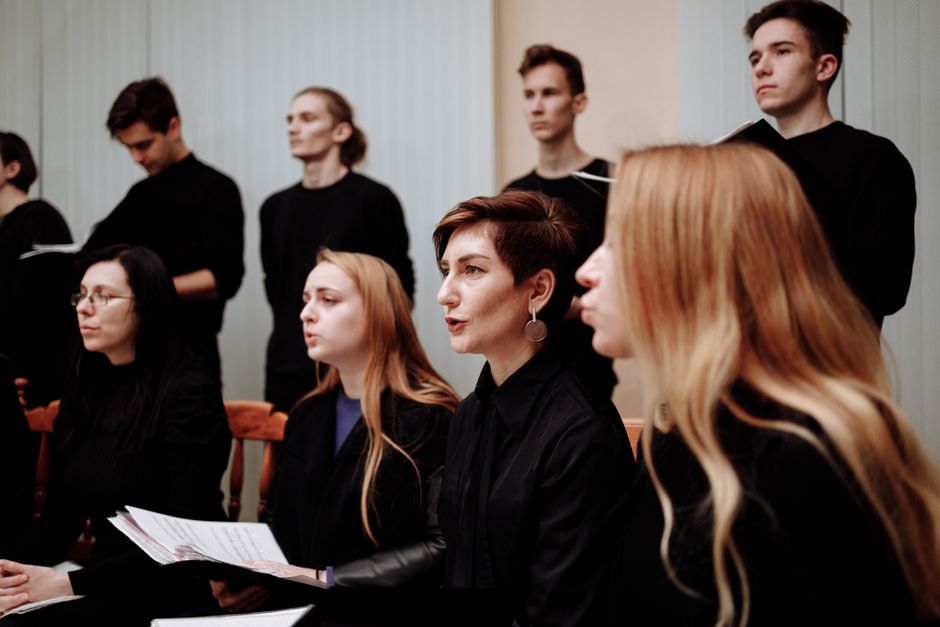
An opera singer can fill a 3,000-seat hall without a microphone because the voice is being amplified by the body itself, not pushed by force. The secret is a technique called resonance — shaping the throat, mouth, and sinuses so they vibrate in tune with the vocal cords. When that happens, the sound doesn’t just get louder. It gets carried. A trained singer produces a focused ring of sound that travels over an orchestra and reaches the back row of the balcony, all from a pair of tiny muscles in the larynx.
That is the plain answer. The rest of this article explains how the body makes it happen, why most untrained voices can’t do it, and what the science actually shows versus what gets repeated online.
How Do Opera Singers Sing So Loud Without A Mic?
The loudness comes from resonance, not from pushing more air. Think of a guitar. A string by itself makes a thin sound. The wooden body of the guitar takes that vibration and makes it fill a room. The human vocal tract works the same way.
Your vocal cords are two small folds of tissue in the larynx. Air from the lungs makes them vibrate, which creates a buzzing sound. That buzz is quiet on its own. But it passes through the throat, mouth, and nasal passages — a tube of air roughly 17 centimeters long in an adult. When the shape of that tube matches the pitch of the buzz, the sound gets much stronger.
Singers learn to tune that tube on purpose. By changing the position of the larynx, the tongue, the soft palate, and the lips, they can make the vocal tract reinforce certain frequencies. The result is a sound that is both louder and richer, without extra strain on the throat.
What Is the “Singer’s Formant”?
There is a specific acoustic signature that lets an opera voice cut through an orchestra. Researchers call it the singer’s formant — a cluster of boosted frequencies around 2,800 to 3,200 hertz.
This matters because a symphony orchestra produces most of its energy at lower frequencies. The singer’s formant sits in a range where the orchestra is relatively quiet. So the voice lands in a sort of acoustic gap and stays audible even when the music swells.
Not every trained singer develops this. Studies using spectrum analysis have found it more often in male voices, particularly basses and baritones, though some sopranos also produce a related boost at higher frequencies. It is a measurable feature, not a myth. What’s less clear is exactly how much of a singer’s carrying power comes from this one effect versus other factors like vowel choice and vibrato. The evidence points to it being important, but it is not the whole story.
Why Can’t Most People Do This?
Untrained singers try to get loud by pushing harder from the throat. That approach hits a ceiling fast. The muscles tighten, the sound gets rough, and the voice tires. Over time it can cause damage.
Trained singers do the opposite. They keep the throat relaxed and open, then use breath support from the diaphragm and abdominal muscles to control airflow. The loudness comes from efficient resonance, not from squeezing.
This takes years to build. Opera training programs typically run for many years before a singer is ready for professional stages. The skill is partly muscular — learning to coordinate dozens of small movements — and partly auditory. Singers have to hear and feel when their vocal tract is tuned correctly.
There is also a physical limit. No training makes a voice infinitely loud. What training does is make a voice more efficient, so more of the energy produced actually reaches the audience instead of getting absorbed or scattered.





Does Body Size or Lung Capacity Matter?
Larger bodies do tend to have longer vocal tracts, which can shift resonance lower. That is one reason bass voices are often associated with bigger singers. But size alone does not determine vocal power.
Lung capacity matters for how long a singer can sustain a phrase, not for how loud the sound is. A singer with average lungs and excellent technique will out-project a singer with large lungs and poor technique almost every time.
What matters more is how the air is managed. Trained singers learn to control the release of breath so that pressure stays steady. Unsteady pressure makes an unsteady sound. Steady pressure, combined with good resonance, produces a sound that carries.
Is Belting the Same as Operatic Singing?
No. Belting is a technique used in musical theater and pop music. It produces a loud, speech-like sound by keeping the larynx higher and using more chest voice. It can be powerful, but it works differently from operatic resonance.
Belting also tends to be more taxing on the voice. Many musical theater performers use microphones precisely because belting does not project the same way opera does over an unamplified orchestra.
Opera singers, by contrast, rely on a lower larynx and a more open throat. This produces a rounder sound that travels farther without as much strain. The two styles are not better or worse than each other. They are built for different jobs.
Can Anyone Learn to Sing This Loudly?
Most people can improve their vocal projection with training. But reaching operatic levels of volume and carrying power is rare. It requires a combination of natural vocal anatomy, years of practice, and good vocal health.
Some people have vocal folds or vocal tracts that are better suited to this kind of singing than others. That does not mean others cannot sing well. It means the specific demands of unamplified opera are unusual, and not every voice is built for them.
What is clear is that the technique is learnable, not magical. The voice is not being forced. It is being tuned.
What Does This Mean for Everyday Voice Use?
You do not need to be an opera singer to benefit from understanding resonance. Teachers, coaches, and anyone who speaks for a living can learn to project without straining.
The basic idea is the same. Keep the throat relaxed. Let the breath do the work. Aim the sound forward rather than pressing it out. These principles show up in vocal training across many fields, from public speaking to singing.
If your voice feels tired or hoarse after speaking, that is a sign you are pushing rather than resonating. A speech therapist or voice teacher can help identify what is going wrong.
Frequently Asked Questions
How loud can an opera singer actually sing?
Measurements vary, but trained opera singers can produce sound levels well above 100 decibels at close range, comparable to a chainsaw or a rock concert. The exact number depends on the singer, the pitch, and how close the measurement is taken.
Do opera singers ever use microphones?
In traditional opera houses, no — the whole point is that the voice carries on its own. Some modern productions and outdoor performances do use subtle amplification, but this is not the standard for classical opera.
Is the singer’s formant something you are born with?
No. It is a product of training. Most singers develop it over years of practice as they learn to shape their vocal tract, though some voices produce it more easily than others.
Can singing loudly damage your voice?
Pushing or forcing the voice can cause strain, nodules, or other injuries over time. Trained operatic singing is designed to avoid this by using resonance instead of force, but even trained singers can injure their voices with poor technique or overuse.
