
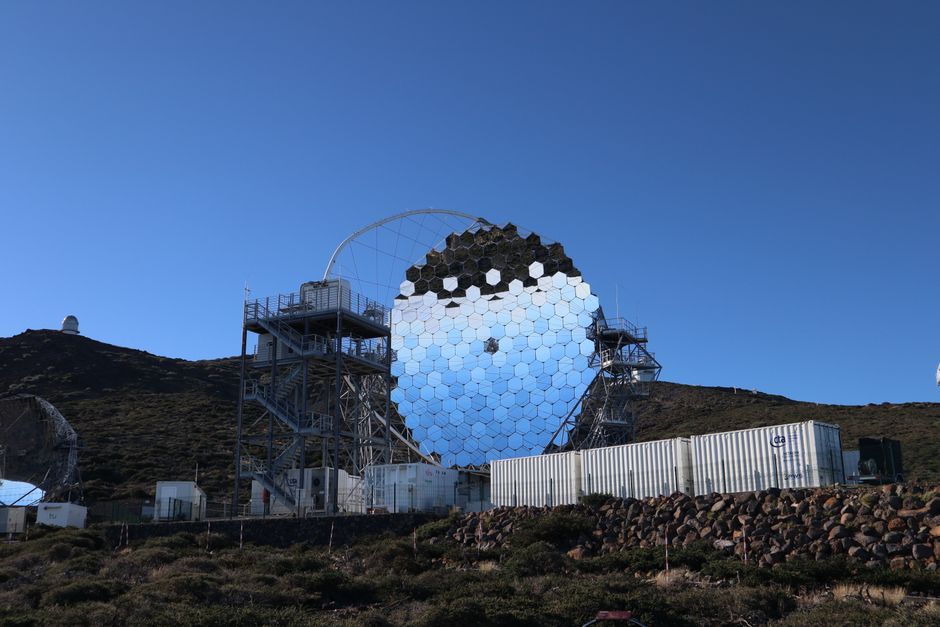
An infrared telescope works by collecting infrared light with mirrors, focusing that light onto a detector, and then turning the detector’s electrical signals into an image. Mirrors are used instead of lenses because they focus all wavelengths of light to the same point and can be made very large without sagging under their own weight. The result is a picture built pixel by pixel from heat and light the human eye cannot see.
That is the short version. The longer version involves polished surfaces, cryogenic cooling, and a chain of electronics that ends in a screen. Each step solves a specific physical problem. Understanding the steps explains why infrared astronomy looks so different from the kind we do with our eyes.
Why Do Infrared Telescopes Use Mirrors Instead of Lenses?
Mirrors focus every wavelength of light at the same point. Lenses do not. That single fact is the main reason infrared telescopes are built around mirrors.
When light passes through glass, different colors bend by slightly different amounts. This is called chromatic aberration. A lens designed to focus visible light sharply will smear infrared light across a slightly different spot. For a telescope trying to capture many wavelengths at once, that is a serious defect. A curved mirror reflects all wavelengths at the same angle, so the focus stays sharp across the whole range.
There is a second reason: size. A telescope’s ability to gather faint light depends on the area of its main mirror. Bigger is better. A mirror can be supported from behind across its entire back surface. A lens of the same size would sag under its own weight and distort the image. This is why the largest optical and infrared telescopes in the world are reflectors, not refractors.
Mirrors also handle the practical side of infrared work. Many infrared telescopes sit in space or at high altitude because Earth’s atmosphere absorbs much of the infrared light arriving from space. A mirror-based design is easier to build, launch, and cool than a large glass lens would be.
How Do Infrared Telescopes Work Mirrors To Images Step by Step?
The path from starlight to picture follows a fixed sequence. Light enters, bounces off mirrors, lands on a detector, and is converted into numbers that become an image.
Here is the chain in order:
- Collection. The primary mirror, the largest one, gathers infrared light from a distant object.
- Focusing. The light reflects off the primary mirror toward a secondary mirror, which redirects it to a focal point.
- Detection. At the focus sits a detector array, a grid of tiny sensors that respond to infrared light.
- Conversion. Each sensor produces an electrical signal proportional to the amount of infrared light hitting it.
- Image building. A computer reads those signals and assigns each one a brightness value, assembling a grid of pixels into a picture.
The detector is the part most people never think about. In visible-light photography, a sensor records photons of visible light. Infrared detectors are built from materials sensitive to longer wavelengths, and they often must be cooled to very low temperatures. Without cooling, the detector itself would glow in the infrared and drown out the faint signal from space. Cooling is not a luxury here. It is a requirement.
One clarification worth making: the mirrors do not create the image. They only direct and focus the light. The image is built by electronics and software from the detector’s readings.
What Does the Detector Actually Measure?
An infrared detector measures how much infrared light lands on each tiny sensor in its grid. That is the whole job. Everything else is interpretation.
Infrared light is simply light with a longer wavelength than visible red light. Warm objects emit it. So do stars, planets, and clouds of dust in space. A detector tuned to these wavelengths can pick up objects that are invisible to the eye, either because they are too cool to glow visibly or because dust blocks the visible light they emit.
The sensor grid matters because it captures many points of light at once. A single sensor would only tell you the total brightness of whatever it pointed at. A grid of thousands of sensors, each recording its own patch of sky, produces the spatial detail that becomes an image. More sensors in the grid means finer detail.
Each sensor’s reading is a number. Software maps those numbers to brightness levels and arranges them in the same grid pattern. The result looks like a photograph, but it is really a map of infrared intensity, translated into something our eyes can read.
Why Are Infrared Telescopes Cooled So Carefully?
Cooling keeps the telescope from blinding itself. Every warm object gives off infrared light, including the telescope’s own mirrors, structure, and detectors.
If a detector is warm, it emits its own infrared glow. That glow would swamp the faint signal from a distant galaxy. The fix is to chill the detector, and often the surrounding optics, to temperatures where their own infrared emission drops to almost nothing. This is why infrared space telescopes carry cryogenic systems or radiators designed to shed heat into space.
This is also why infrared telescopes are often placed in space or at high, dry altitudes. Earth’s atmosphere absorbs a large share of incoming infrared light and also emits its own. Getting above most of the atmosphere removes a major source of interference. The cooling and the location work together toward the same goal: a clean signal.
How Does a Mirror Turn Light Into a Picture We Can See?
A mirror turns light into a picture only through the electronics downstream. The mirror’s job ends when the light reaches the detector.
Here is what happens after detection. The detector converts infrared photons into electrical charge. That charge is read out, digitized, and stored as a grid of numbers. Software then applies corrections, adjusts brightness and contrast, and assigns colors. Because infrared light is invisible, the final image usually uses visible colors as a stand-in, with different wavelengths mapped to red, green, or blue. Those colors are a translation, not what the object would actually look like to your eye.
This is a point worth sitting with. The striking images from infrared telescopes are real data, but the colors are choices made to make the data visible. The structure is genuine. The palette is a human convenience.
What Makes Infrared Telescopes Different From Visible-Light Telescopes?
Infrared telescopes see heat and can peer through dust that blocks visible light. Those two abilities drive most of the design differences.
The mirrors and focusing principles are similar. The differences sit in the detector materials, the cooling systems, and often the location. Visible-light telescopes can operate from the ground under ordinary conditions. Infrared instruments need colder detectors and cleaner skies, which pushes them toward space or high, dry mountaintops.
Infrared also reveals objects that visible light misses. Cool stars, planets, and dust clouds glow in the infrared. Dust that hides a newborn star from visible view is partly transparent to infrared light, so infrared telescopes can see into regions where visible-light telescopes see only a dark cloud. That is why infrared astronomy has been central to studying how stars form.
Frequently Asked Questions
Why do infrared telescopes use mirrors instead of lenses?
Mirrors focus all wavelengths of light to the same point, while lenses bend different wavelengths by different amounts and blur the focus. Mirrors can also be built much larger without sagging under their own weight.
Do infrared telescope mirrors create the image?
No. The mirrors only collect and focus the light. The image is built by a detector array and software that converts electrical signals into a grid of pixels.
Why must infrared telescope detectors be kept cold?
Warm objects emit their own infrared light, which would drown out faint signals from space. Cooling the detector reduces that self-emission so the telescope can record distant objects clearly.
Are the colors in infrared telescope images real?
The colors are not what your eye would see, because infrared light is invisible. The colors are assigned by software to represent different infrared wavelengths so the data can be viewed.
