
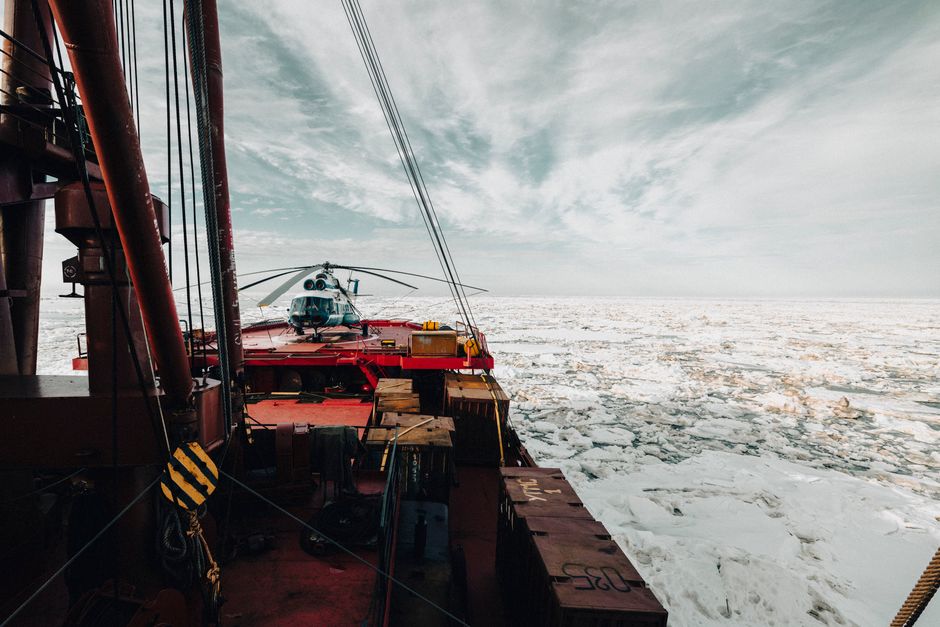
Icebreaker ships push through frozen seas using a combination of massive power, specially shaped hulls, and their own weight. They do not slice through ice like a knife. Instead, most icebreakers ride up onto the ice and press down until the ice breaks under the ship’s weight. This method, combined with reinforced hulls and powerful engines, allows these vessels to open shipping lanes in waters that would stop a normal ship completely.
How Do Icebreaker Ships Work The Engineering Explained
The basic principle is simple: use weight and shape to break ice from above. A conventional ship has a sharp bow designed to cut through water. An icebreaker has a rounded, spoon-shaped bow that allows the front of the ship to slide up onto the ice sheet. As the ship pushes forward, the bow rises onto the ice. The ship’s weight then bears down on the ice from above, which is far more effective than trying to push through it from the side. The ice cracks and breaks under the load, and the ship pushes the broken pieces aside.
This process requires enormous force. A ship cannot simply idle up onto thick ice. The engines must produce enough thrust to drive the bow up the slope of the ice edge. Once the bow is on top of the ice, the weight of the entire ship does the breaking work. Modern icebreakers also use a system of water tanks called heeling tanks. Crews pump water rapidly from one side of the ship to the other, making the ship rock side to side. This rocking motion widens the channel and helps break ice that is thicker than the ship’s normal breaking capacity.
What Makes an Icebreaker Hull Different From a Normal Ship Hull?
The hull shape is the most critical difference. Normal cargo ships have V-shaped bows that push water out of the way. Icebreakers use a hull that is wider and rounder at the bottom. This shape serves two purposes. First, it allows the bow to ride up onto the ice. Second, it directs broken ice away from the hull and down underneath the ship, preventing ice from jamming against the sides.
The steel used in icebreaker hulls is also different. Icebreaker hulls are built with thicker steel plates, often double the thickness of a standard ship’s hull. The steel is also specially treated to remain tough in extreme cold. Ordinary steel becomes brittle at very low temperatures and can crack under impact. Icebreaker steel is formulated to stay ductile, meaning it can bend and absorb impact without shattering.
The hull is reinforced with a system of internal frames and bulkheads spaced closely together. This internal skeleton distributes the massive forces of ice impact across a wider area of the hull. Without this reinforcement, the pressure of the ice would dent or puncture the hull plating.
What Kind of Engines and Power Do Icebreakers Need?
Icebreakers require immense power to move through ice. The most powerful icebreakers in the world are nuclear-powered, such as those operated by Russia in the Arctic. These vessels generate tens of thousands of horsepower. Conventional icebreakers use diesel-electric propulsion systems, where diesel engines generate electricity that powers electric motors connected to the propellers.
Diesel-electric systems are preferred for icebreakers for a specific reason: control. Electric motors can deliver maximum torque at low speeds, which is exactly what an icebreaker needs when it is pushing against solid ice. They also allow the propellers to reverse direction quickly, which is essential for backing away from ice that is too thick to break.
Propeller design is another critical engineering element. Icebreakers use specially designed propellers made from high-strength materials like stainless steel. The propellers must withstand constant contact with ice fragments. Many icebreakers also use controllable-pitch propellers, which allow the crew to adjust the angle of the blades without changing engine speed. This gives precise control in tight maneuvering situations.





Why Do Some Icebreakers Use a Specialized Hull Shape Called a “Polar Class” Bow?
Not all icebreakers are built the same. Ships are classified by their ice-breaking capability, often referred to as Polar Class ratings. These ratings range from Polar Class 1, which can operate year-round in all polar waters, to Polar Class 7, which can only handle thin first-year ice in summer. The hull shape and structural strength differ significantly between these classes.
Some modern icebreakers, particularly those designed by the Finnish company Aker Arctic, use a double-acting design. These ships have an icebreaking bow at the stern and a conventional bow at the front. In heavy ice, the ship simply turns around and travels backward, using the icebreaking stern to smash through the ice. This design allows the ship to maintain a conventional hull shape for open water efficiency while still having icebreaking capability.
The shape of the bow itself has evolved over decades of testing. Early icebreakers had steep bows that pushed ice downward. Modern designs use a shallower bow angle, which allows the ship to ride further up onto the ice before breaking it. This creates a smoother, more continuous breaking action rather than a series of violent impacts.
How Thick Ice Can an Icebreaker Actually Break?
There is no single answer because ice thickness is not uniform. Ice varies in strength depending on temperature, salinity, and whether it is first-year ice or multi-year ice. Multi-year ice is significantly harder because the salt has drained out of it over successive seasons, leaving dense, tough ice behind.
A typical medium icebreaker can continuously break through ice about 1 meter (3 feet) thick. The most powerful polar icebreakers can break through ice up to 2.5 to 3 meters (8 to 10 feet) thick while moving continuously. In extreme cases, using the ramming technique, the most powerful icebreakers can break through ice that is significantly thicker. Ramming involves backing the ship up and then charging forward at full speed, using momentum to drive the bow up and over the ice before the weight of the ship crushes it.
However, even the most powerful icebreaker has limits. No ship can break through extremely thick multi-year ice ridges that can exceed 10 meters in depth. In these cases, icebreakers work together or wait for conditions to change.
What Other Systems Help Icebreakers Do Their Job?
Several auxiliary systems are essential to icebreaker operations. The heeling system, mentioned earlier, uses pumps to transfer water between tanks on opposite sides of the ship. This rocking motion is not just for breaking ice — it also prevents the ship from becoming stuck. If an icebreaker comes to a stop in thick ice, the surrounding ice can freeze around the hull and trap the ship. The rocking motion keeps the hull moving and prevents this freeze-in from occurring.
Air bubbling systems are also common on modern icebreakers. Compressed air is forced through nozzles along the hull below the waterline. The rising bubbles create a lubricating layer of water between the hull and the ice. This reduces friction significantly, allowing the ship to slide through the ice channel more easily and with less power.
Icebreakers also carry sophisticated navigation and sensing equipment. Radar, sonar, and satellite imagery help crews identify the thinnest ice routes. Some newer icebreakers use thermal imaging and laser systems to measure ice thickness ahead of the ship, allowing the crew to plan their approach before committing to a particular path.
Why Are Icebreakers Essential for Shipping and Research?
Icebreakers serve a critical role in maintaining shipping routes in cold regions. The Northern Sea Route along the Russian Arctic coast and the Northwest Passage through Canadian waters are only navigable because icebreakers escort cargo ships through the ice. Without icebreakers, these routes would be closed for most of the year.
Icebreakers are also essential for scientific research in polar regions. Research icebreakers carry scientists and equipment to remote locations to study climate change, ocean currents, marine life, and ice dynamics. These vessels are floating laboratories, equipped with cranes, winches, and specialized sampling equipment that allow researchers to collect data from the ocean and the ice itself.
The engineering that makes icebreakers work is a remarkable example of solving a physical problem with design and power. They do not fight the ice head-on. They use shape, weight, and controlled force to overcome one of the most challenging environments on Earth.
Frequently Asked Questions
How does an icebreaker break thick ice?
The ship drives its bow up onto the ice and uses the weight of the vessel to press down and crack the ice from above. For very thick ice, the ship backs up and rams the ice at full speed to gain momentum.
Why are icebreaker hulls shaped differently?
The rounded, spoon-shaped bow allows the ship to ride up onto the ice rather than trying to cut through it. The wide, rounded bottom also pushes broken ice away from the hull and prevents it from jamming against the ship.
Can an icebreaker break through any ice?
No. Even the most powerful icebreakers cannot break through extremely thick multi-year ice ridges. They have limits and must sometimes wait for conditions to change or find a thinner route.
Why are some icebreakers nuclear-powered?
Nuclear power provides enormous continuous energy without needing to refuel, which is essential for ships operating in remote Arctic regions for months at a time. Nuclear icebreakers are also the most powerful class of icebreakers in the world.
