
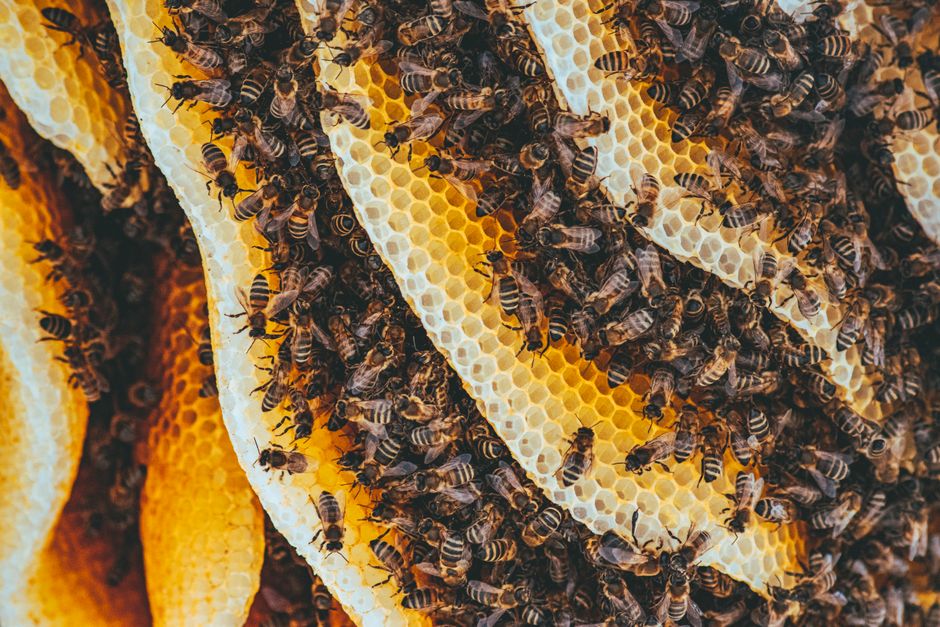
Honey bees make honeycomb from beeswax, a material their own bodies produce. Worker bees have four pairs of wax glands on the underside of their abdomen. These glands secrete thin flakes of wax, which the bee chews and shapes into the six-sided cells that form the comb. The comb is built to hold honey, pollen, and developing young — and its structure is one of the most efficient known in nature.
How Do Honey Bees Make Honeycomb Step by Step?
The process starts with nectar, not wax. Young worker bees eat large amounts of honey and pollen, and their bodies convert the sugars into wax. This is why comb gets built during a nectar flow — the colony needs an energy surplus before it can afford to build.
The wax glands sit on the underside of the abdomen. They become active in younger workers, roughly during the first two to three weeks of adult life, and typically shut down as the bee ages and moves on to foraging. A bee that is out collecting nectar is generally not the same bee producing wax.
Here is the sequence:
- The bee eats honey, and the wax glands convert sugar into liquid wax.
- The wax hardens into small, clear flakes as it contacts air.
- The bee uses its legs to move the flakes to its mouthparts.
- It chews the wax, mixing it with saliva, until it becomes soft and workable.
- The bee presses and shapes the wax into place on the comb.
One detail that surprises people: a single wax flake is tiny. Building even a small section of comb takes thousands of flakes from many bees working together. The colony does not build comb one bee at a time — it builds it as a coordinated group effort.
Why Is Honeycomb Always Six-Sided?
Because the hexagon is the most efficient shape for packing cells together without wasted space. Circles leave gaps between them. Squares and triangles tile without gaps, but they use more wax to enclose the same volume. Hexagons enclose the most space with the least wall material.
This matters because wax is expensive for the colony to produce. It takes a large amount of honey to make a small amount of wax — the energy cost is steep. Any shape that saves wax while holding the same amount of honey gives the colony an advantage.
There is a common claim that bees are “master mathematicians” who calculated the optimal shape. That overstates it. The more accurate explanation is that bees follow simple local building rules, and the physics of how wax flows and presses together under those rules produces hexagonal cells. Some research has explored how bees build cells of different sizes and how those cells meet, and the exact mechanics are still studied. What is clear is that the result is efficient. Whether the bee “intends” that efficiency is a different question.
What Is Honeycomb Used For Inside a Hive?
Honeycomb is the hive’s entire infrastructure. It serves as pantry, nursery, and communication surface all at once. The colony cannot store food or raise young without it.
The bees use different parts of the comb for different purposes:
- Honey storage — cells in the upper and outer areas are filled with honey and capped with wax.
- Pollen storage — cells near the brood nest hold pollen, often called “bee bread” once packed and processed.
- Brood rearing — the queen lays eggs in cells in the central brood area, and workers cap them while the young develop.
The comb itself is reused. Bees do not rebuild from scratch every season. Old comb gets repaired, cleaned, and reshaped. Beekeepers often reuse drawn comb for years because building new comb costs the colony so much energy.
How Long Does It Take Bees to Build Honeycomb?
There is no single answer, because the rate depends on colony size, food supply, temperature, and how much comb already exists. A strong colony with abundant nectar during warm weather can draw out new comb relatively quickly. A small colony, or one building in cool weather with limited food, may take far longer or stop building altogether.
What is well established is the limiting factor: energy. Comb building requires a nectar or honey surplus. Bees generally will not invest in new comb when food is scarce, because wax production competes directly with the colony’s food reserves. This is why beekeepers often feed sugar syrup to support comb building during a dearth — they are supplying the raw energy the bees need.
Temperature matters too. Wax becomes brittle when cold and is difficult to shape. Comb building slows or halts in cool conditions and picks up when the hive is warm.
How Much Honey Does It Take to Make Wax?
More than most people expect. The widely cited ratio in beekeeping literature is roughly six to eight pounds of honey consumed to produce one pound of wax. This figure is a long-standing estimate rather than a precisely measured constant, and actual efficiency varies with conditions. But the direction is not in dispute: wax is one of the most energy-expensive materials the colony produces.
That cost explains a lot of bee behavior. It explains why bees repair old comb instead of building new. It explains why they build comb only when food is plentiful. And it explains why a beekeeper who harvests comb is taking something genuinely costly from the colony, not just a container.
Is All Honeycomb the Same Size?
No. Bees build different cell sizes for different purposes. Worker brood cells are smaller than drone brood cells, and honey storage cells can differ again. The bees adjust cell size based on what the cell will be used for.
Beekeepers sometimes use foundation — a pre-formed wax or plastic sheet with a cell pattern pressed into it — to guide the bees toward a particular cell size. Whether foundation is necessary is debated among beekeepers, and some keep hives without it. The bees are capable of building comb without guidance; foundation mainly standardizes the result and saves the colony some work.
Does Honeycomb Building Ever Go Wrong?
Yes. When bees build comb in the wrong place, beekeepers call it burr comb or brace comb. It shows up in gaps, on lids, or between frames, and it makes the hive harder to work. Bees build where there is open space, so any gap in a hive can become a building site.
Comb can also be built at odd angles if the hive is not level. Bees use gravity as a reference when building, and a hive that is tilted can produce comb that is not straight. This is one practical reason beekeepers level their hives.
None of this is a sign of disease or a failing colony. It is normal bee behavior responding to the space available.
Frequently Asked Questions
How do honey bees make honeycomb?
Worker bees secrete wax from glands on the underside of their abdomen, chew the wax to soften it, and shape it into six-sided cells. The bees need to eat large amounts of honey to fuel wax production.
What is honeycomb made of?
Honeycomb is made of beeswax, a substance produced by the bees’ own wax glands from the sugars in honey. It is not made from pollen, nectar directly, or plant material gathered from outside the hive.
Why do bees make hexagonal cells instead of round ones?
Hexagons pack together with no wasted space and use the least wax to enclose a given volume. Since wax is costly for the colony to make, the hexagon gives the most storage for the least energy.
Do bees reuse honeycomb?
Yes. Bees repair and reuse existing comb rather than rebuilding it each season, because producing new wax costs a large amount of honey. Beekeepers also typically reuse drawn comb for the same reason.
