
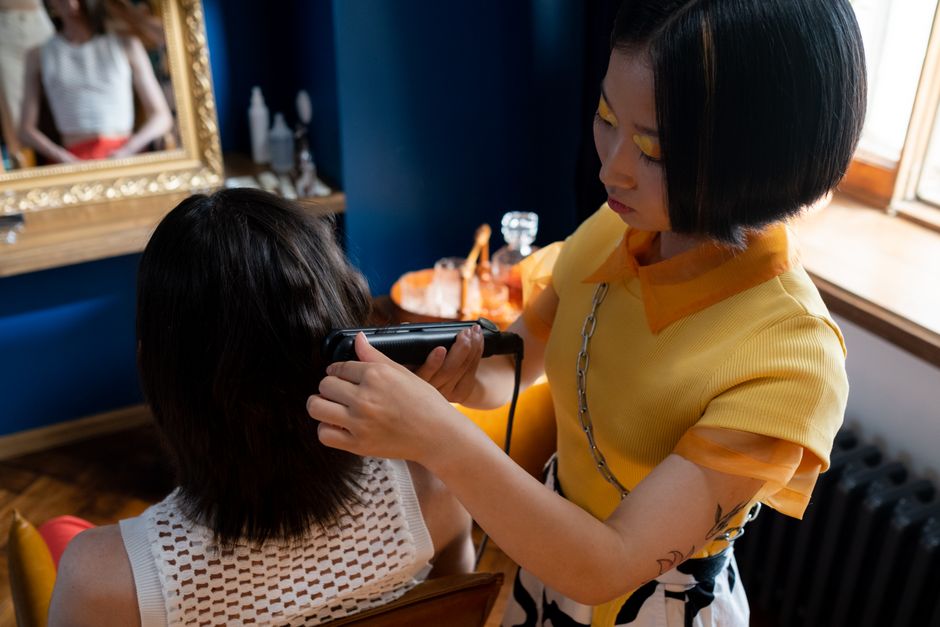
Hair straighteners work by breaking a specific type of chemical bond inside the hair fiber, reshaping the hair, then locking it into its new form. The heat from the iron does part of the job, but the chemistry that makes straightening last for weeks or months is a reaction between a reducing agent and the protein structure of your hair.
That reaction has a name: it targets the disulfide bonds that give hair its natural shape. Understanding this process explains why some treatments last months, why others wash out in a week, and why certain hair types respond very differently to the same product.
What Is Hair Made Of at the Structural Level?
Hair is mostly protein. The main structural protein is keratin, and it is organized into long chains called polypeptides. These chains twist together into larger bundles, and those bundles form the visible strand.
What holds the chains together matters more than the chains themselves. Several types of bonds and interactions link keratin strands to each other:
- Disulfide bonds — strong chemical links between sulfur-containing amino acids, mainly cystine
- Hydrogen bonds — weaker attractions that break with water and reform as hair dries
- Salt bonds — pH-dependent attractions that shift with acidity
- Hydrophobic interactions — water-repelling forces between parts of the protein
Disulfide bonds are the ones that matter most for permanent changes in hair shape. They are covalent bonds, meaning they are actual chemical links rather than temporary attractions. Breaking them requires a chemical reaction, not just heat or water.
The number and arrangement of disulfide bonds differ between people. This is a major reason why straightening results vary so much from one person to another.
How Do Hair Straighteners Work Science Explained
Chemical straightening products use a reducing agent to break disulfide bonds. A reducing agent is a substance that donates electrons, and in this context it splits the sulfur-sulfur link into two separate sulfur-hydrogen groups.
Once those bonds are broken, the keratin chains can slide past each other. The hair becomes pliable and can be pulled into a straighter configuration. This is the reshaping step, and it typically involves combing or smoothing the hair while the product is still active.
The final step is oxidation. An oxidizing agent — often hydrogen peroxide or a similar compound — rebuilds disulfide bonds, but in new positions. The hair is now locked into its straighter shape.
Here is the part that is often misunderstood. The bonds are not the same as before. They are new bonds formed between different points along the protein chains. That is why the change can last through many washes. Water alone cannot undo it, because water breaks hydrogen bonds, not covalent disulfide bonds.
The strength of the reducing agent determines how many bonds break. A mild product might break enough to relax a wave. A stronger formulation can flatten tight curl. More bond disruption generally means a more dramatic change, but also more stress on the hair fiber.
How Do Thermal Flat Irons Straighten Hair Without Chemicals?
A flat iron does not break disulfide bonds. It works through a different mechanism, and the results are temporary.
Heat and moisture disrupt hydrogen bonds. These bonds are much weaker than disulfide bonds and reform easily. When you pass a hot iron over damp or dry hair, the heat temporarily loosens hydrogen bonds, allowing the hair to be pulled straight. As the hair cools, hydrogen bonds reform in the new position.
This is why flat-ironed hair reverts when it gets wet or exposed to humidity. Water reintroduces the conditions that let hydrogen bonds shift back toward the hair’s natural pattern.
Temperature matters for how well this works. Most flat irons operate between roughly 300°F and 450°F. Higher temperatures create a more lasting temporary set, but they also increase the risk of heat damage to the cuticle and cortex. There is no temperature that straightens hair permanently through heat alone.
One non-obvious point: the “wet to dry” flat irons that hiss and steam are not chemically straightening anything. They are doing the same hydrogen bond disruption as any other iron, just starting from wet hair. The steam is water leaving the hair, not a sign of a chemical reaction.




Why Do Some Straightening Treatments Last Longer Than Others?
Duration depends on how many disulfide bonds were permanently rearranged and how well the new bonds hold up.
Thermal flat ironing lasts until the hair gets wet or the hydrogen bonds shift back. That can be hours to a few days depending on humidity, hair type, and how the hair is handled.
Chemical relaxing or permanent straightening rearranges disulfide bonds, so the change survives washing. How long it lasts varies widely. New hair growing in from the root will have the original texture, so the treated length stays straight while the roots do not. This is why many people need touch-ups every few months.
Some products marketed as “permanent” are actually semi-permanent. They may coat the hair or deposit a light film that temporarily smooths the surface. These do not break disulfide bonds, and they wash out. The distinction between surface smoothing and true chemical straightening is one of the most important things to understand when comparing products.
Formaldehyde-releasing ingredients appear in some professional smoothing treatments. These work differently from classic relaxers and have raised health concerns. Regulatory agencies including the U.S. Food and Drug Administration have issued warnings about formaldehyde in hair smoothing products, and some formulations have been the subject of safety alerts. Anyone considering these treatments should review current regulatory guidance, since the status of specific products has changed over time.
What Determines How Much Damage Straightening Causes?
Any process that breaks disulfide bonds or applies high heat can weaken hair. The extent depends on several factors.
Hair porosity is a major one. Porous hair — often from prior chemical treatment, heat damage, or natural texture — absorbs chemicals faster and may be more vulnerable to over-processing. Low-porosity hair resists absorption and may need longer processing to achieve the same result.
The strength of the chemical and how long it stays on the hair both matter. Leaving a relaxer on too long can break more bonds than intended, leading to brittleness and breakage. Overlapping treatments on already-processed hair compounds the damage.
Heat damage works differently. Repeated high-temperature ironing can create bubbles inside the hair shaft, a condition sometimes called bubble hair. It can also degrade the cuticle, the outer protective layer. Once the cuticle is significantly damaged, it does not fully regenerate. The hair has to grow out.
There is no treatment that reverses disulfide bond damage or repairs a degraded cuticle. Products that claim to “repair” hair generally work by temporarily filling gaps or smoothing the surface. They can improve how hair feels and looks, but they do not restore the original protein structure.
Does Hair Type Affect How Straightening Works?
Yes, and significantly. The curl pattern of hair is largely determined by the shape of the hair follicle and the arrangement of disulfide bonds along the fiber.
Straight hair has few disulfide bonds holding it in a curved shape. Wavy hair has more. Tightly coiled hair has the most, along with a more elliptical follicle shape that contributes to the curl.
This is why straightening tightly coiled hair typically requires stronger chemicals or longer processing than straightening wavy hair. It is also why the same product can produce very different results on two people.
Fine hair generally processes faster because it has less total protein mass. Coarse hair may need more time or a stronger formulation. These are general patterns, not rules. Individual variation is large, and a patch test is the standard way to check how a specific person’s hair responds before treating the whole head.
What Happens to Hair After Repeated Straightening?
Repeated chemical and heat treatments accumulate damage over time. Each round of bond breaking and reforming leaves the fiber slightly weaker.
Common signs of cumulative damage include:
- Increased breakage, especially near the ends
- Loss of elasticity, so hair snaps instead of stretching
- Rough or raised cuticle texture
- Split ends that travel up the shaft
- Reduced shine as the cuticle loses its smooth surface
Because hair is not living tissue, it cannot heal itself. The only way to replace damaged hair is to let new hair grow. This is why stylists often recommend spacing out chemical treatments and giving hair a break between sessions.
Some people alternate between chemical straightening and heat styling, which can be harder on hair than sticking with one method. Combining both increases the total stress on the fiber.
Frequently Asked Questions
Do hair straighteners permanently change hair structure?
Chemical straighteners permanently rearrange disulfide bonds, so the change lasts until new hair grows in. Thermal flat irons only temporarily disrupt hydrogen bonds, and the effect reverses with moisture.
Why does flat-ironed hair frizz up in humidity?
Humidity reintroduces water, which breaks the hydrogen bonds that were holding the hair straight and lets them reform in the original pattern. Chemical straightening resists this because it changes covalent bonds instead.
Is chemical hair straightening safe?
Safety depends on the specific product, how it is applied, and the condition of the hair. Some smoothing treatments contain formaldehyde-releasing ingredients that have drawn regulatory warnings, so checking current FDA guidance before a treatment is reasonable.
Can damaged hair from straightening be repaired?
No product restores broken disulfide bonds or regrows a damaged cuticle. Products can temporarily improve texture and appearance, but the only real fix is new hair growing in.
