
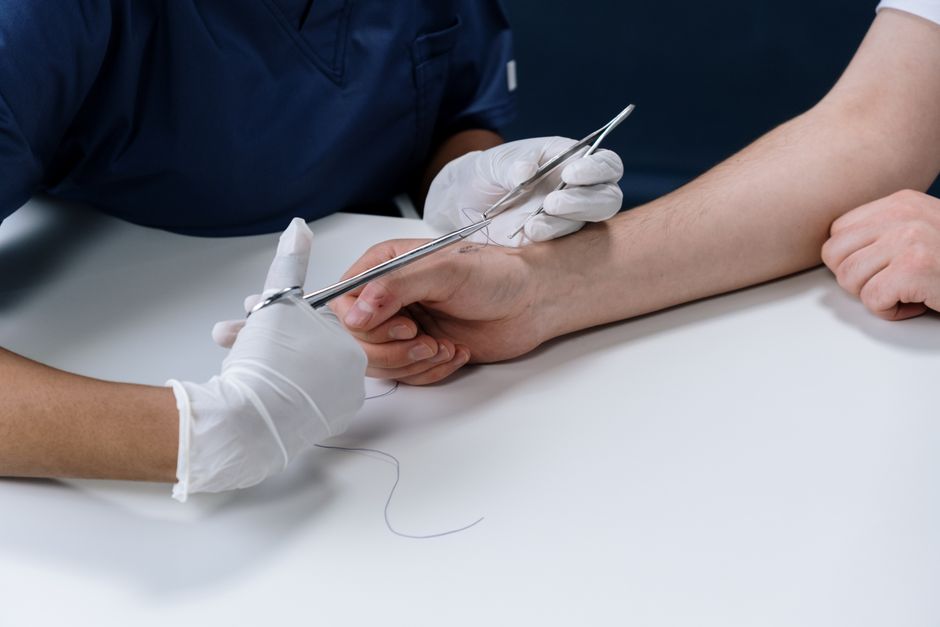
Dissolving stitches are made from materials your body naturally breaks down over time. Unlike regular stitches that a doctor must remove, dissolving stitches disappear on their own as your body absorbs them. Most dissolving stitches last between 1 and 6 weeks, but the exact time depends on the stitch material, where they are placed, and how quickly your body heals.
How Do Dissolving Stitches Work And How Long They Last?
Dissolving stitches work through a process called hydrolysis. Your body’s water and enzymes attack the stitch material and break it into smaller pieces. The pieces are then absorbed and metabolized like any other waste product.
The material itself determines the timeline. Some synthetic materials lose most of their strength in 1 to 2 weeks. Others hold their strength for 3 to 4 weeks before breaking down. A few types last several months. Your surgeon chooses the material based on how long the wound needs support.
It is important to understand that the stitch does not disappear all at once. The stitch loses tensile strength first, meaning it stops holding the wound closed. Then the material breaks into fragments. Finally, the fragments are absorbed by the body.
What Are Dissolving Stitches Made Of?
Most dissolving stitches are made from synthetic polymers. These are man-made materials designed to break down predictably. Common types include polyglactin, polydioxanone, and polyglycolic acid.
Some older stitches were made from natural materials like catgut, which comes from animal intestines. Catgut is rarely used today because synthetic materials cause less inflammation and behave more consistently.
The body does not reject these materials because they are broken down rather than recognized as foreign. The breakdown products are simple molecules that the body processes without difficulty.
How Long Do Dissolving Stitches Actually Last?
There is no single answer because stitch materials are designed for different purposes. Here is what you can generally expect based on stitch type:
- Short-term stitches — lose most strength in 7 to 10 days and fully dissolve in 2 to 3 weeks. Used for skin closures where healing is fast.
- Medium-term stitches — hold strength for 2 to 3 weeks and dissolve fully in 4 to 6 weeks. Common for deeper tissue repair.
- Long-term stitches — maintain strength for 4 to 6 weeks and may take 3 to 6 months to fully disappear. Used for tendons, blood vessels, or internal organs that need longer support.
Location matters just as much as material. Stitches in the mouth dissolve faster because saliva and constant movement speed up breakdown. Stitches on the back or chest may last longer because skin tension is higher and blood flow is lower.
Your age, nutrition, and overall health also affect the timeline. Younger people tend to heal faster, which means the wound closes sooner, but the stitch material still follows its own breakdown schedule.





Do Dissolving Stitches Actually Dissolve Completely?
Yes, but not always visibly. Many patients believe the stitches are gone within a week because the visible ends fall off. In reality, the part of the stitch inside the tissue may still be there, holding deeper layers together.
What you see on the surface is only a small portion of the stitch. The buried portion dissolves last. This is why a wound can look healed on the outside while the deeper layers are still being supported.
Sometimes small fragments of the stitch work their way to the surface before fully dissolving. This looks like a tiny white or clear thread poking through the skin. It is usually harmless and can be trimmed by a healthcare provider if it becomes bothersome.
What Should You Do If Your Dissolving Stitches Are Still There After Weeks?
It is normal for stitches to still be visible at the 2-week mark, especially with longer-lasting materials. Some stitches are designed to remain for a month or more. If your stitches are still present after 4 weeks, it does not automatically mean something is wrong.
However, you should contact your surgeon or healthcare provider if:
- The stitches have not changed at all after 4 to 6 weeks
- The wound reopens or gaps apart
- You notice redness, swelling, warmth, or discharge
- The area becomes increasingly painful
- You develop a fever
These signs may indicate infection or wound breakdown, and they require medical evaluation. Do not try to remove the stitches yourself. Pulling on a partially dissolved stitch can tear the wound open.
What Happens If Dissolving Stitches Dissolve Too Early?
If stitches dissolve before the wound has regained enough strength, the wound can open. This is called wound dehiscence. It is more common in areas under tension, such as joints, or in people with poor healing due to diabetes, smoking, or steroid use.
Surgeons account for this when choosing stitch material. A wound under high tension gets a longer-lasting stitch. A wound in a low-tension area gets a shorter-lasting one. The material is matched to the expected healing time.
If your wound opens, keep it clean and covered, and contact your healthcare provider promptly. Do not try to close it yourself with adhesive strips unless instructed to do so.
Dissolving Stitches vs. Non-Dissolving Stitches
Non-dissolving stitches, also called non-absorbable sutures, are made from materials like nylon, polypropylene, or silk. They do not break down. A healthcare provider removes them after the wound has healed enough, usually 7 to 14 days for skin wounds.
Dissolving stitches are preferred when removal would be difficult, such as deep inside the body, or when the wound needs support for longer than a week or two. They are also used in children, who may not sit still for stitch removal.
Non-dissolving stitches are often used on the skin surface because they hold edges together more precisely and can be removed at the ideal time. There is no universal rule; the choice depends on the wound type and location.
How To Care For Wounds With Dissolving Stitches
Keep the area clean and dry for the first 24 to 48 hours unless your surgeon gives different instructions. After that, gentle washing with mild soap and water is fine. Pat the area dry — do not rub.
Avoid soaking the wound in baths, pools, or hot tubs until the stitches dissolve or your doctor clears you. Prolonged moisture can soften the stitch material and cause it to break down faster than intended.
Do not pick at the stitches or pull on loose ends. If a stitch end is irritating your skin, cover it with a small bandage and let it fall off naturally. Trimming it yourself increases the risk of pulling the stitch out of the wound.
Watch for signs of infection throughout the healing period. Redness that spreads, increasing pain, pus, or a bad odor from the wound are reasons to call your doctor. Mild redness around the wound edges is normal for the first few days.
When To See A Doctor
Most dissolving stitches cause no problems. But some situations require medical attention.
Seek care if the wound reopens, if you see signs of infection, or if the stitches remain completely unchanged after 6 weeks. Also seek care if you experience sudden bleeding, severe pain, or if the area becomes numb.
If you are unsure whether your stitches are dissolving normally, call your surgeon’s office. They would rather hear from you than have you wait with a wound that is not healing properly.
Frequently Asked Questions
How long do dissolving stitches take to dissolve?
Most dissolving stitches fully dissolve within 1 to 6 weeks, depending on the material used and where they are placed. Some long-term materials can take up to 3 months to disappear completely.
Can dissolving stitches fall out too early?
Yes, they can, especially if the wound is under tension or if the area is soaked repeatedly. If the wound opens or gaps apart, contact your healthcare provider.
Is it normal for dissolving stitches to still be visible after 2 weeks?
Yes, this is completely normal. Many stitch materials are designed to hold for 3 to 6 weeks, so visible stitches at 2 weeks do not indicate a problem.
Can I remove dissolving stitches myself?
No. Pulling or cutting dissolving stitches yourself can open the wound and increase infection risk. Let them dissolve naturally or have a healthcare provider remove them if needed.
