
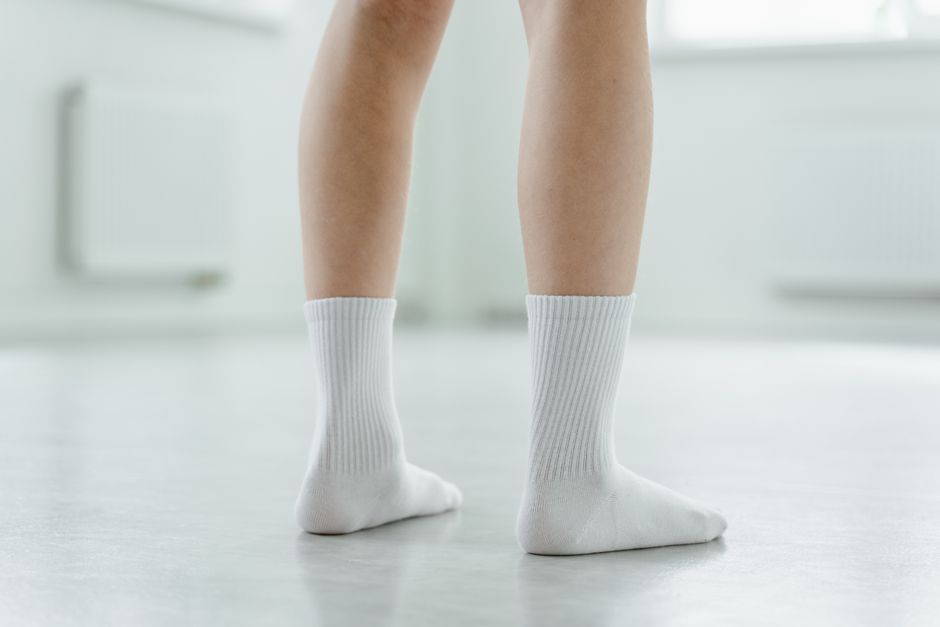
Compression socks help with swelling by applying gentle, graduated pressure to the leg. The pressure is tightest at the ankle and gradually loosens as it moves up the calf. This steady squeeze helps push fluid out of the tissues and back into the veins, where it can be carried away. The approach is well established in medicine, and it is used for everything from long flights to chronic venous disease.
How Do Compression Socks Help With Swelling? Science Says
Swelling in the lower legs, called edema, happens when fluid builds up in the tissues faster than it drains away. In healthy legs, muscles and veins work together to push blood back up toward the heart. Veins have one-way valves that keep blood from sliding backward. When those valves weaken or the veins widen, blood can pool in the lower leg. Pressure rises inside the tiny blood vessels, and fluid leaks into surrounding tissue. That is the puffiness you feel by evening.
Compression socks change the pressure balance. By squeezing the surface of the leg, they raise the pressure in the tissue just under the skin. That narrows the gap between the pressure inside the vessels and the pressure outside them, so less fluid leaks out. The squeeze also helps the veins move blood upward more efficiently. This is called graduated compression, and the gradient matters. A sock that squeezed evenly, or squeezed hardest at the top, would not work the same way.
This is not a new idea. Graduated compression has been a standard part of vein and circulation care for decades. It is one of the more studied physical treatments in medicine, though the quality of individual studies varies widely by condition.
What Does the Research Actually Show?
The evidence is strongest for certain conditions and weaker for others. It helps to separate them.
For chronic venous insufficiency — a condition where veins in the leg don’t return blood efficiently — compression is a mainstay. Clinical guidance generally supports compression stockings as first-line treatment for the symptoms and swelling of this condition. This is one of the areas where the evidence is most consistent.
For preventing blood clots after surgery or during hospital stays, compression socks and sleeves are widely used. The evidence here is generally supportive for people at moderate risk, though the specifics depend on the type of surgery and the person’s risk level. In hospitals this is often combined with other preventive measures.
For pregnancy-related leg swelling, some studies suggest compression stockings can reduce swelling and discomfort. The evidence is reasonable but not as strong as for venous disease, and guidance for pregnant women should come from their own clinician.
For travel-related swelling, research indicates that compression stockings reduce leg swelling on long flights. Whether they prevent dangerous clots in all travelers is less certain. The evidence suggests benefit mainly for people at higher risk, not everyone.
For everyday tired, mildly puffy legs in otherwise healthy people, the evidence is thinner. Many people report relief, and the physiology is sound, but large trials in healthy adults are limited. It is fair to say the mechanism is real and the benefit is plausible, without claiming it is proven for this group.
What Do the Pressure Levels Mean?
Compression socks are graded by the pressure they apply, measured in millimeters of mercury (mmHg). The number usually reflects the pressure at the ankle. Lower numbers are sold over the counter. Higher numbers are generally fitted by a clinician.
In general terms, mild compression (roughly 15–20 mmHg) is what most over-the-counter travel and everyday socks provide. Moderate compression (roughly 20–30 mmHg) is often used for mild to moderate venous symptoms. Stronger compression is typically reserved for more serious venous disease and is fitted and recommended by a healthcare professional.
These ranges are general categories, not a prescription. The right level depends on why you are using compression and your own health. For anything beyond mild everyday use, a clinician should guide the choice.




Do Compression Socks Really Work, or Is It Marketing?
Some of what you see marketed is supported by evidence, and some is not. The core claim — that graduated compression reduces leg swelling — rests on well-understood physiology and decades of clinical use. That part is real.
What gets oversold is the reach of that claim. Socks marketed for “detox,” “improved athletic recovery,” or “better performance” are a different matter. Some studies suggest modest benefits for recovery and perceived leg freshness after exercise. The evidence is mixed and often small in scale, and results vary. No clinical evidence currently confirms that compression socks detoxify anything or meaningfully boost athletic performance in trained athletes.
One clarification worth knowing: the pressure gradient is the active ingredient. A tight tube sock pulled over the calf does not do the same job as a properly graduated sock. Fit and gradient matter more than brand or price.
Who Should Be Careful With Compression Socks?
Compression socks are not right for everyone, and some people should not use them without medical advice. This is a genuine safety point, not a formality.
People with peripheral artery disease can be harmed by compression if the blood supply to the leg is already reduced. Compression can further limit blood flow. Anyone with known circulation problems in the legs should talk to a clinician before using compression.
The same caution applies to people with heart failure or significant heart disease, because moving fluid can affect the body’s fluid balance. People with diabetes and nerve damage in the feet need professional fitting and supervision, since they may not feel problems developing. Anyone with skin infections, open wounds, or severe leg swelling of unknown cause should see a clinician first. Sudden swelling in one leg, especially with pain or warmth, can signal a blood clot and needs urgent medical attention — not a pair of socks.
If you are unsure which group you fall into, ask a clinician. That is the honest, safe answer.
How Should You Use Them for Swelling?
For everyday or travel use, the practical points are simple. Put the socks on in the morning, before swelling builds up during the day. Once fluid has pooled, it is harder to push back. Wear them for the period your situation calls for — a flight, a long day on your feet, or as directed by a clinician.
Fit matters more than most people expect. A sock that is too loose slides down and applies uneven pressure. One that is too tight, or bunched at the top, can create a tourniquet effect. Measure your ankle and calf and follow the sizing chart rather than guessing. If a sock rolls down or digs in, it is the wrong size or level.
Keep the skin clean and check your legs and feet for redness, marks, or numbness. Stop using them and seek advice if you notice pain, color changes, or numbness. For ongoing swelling, compression is often one part of a plan that may include movement, elevation, and treating the underlying cause.
Compression socks manage swelling. They do not fix the reason it is happening. Persistent or one-sided swelling deserves a proper look, because the cause matters as much as the symptom.
Frequently Asked Questions
How do compression socks reduce swelling?
They apply graduated pressure that is tightest at the ankle and looser up the calf, which helps push fluid out of the tissues and back into the veins. This lowers the pressure inside small blood vessels so less fluid leaks into the leg.
Can compression socks get rid of leg swelling overnight?
They can reduce swelling over hours of wear, but they do not resolve it instantly, and they do not treat the underlying cause. Swelling that persists or affects only one leg should be checked by a clinician.
What pressure level should I choose for swollen legs?
Mild over-the-counter compression is often around 15–20 mmHg, while stronger levels are typically fitted by a clinician. The right level depends on the cause of your swelling and your health, so ask a professional for anything beyond mild everyday use.
Are compression socks safe for everyone?
No. People with peripheral artery disease, significant heart disease, or diabetes with nerve damage should get medical advice before using them. Sudden one-sided swelling needs urgent care rather than self-treatment.
