
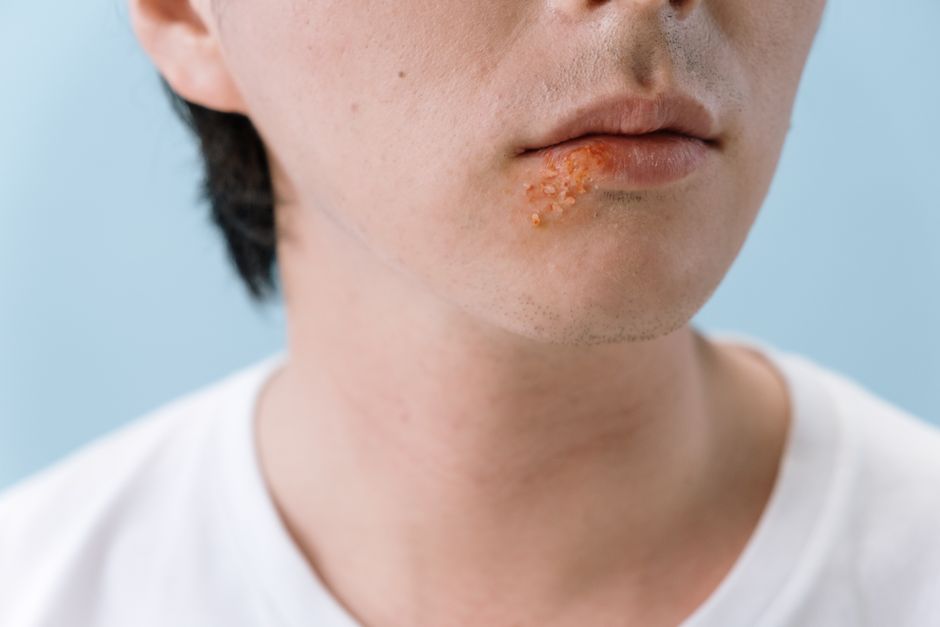
Cold sores spread through direct skin-to-skin contact with the virus that causes them, usually herpes simplex virus type 1 (HSV-1). The virus passes from person to person when an infected area touches broken or intact skin or the moist lining of the mouth, nose, or eyes. It can spread even when no blister is visible, which is why many people get infected without ever knowing how.
The virus is not spread through the air or by sharing a room with someone who has a cold sore. It needs contact. That single fact explains most of what follows.
How Do Cold Sores Spread Transmission Explained
HSV-1 moves from one person to another when the skin or mucous membranes touch. The virus lives in fluid inside the blister and also in saliva and skin cells of an infected person. When that fluid or those cells contact a receptive surface on someone else, the virus can enter and begin an infection.
A receptive surface is usually a break in the skin, however small, or a mucous membrane. Mucous membranes line the lips, the inside of the mouth, the nose, and the eyes. These areas lack the tough outer layer of skin, so the virus enters more easily.
The virus does not stay on the surface. It travels into nerve endings beneath the skin and moves along the nerve to a cluster of nerve cells called a ganglion. For HSV-1, that is usually the trigeminal ganglion near the ear. There the virus settles into a dormant state and can remain for life.
This is the part many people misunderstand. Once HSV-1 enters the body, it does not leave. The immune system can control it, and outbreaks can become rare, but the virus stays in the nerve cells. It can reactivate later and travel back down the nerve to the skin, causing another cold sore. That reactivation is also when a person can pass the virus on again.
Can You Spread Cold Sores Without a Visible Blister?
Yes. This is one of the most important facts about cold sore transmission, and it is the reason the virus is so common.
The virus can be present in saliva and on the skin even when there is no blister, no tingling, and no visible sign of an outbreak. This is called asymptomatic shedding. A person can carry HSV-1, feel completely normal, and still pass the virus to someone else through a kiss or shared object.
Some research suggests that a large share of HSV-1 transmission happens during these symptom-free periods. That does not mean the risk is equal at all times. When a blister is present, the amount of virus on the skin is much higher, and transmission is more likely. But the absence of a blister is not proof that a person cannot pass the virus on.
This is why asking a partner whether they have a cold sore right now does not fully answer the question. Many people who carry HSV-1 do not know they have it, because they have never had a noticeable outbreak.
What Activities Most Often Spread Cold Sores?
Direct contact with the mouth or face is the main route. The virus needs to reach a mucous membrane or broken skin, so activities that bring those surfaces together carry the most risk.
- Kissing — especially kissing a young child, who may not yet carry the virus.
- Sharing utensils, cups, or water bottles — saliva can carry the virus.
- Sharing lip balm, lipstick, or razors — these items contact the lips or skin directly.
- Touching a cold sore and then touching your own eyes, nose, or mouth — this can move the virus to a new site on your own body.
- Oral sex — HSV-1 can be passed to the genital area, causing genital herpes.
Sharing food is a gray area. If a utensil or a hand has touched a cold sore or infected saliva and then touches someone’s mouth, transmission is possible. Casual contact like sitting near someone, hugging, or using the same bathroom does not spread HSV-1.
One non-obvious point: the virus does not survive long on dry surfaces like doorknobs or countertops. It spreads through objects mainly when the object goes directly from one mouth to another, such as a shared cup or lip balm. It is not a surface-contamination virus in the way that cold and flu viruses can be.





When Is a Cold Sore Most Contagious?
A cold sore is most contagious when it is open and weeping fluid. That is when the concentration of virus on the skin is highest.
The contagious period usually begins about a day or two before the blister appears, during the tingling or itching stage. It stays high while the blister is present and weeping, and it drops as the sore crusts over and heals. Once the skin has fully healed, the risk of passing the virus on is much lower, though asymptomatic shedding can still occur at any time.
Because the virus is already present before the blister shows, a person can be contagious before they realize an outbreak is starting. That early stage is easy to miss.
How Long Does It Take for Symptoms to Appear After Exposure?
If a person develops symptoms after first exposure, they usually appear within a few days to about a week. The first outbreak tends to be the most noticeable, sometimes with fever, swollen neck glands, and several sores inside and around the mouth.
Not everyone gets symptoms at all. Many first infections cause nothing noticeable, or only a mild sore throat or a single small sore that heals without much attention. This is one reason so many adults carry HSV-1 without knowing it.
After the first infection, the virus stays dormant in the nerve cells. Later reactivations tend to be milder and often appear in the same spot each time, usually at the edge of the lip.
What Triggers a Cold Sore to Come Back?
Reactivation happens when the dormant virus travels back down the nerve to the skin. Several common triggers are linked to this, though the evidence for each varies.
- Fever or illness, which is why cold sores are sometimes called fever blisters
- Sun exposure and wind on the lips
- Physical or emotional stress
- Fatigue and lack of sleep
- Hormonal changes, including menstruation
- Skin injury or trauma to the lip area
These triggers are widely reported by people who get cold sores, but the research linking each one directly to reactivation is not equally strong. Sun exposure and fever have the clearest association. For others, the connection is based more on patient reports than on controlled studies.
Reactivation is not a sign that someone is unhealthy or that their immune system has failed. It is a normal part of how this virus behaves in the body.
How Can You Lower the Risk of Spreading Cold Sores?
Avoiding contact with the sore during an outbreak is the most effective step. When a blister is present, keep it away from other people’s skin, especially the mouth, eyes, and genitals.
- Do not kiss anyone while a sore is present, and avoid kissing babies and young children.
- Do not share cups, utensils, towels, or lip products.
- Wash your hands after touching the sore or applying any product to it.
- Avoid touching your eyes after touching the sore.
- Skip oral sex while a cold sore is active.
Because the virus can shed without symptoms, these steps reduce risk but do not remove it entirely. Someone who carries HSV-1 can still pass it on at other times. That is simply how the virus works, and it is not a sign that anyone did something wrong.
For people who get frequent outbreaks, some clinicians recommend antiviral medication. Whether it helps and how it is used is a decision for a doctor, since the benefits and the right approach depend on the individual.
Can Cold Sores Spread to Other Parts of Your Own Body?
Yes, and this is worth knowing. Touching an active cold sore and then touching another part of your body can move the virus to a new site.
The eyes are the main concern. HSV-1 can infect the eye, causing a condition called herpes keratitis, which can affect vision and needs medical care. If you have a cold sore, wash your hands before touching your face or eyes, and do not rub your eyes with a hand that has touched the sore.
The fingers can also become infected, though this is uncommon in adults. It is more of a concern in young children who suck their thumbs and in people who work with the mouth area, such as dental staff. A person who already carries HSV-1 and has antibodies is less likely to spread it to a new site on their own body, because the immune system has seen the virus before.
If a cold sore spreads near the eye or if you notice eye pain, redness, or blurry vision during an outbreak, see a doctor promptly rather than waiting it out.
Frequently Asked Questions
Can you get a cold sore from sharing a drink?
Yes, it is possible if the cup or bottle has touched infected saliva or a sore and then touches your mouth. The virus does not survive long on dry surfaces, so the risk comes from direct mouth-to-mouth sharing rather than from the object itself.
Are cold sores contagious when they are scabbed over?
They are much less contagious once they have crusted and healed, because the amount of virus on the skin drops. Some risk remains until the skin is fully repaired, and the virus can also shed at other times with no sore at all.
Can you spread cold sores to your genitals?
Yes, HSV-1 can be passed to the genital area through oral sex, where it can cause genital herpes. Avoiding oral contact while a cold sore is active lowers this risk but does not eliminate it.
How long are cold sores contagious?
A cold sore is most contagious from about a day before it appears until it has fully crusted and healed, which usually takes one to two weeks. The virus can also be passed during symptom-free periods, so the contagious window is not limited to a visible sore.
