
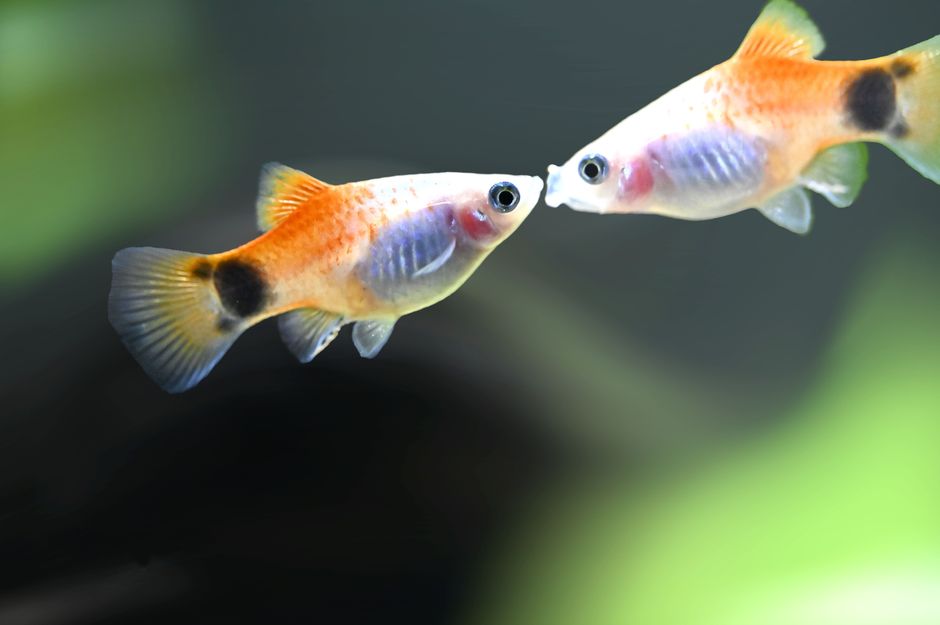
Black mollies mate when a male inserts his gonopodium into the female’s vent, transferring sperm that she stores internally. The female then develops fertilized eggs inside her body and gives birth to free-swimming fry roughly three to four weeks later. A single mating can produce multiple broods, because female mollies can store sperm for months.
How Do Black Mollies Mate And Give Birth To Fry?
Mollies are livebearers. That single fact explains most of what makes their reproduction different from egg-laying fish.
In most aquarium fish, the female releases eggs into the water and the male fertilizes them outside her body. Mollies do not do this. Fertilization happens inside the female, and the embryos develop there until they are ready to be born as fully formed fry. The process is closer to what happens in mammals than to what happens in most fish.
The male has a modified anal fin called a gonopodium. It is not a penis in the mammalian sense, but it serves a similar function. During mating, the male swings this fin forward and uses it to deliver sperm into the female’s vent. The whole act is fast, often lasting only a fraction of a second, and can be easy to miss in a busy tank.
Once sperm enters the female, she stores it in specialized tissue inside her reproductive tract. She can use that stored sperm to fertilize eggs for months without mating again. This is why a female molly bought from a store as a “single fish” can suddenly produce fry weeks later. She was almost certainly already pregnant when she left the store.
What Does Molly Mating Behavior Look Like?
Male mollies pursue females almost constantly. The behavior is hard to miss once you know what to look for.
A male will swim alongside or slightly behind a female, sometimes nudging her side or her vent area with his snout. He may tilt his body and flare his fins. The actual mating attempt is a quick sideways lunge where he swings the gonopodium forward. Females often respond by swimming away or by positioning themselves in a way that blocks access.
In tanks with several males and few females, the harassment can become intense. Females may hide, stop eating well, or show signs of stress. The common recommendation among experienced keepers is to keep at least two or three females for every male, and some keepers prefer to keep only females to avoid the issue entirely.
Females do not always cooperate. A female that is not receptive can avoid mating for a while, but male mollies are persistent and the female cannot always prevent it. This is one reason the sex ratio in a tank matters more for mollies than for many other community fish.
How Can You Tell If a Female Black Molly Is Pregnant?
A pregnant female molly develops a visible swelling in her abdomen and a dark area near her anal fin called the gravid spot.
The gravid spot is not a reliable sign on its own. In many female livebearers, a dark area near the anal fin is present whether or not the fish is pregnant, and in black mollies the whole body is already dark, which makes the spot hard to distinguish. Body shape is usually the better clue.
As the pregnancy advances, the female’s belly becomes noticeably rounded and boxy. Viewed from the front or from above, she looks wider than usual. A few days before giving birth, the belly often looks almost square rather than round, and the female may become less active or seek out quiet corners of the tank. Some females stop eating shortly before delivery.
None of these signs are precise. A female can look ready to give birth for several days before anything happens, and a female that shows no obvious signs can surprise you overnight. The most reliable indicator is a combination of body shape, behavior, and knowing that she has been housed with a male at some point.





How Long Is a Black Molly Pregnant Before She Gives Birth?
Gestation in mollies typically lasts around three to four weeks, though the exact timing varies with water temperature and the individual fish.
Warmer water tends to shorten the pregnancy. Cooler water tends to lengthen it. Because most home aquariums are kept in a fairly narrow temperature range, the variation is usually a matter of days rather than weeks. If you are trying to predict a due date, watch the female’s shape rather than counting days from a mating you may or may not have seen.
Females can give birth to successive broods without mating again between them. After one delivery, a female may produce another batch of fry a few weeks later using sperm she stored earlier. This can continue for several broods. In some cases, a female that has not been near a male for months will still deliver fry.
How Many Fry Does a Black Molly Have?
Brood size varies widely. A young or small female might produce a handful of fry. A large, mature female can produce several dozen.
There is no fixed number, and it is not useful to plan around one. What matters more is that fry are extremely vulnerable in a community tank. Adult fish, including the mother, will eat them. Many breeders move a pregnant female into a separate tank before she delivers, or use a breeder box that lets fry drop into a compartment the adults cannot reach.
If you leave the female in the main tank, expect heavy losses. Some fry usually survive by hiding in plants, but the number is unpredictable. Dense floating plants or fine-leaved plants like hornwort give fry places to hide and improve survival odds considerably.
What Do You Do With Black Molly Fry?
Fry are born ready to swim and eat. They do not need parental care, and the mother does not care for them.
Newborn fry are large enough to eat finely crushed flake food, powdered fry food, or live foods such as microworms and baby brine shrimp. Feeding small amounts several times a day supports faster growth. Water quality matters as much for fry as for adults, and uneaten food should be removed to avoid fouling the tank.
Fry grow quickly when well fed. Sex differences usually become visible as they mature, and males will begin showing the gonopodium and mating behavior. If you do not want more fish, separate the sexes before the young males reach maturity, or plan to rehome the offspring. Mollies breed readily, and a tank can become overcrowded faster than most people expect.
Common Myths About Molly Reproduction
A few ideas about molly breeding circulate widely and are not accurate.
- Myth: A female must mate again for each brood. She does not. Stored sperm can fertilize multiple batches of eggs over months.
- Myth: The gravid spot always means pregnancy. It is not a reliable indicator on its own, especially in dark-colored mollies.
- Myth: Fry need special care from the parents. They do not. Mollies provide no parental care, and adults will eat fry if given the chance.
- Myth: Mollies always give birth at night. Some deliveries happen at night, but there is no reliable rule. Fry can appear at any time.
The one thing worth remembering is that mollies are prolific. A single female can turn a small group into a crowded tank within a few months. Planning for that is more useful than trying to predict exact timing or brood size.
Frequently Asked Questions
How do black mollies mate?
The male uses a modified anal fin called a gonopodium to transfer sperm into the female’s vent. The act is brief and often happens without the keeper noticing.
How long after mating does a black molly give birth?
Gestation usually runs about three to four weeks, with warmer water tending to shorten it. Body shape is a better guide than counting days.
Can a black molly have babies without a male?
Yes, if she has mated at any earlier point. Females store sperm and can produce several broods over months without mating again.
Why do my molly fry keep disappearing?
Adult fish, including the mother, eat fry. Without dense plants or a separate rearing tank, most fry in a community aquarium do not survive.
