
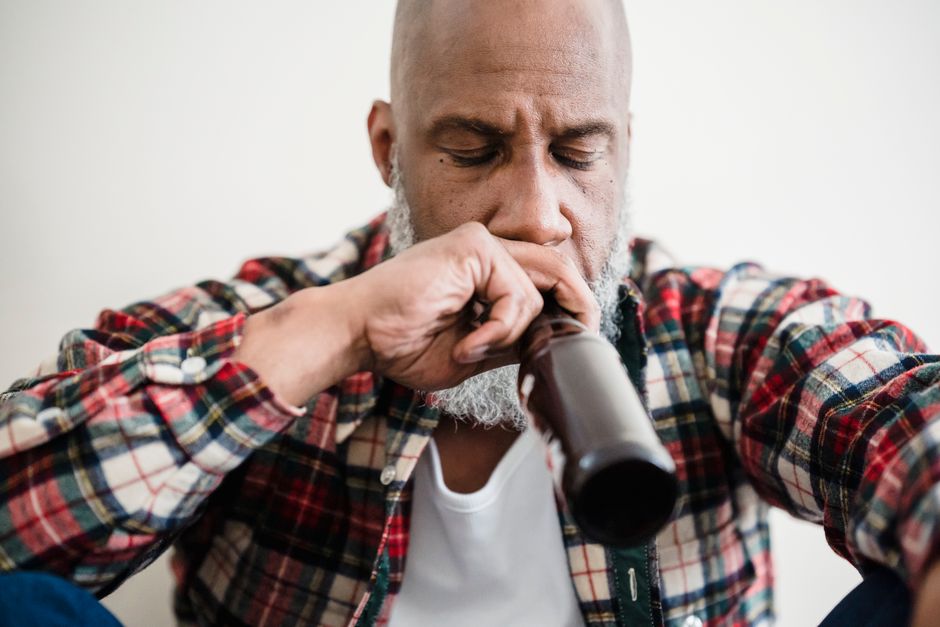
Alcohol changes how the brain learns, rewards, and decides. Over time, heavy drinking reshapes the brain circuits that govern motivation and self-control, so a person with alcohol use disorder often thinks in ways that look irrational from the outside but follow a predictable internal logic. The thinking patterns are not a personality flaw. They are the output of a brain that has been altered by repeated alcohol exposure.
How Do Alcoholics Think The Patterns Explained?
Alcohol use disorder is a recognized medical condition, not a moral failing or a simple lack of willpower. The thinking patterns that go with it come from measurable changes in brain function.
Alcohol affects several brain systems at once. The most important for understanding thinking patterns is the reward system, which runs largely on the neurotransmitter dopamine. Alcohol causes a release of dopamine that the brain registers as rewarding. With repeated heavy drinking, the brain adapts by producing less dopamine on its own and by reducing the sensitivity of dopamine receptors. The result is that ordinary pleasures — food, hobbies, relationships — feel flatter and less motivating.
At the same time, the prefrontal cortex, the part of the brain involved in planning, weighing consequences, and holding back impulses, becomes less effective at controlling urges. The amygdala and related stress circuits become more reactive. So a person is left with a reward system that pushes hard toward alcohol and a control system that has a harder time saying no.
This is why the thinking patterns below are not choices in the ordinary sense. They are the predictable result of a brain that has been reorganized around alcohol.
What Are the Main Thinking Patterns in Alcohol Use Disorder?
Several patterns show up again and again. They overlap, and not every person shows all of them, but they are common enough to recognize.
- Preoccupation. Thoughts about drinking take up more mental space than they should. A person may plan the day around when and where they can drink.
- Minimizing. Downplaying how much they drink or how much harm it causes. “I only drink on weekends” may ignore that the weekends are heavy.
- Rationalizing. Building reasons to drink. Stress, celebration, a bad day, a good day — almost anything becomes a justification.
- Denial. Genuinely not seeing the problem, or seeing it but not connecting it to their own behavior.
- Black-and-white thinking. “I already had one drink, so the day is ruined” can lead to drinking far more than planned.
- Catastrophizing. Expecting the worst if they stop drinking, which makes quitting feel impossible.
- Blame and externalizing. Attributing problems to other people or circumstances rather than to drinking.
These patterns are not unique to alcohol. Similar thinking appears in other substance use disorders and in some behavioral conditions. What makes them powerful in alcohol use disorder is that they are reinforced by a brain that has learned to treat alcohol as a primary need.
Why Does the Brain Prioritize Alcohol Over Everything Else?
Repeated heavy drinking trains the brain to treat alcohol as unusually important. This happens through a process sometimes called incentive sensitization.
Early on, drinking is about pleasure or relief. Over time, the brain starts to assign a kind of exaggerated salience to alcohol and to cues connected with it — a certain bar, a certain time of day, certain people. These cues trigger cravings before any drinking happens. The craving is not just wanting to feel good. It is a strong pull that feels like a need.
This is why a person can genuinely intend to have one drink and end up having many. The intention is real. The pull is stronger than the intention in that moment.
At the same time, the brain’s stress systems adapt to the presence of alcohol. When alcohol is removed, these systems become overactive, producing anxiety, irritability, and a sense of unease. Drinking relieves that unease, which teaches the brain that alcohol solves the problem it created. This cycle is a core feature of dependence.





How Does Denial Actually Work in the Brain?
Denial is often described as lying to oneself, but the mechanism is more subtle. It is partly a failure of self-awareness and partly a motivated blind spot.
The prefrontal cortex is responsible for self-monitoring and for comparing behavior against intentions. Heavy alcohol use impairs prefrontal function, so this comparison becomes less reliable. A person may genuinely not register the gap between what they intend and what they do.
There is also a motivational component. The brain is biased toward protecting the thing it has learned to need. Admitting a problem threatens access to alcohol, so the brain generates reasons to avoid that conclusion. This is not conscious deception. It is the brain doing what it has been trained to do.
This matters for how we talk to people with alcohol use disorder. Confrontation that assumes deliberate lying often backfires. Approaches that reduce shame and build motivation tend to work better, though the evidence on specific communication styles is mixed and depends on the person and situation.
Is the “Alcoholic Personality” a Real Thing?
No consistent “alcoholic personality” has been identified. Research has not found a single personality type that reliably predicts who will develop alcohol use disorder.
What research does show is that certain traits are associated with higher risk. These include impulsivity, sensation-seeking, and difficulties with emotional regulation. But association is not the same as cause, and many people with these traits never develop a drinking problem. Many people without them do.
Personality also changes with heavy drinking. Someone who was calm and reliable may become irritable and unreliable. This is often mistaken for a fixed personality when it is actually a consequence of the disorder and of the brain changes that come with it.
It is more accurate to talk about patterns of thinking and behavior that develop with the disorder than about a fixed personality type.
How Do Thinking Patterns Change in Recovery?
Thinking patterns can change, but the process takes time and usually involves more than simply stopping drinking. The brain has to relearn how to respond to reward, stress, and cues.
In early recovery, cravings and preoccupation often remain strong. This is expected. The brain circuits that were trained by years of drinking do not reset overnight. Cues can still trigger urges, and stress can still feel overwhelming without alcohol to blunt it.
Over time, with sustained abstinence or reduced drinking, many of these patterns weaken. The brain’s reward system begins to respond more normally to everyday pleasures. Prefrontal control improves. Stress responses settle. This is sometimes called neuroadaptation, and it is a gradual process measured in months, not days.
Relapse is common and is generally treated as part of the disorder rather than as a personal failure. It does not mean the person cannot recover. It usually means the treatment or support needs to be adjusted.
Treatment approaches that address thinking patterns directly include cognitive behavioral therapy, motivational enhancement therapy, and contingency management. Medications such as naltrexone and acamprosate are also used, and their effectiveness varies by person. No single approach works for everyone, and combining approaches is often more effective than any one alone.
Why Do These Patterns Look Like Excuses to Other People?
From the outside, the thinking patterns of alcohol use disorder can look like excuses, manipulation, or stubbornness. From the inside, they often feel like reasonable conclusions.
This gap causes a lot of pain in families. A partner may see clearly that drinking is causing harm. The person drinking may genuinely not see it the same way, or may see it but feel unable to act on it. Both can be true at once.
Understanding the mechanism does not excuse harmful behavior. It does change how we respond to it. Shame and blame tend to increase defensiveness, which strengthens denial. Approaches that focus on the person’s own goals and values, and that treat the disorder as a health condition, tend to be more productive.
It also helps to remember that the thinking patterns are symptoms, not the whole person. They can change with treatment, support, and time.
What Does the Evidence Actually Show?
The brain changes associated with alcohol use disorder are well documented in imaging and neuropsychological research. Reduced dopamine function, impaired prefrontal control, and altered stress circuitry are consistent findings in people with moderate to severe alcohol use disorder.
What is less certain is how these changes map onto specific thoughts in real time. Much of the research measures group averages, and individual variation is large. Not everyone with alcohol use disorder shows the same degree of change, and some people recover more fully than others.
The thinking patterns described here are well recognized in clinical practice and in the psychological literature. The precise brain mechanisms behind each pattern are still being studied. Treating them as fixed or fully understood would overstate what science currently knows.
What is clear is that alcohol use disorder is a medical condition with a biological basis, that it involves predictable patterns of thinking, and that it can be treated. That much is not in dispute.
Frequently Asked Questions
Is alcohol use disorder a choice or a disease?
It is a medical condition with a strong biological basis, though the person still makes choices within that condition. The brain changes caused by heavy drinking make those choices harder, not absent.
Can someone with alcohol use disorder think normally again?
Many people show improvement in thinking, mood, and self-control with sustained abstinence or reduced drinking. The process is gradual and varies widely between individuals.
Why do alcoholics deny they have a problem?
Denial is partly a result of impaired self-awareness and partly the brain protecting its learned need for alcohol. It is usually not deliberate lying.
Does everyone who drinks heavily develop these thinking patterns?
No. Risk depends on genetics, drinking patterns, mental health, and other factors. Not everyone who drinks heavily develops alcohol use disorder.
