
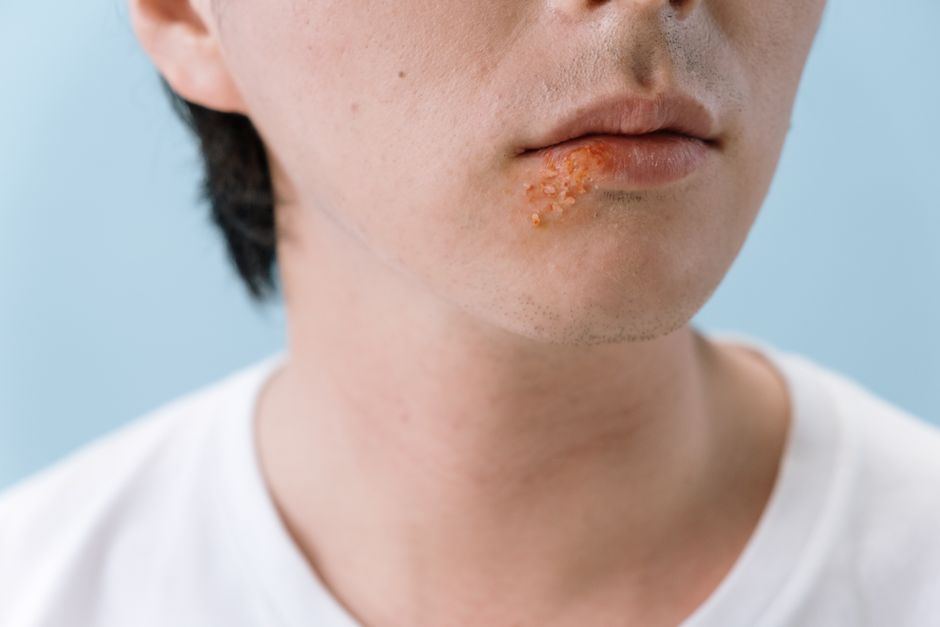
You woke up, felt that familiar tingle, looked in the mirror, and there it is — a cold sore. If you are wondering how you got this cold sore, the answer is almost certainly the herpes simplex virus type 1 (HSV-1). Most people get it during childhood through ordinary, non-sexual contact like a kiss from a relative or sharing a cup. The virus then stays in your body for life, mostly dormant, occasionally reactivating as a cold sore when your immune system is under pressure.
That is the short version. The longer version explains why it happened now, why it keeps happening, and what actually helps.
What Actually Causes a Cold Sore?
Cold sores are caused by the herpes simplex virus. Two types exist: HSV-1 and HSV-2. HSV-1 is responsible for the large majority of cold sores around the mouth. HSV-2 is more commonly associated with genital herpes, though it can also cause oral sores in some cases.
The virus does not live on your skin surface. It travels along nerve pathways and settles into a cluster of nerve cells called the trigeminal ganglion, near the base of your skull. There it stays permanently. Your immune system keeps it in check most of the time, but it never fully clears the virus.
This is why cold sores come back. It is not a new infection each time. It is the same virus reactivating.
How Did I Get This Cold Sore in the First Place?
You got it through direct skin-to-skin contact with someone who was shedding the virus. That contact likely happened years or even decades before your first noticeable cold sore.
The most common routes of transmission include:
- Being kissed on the face or mouth by a relative as a child
- Sharing eating utensils, cups, water bottles, or straws
- Sharing lip balm, lipstick, or towels
- Touching a cold sore on someone else and then touching your own mouth or face
Here is the part many people do not know: the virus can spread even when no sore is visible. This is called asymptomatic shedding. A person can carry HSV-1 and never show symptoms, yet still pass it to others. Research suggests a large share of HSV-1 transmission happens during these invisible shedding periods.
By adulthood, a majority of people worldwide carry HSV-1. Many have never had a noticeable cold sore and may not know they carry it.
Why Did I Get a Cold Sore Now?
The virus reactivates when your immune system’s grip on it loosens. Several well-recognized triggers can set this off.
- Illness or fever — this is why they are called “cold sores” or “fever blisters.” A cold, flu, or infection can give the virus an opening.
- Emotional stress — sustained stress affects immune function in ways that can allow reactivation.
- Physical stress or injury — surgery, dental work, or trauma to the lip area can trigger an outbreak.
- Sun exposure and UV light — ultraviolet radiation is a well-documented trigger. Sunburn on the lips is a common culprit.
- Hormonal changes — some people notice outbreaks around menstruation.
- Fatigue and poor sleep — sleep strongly influences immune regulation.
- Weakened immunity — from illness, certain medications, or medical conditions that suppress immune function.
Not everyone reacts to the same triggers. Some people identify their pattern over time. Others never figure out what sets theirs off.
The first outbreak is usually the worst. It often happens in childhood and can include fever, swollen lymph nodes, and multiple sores inside and around the mouth. Later outbreaks tend to be milder and shorter.





Is a Cold Sore the Same as a Canker Sore?
No. They are different conditions with different causes, and confusing them is common.
A cold sore is caused by a virus. It usually appears on or near the outer lip, is contagious, and often starts with a tingling or itching sensation before a blister forms.
A canker sore is not caused by a virus and is not contagious. It appears inside the mouth — on the tongue, gums, or inner cheek — and typically has a white or yellow center with a red border. The exact cause of canker sores is not fully understood, though stress, certain foods, and minor mouth injury are often associated with them.
This distinction matters because the two require different approaches. Antiviral treatments help cold sores. They do nothing for canker sores.
How Long Does a Cold Sore Last and What Helps?
A typical cold sore runs its course in about one to two weeks. It usually moves through stages: tingling, blistering, weeping, crusting, and finally healing.
Antiviral medications can shorten outbreaks and reduce severity when started early. Options include topical creams and oral medications. Oral antivirals generally work better than creams for reducing how long an outbreak lasts. These are prescription medications in the United States, so you would need to see a clinician.
Some clinicians recommend starting an antiviral at the first tingle, before the blister appears. That timing matters because the medication works best when the virus is actively replicating. Once the sore is fully formed, antivirals have less impact on that particular outbreak.
For people who get frequent outbreaks, some clinicians prescribe daily antiviral therapy to reduce how often they occur. This is a recognized approach, though whether it is appropriate depends on individual circumstances.
Over-the-counter options like topical anesthetics can ease pain but do not shorten the outbreak. Docosanol is an over-the-counter cream that some studies suggest may modestly shorten healing time, though the evidence is not strong.
Basic care that may help:
- Keep the area clean and avoid picking at the sore
- Apply a cold compress for comfort
- Use lip balm with sun protection to prevent UV-triggered outbreaks
- Avoid touching the sore, and wash your hands if you do
- Do not share utensils, towels, or lip products during an outbreak
Can I Prevent Spreading a Cold Sore to Others?
Yes, you can reduce the risk, though you cannot eliminate it entirely because the virus can shed without visible symptoms.
During an active outbreak, the virus is most contagious from the moment you feel the tingle until the sore has completely healed and new skin has formed. During that window:
- Avoid kissing, especially babies and young children
- Do not share cups, utensils, straws, or water bottles
- Do not share lip balm, lipstick, or towels
- Wash your hands frequently, particularly after touching your face
- Avoid touching your eyes — HSV can cause a serious eye infection if it reaches the eye
For people with active cold sores, the risk to newborns is a genuine concern. Neonatal herpes is rare but serious. Anyone with a cold sore should avoid close contact with a newborn, and this is standard guidance from pediatric and obstetric organizations.
When Should I See a Doctor About a Cold Sore?
Most cold sores do not need medical attention. But some situations warrant a call to a clinician.
- The sore is severe, widespread, or does not heal within two weeks
- You have a weakened immune system due to a medical condition or medication
- Sores appear near or in your eyes
- You have frequent outbreaks that disrupt your daily life
- You are unsure whether the sore is a cold sore or something else
A clinician can confirm the diagnosis and discuss whether antiviral treatment is appropriate for you.
Frequently Asked Questions
Can I get a cold sore without kissing anyone?
Yes. The virus spreads through shared items like utensils, cups, or lip balm, and it can also be passed through asymptomatic shedding from someone who has no visible sore. You may have been infected years before your first outbreak.
Are cold sores contagious when there is no blister?
Yes. The virus can shed from the skin even when no sore is visible, which is called asymptomatic shedding. This is why transmission can happen without either person realizing the virus is active.
How long is a cold sore contagious?
A cold sore is most contagious from the first tingle until the sore has fully crusted over and healed, which typically takes one to two weeks. The virus can also shed at other times without symptoms.
Can stress really cause a cold sore?
Yes. Emotional and physical stress can affect immune function in ways that allow the dormant virus to reactivate. Many people identify stress as one of their personal triggers.
