
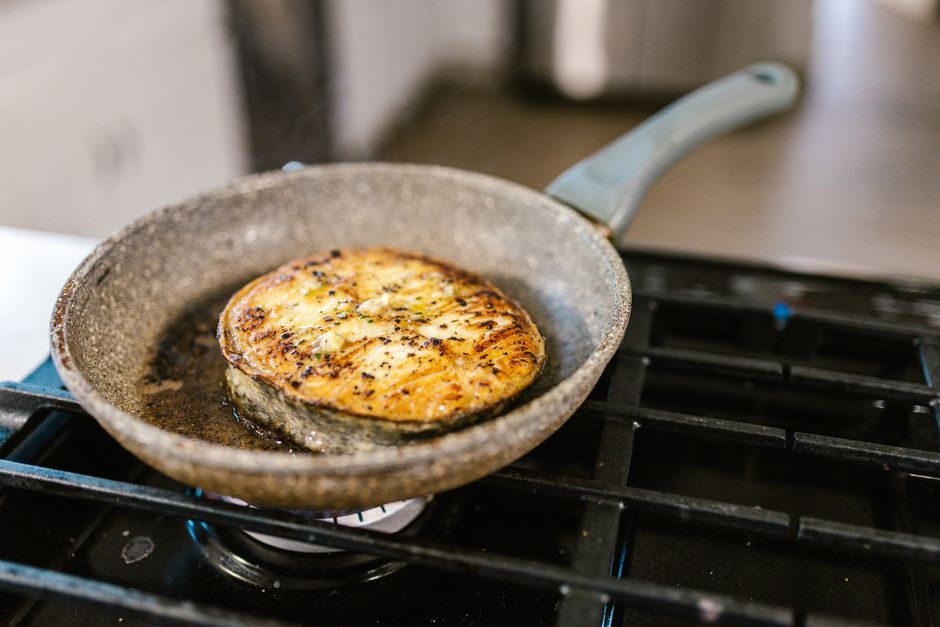
Salmon is done when its internal temperature reaches 145°F (63°C), measured with a food thermometer in the thickest part of the fish. At that temperature, the flesh turns opaque, separates into flakes, and any translucent or gelatinous raw texture is gone. You can also judge doneness by appearance and texture, but a thermometer is the only method that confirms it reliably.
Why Temperature Is the Most Reliable Way to Check Salmon
The U.S. Food and Drug Administration and the USDA both set 145°F (63°C) as the safe minimum internal temperature for fish. That number is not a matter of chef preference. It is the point at which foodborne pathogens of concern in fish, including Listeria and various parasites, are killed under normal cooking conditions.
Visual cues can mislead. Salmon flesh changes color depending on the specific fish, its diet, whether it was wild or farmed, and how it was handled. A fillet that looks pale and opaque on the outside may still be cooler in the center than it appears. A fillet that looks slightly translucent may already be at temperature.
The thermometer removes that guesswork. Insert the probe into the thickest part of the fillet, away from bone and away from the pan or grill surface. If you are cooking a whole fish, check behind the head or in the thickest section of the body. For thin fillets, approach from the side so the probe sits in the center rather than poking through.
One clarification that surprises many home cooks: carryover cooking is real but modest in fish. A salmon fillet will rise a few degrees after it leaves the heat. That is one reason some cooks pull it slightly below target. But if food safety is the goal, the temperature has to actually reach 145°F at some point. Pulling a fillet at 120°F and hoping it climbs to 145°F off the heat is not a safe assumption.
How Can You Tell If Salmon Is Done Without a Thermometer?
Without a thermometer, you are estimating. That is worth saying plainly, because the visual and tactile cues people rely on are real but not exact. They tell you the salmon is probably cooked. They do not confirm it.
With that caveat, here is what cooks look for:
- Color: Raw salmon is translucent and glossy. Cooked salmon is opaque. The change from translucent to opaque happens as the proteins denature, and it moves from the outside in.
- Flaking: When the flesh separates into distinct flakes with light pressure from a fork, it is likely done. If it resists and looks smooth and dense, it is undercooked. If it crumbles apart with no resistance, it is overcooked.
- Texture at the center: A properly cooked fillet is firm but still moist. A raw center feels springy and gelatinous.
- White beads on the surface: The white protein that sometimes oozes out is albumin. It appears when the fish is cooked, but it also appears in overcooked fish, so it is a weak signal on its own.
Notice that these cues cluster together. One alone is unreliable. Several together give you a reasonable estimate. None of them replace a thermometer if you are cooking for anyone at higher risk from foodborne illness.
What Does Undercooked Salmon Look Like?
Undercooked salmon looks translucent in the center, often with a deeper, more saturated color than the cooked edges. The flesh may look glossy or wet. When you press it, it feels soft and springy rather than firm. It may not flake at all, or it may flake only at the thin edges while the middle stays intact.
This is the appearance many people associate with “medium” or “medium-rare” salmon, which is a common restaurant preparation. It is also, from a food safety standpoint, undercooked. The distinction matters because the two are easy to confuse.
Raw and undercooked fish can carry parasites and bacteria. For most healthy adults, the risk from a piece of fresh, well-handled fish is low but not zero. For pregnant women, young children, older adults, and people with weakened immune systems, the risk is meaningfully higher. Those groups are advised to eat fish only when it has been cooked to a safe internal temperature.
Freezing fish at the right temperature for the right duration can kill parasites, which is why some sushi-grade fish is considered safer raw. That process does not kill all bacteria, and it is not something most home freezers do reliably. It is also not a substitute for cooking when you are actually cooking.
What Does Overcooked Salmon Look Like?
Overcooked salmon looks pale, dry, and chalky. The flakes separate too easily and may fall apart when you lift the fillet. A lot of white albumin has usually pushed to the surface, giving it a frothy, curdled look. The texture is dense and fibrous rather than silky.
The irony is that overcooked salmon is often the result of trying to be safe. Cooks who fear undercooking tend to leave fish on the heat too long. The gap between perfectly done and overcooked salmon is narrow, often just a minute or two depending on thickness and heat.
If your salmon is dry, it is still safe to eat. Doneness and quality are two different questions. A fillet at 160°F is well past ideal texture but carries no additional safety benefit over one at 145°F.
Does the Cooking Method Change How You Check?
The target temperature does not change. 145°F is 145°F whether you bake, grill, poach, pan-sear, or cook sous vide. What changes is how quickly you get there and where the heat comes from.
Baking and roasting cook from the outside in, so the center is the last part to reach temperature. Check there.
Grilling adds direct high heat and can char the surface while the center lags. A fillet that looks done on the grill marks may still be cool inside.
Poaching uses gentler, more even heat. The fish cooks more uniformly, but the center still needs to hit 145°F.
Sous vide holds a precise water temperature for a set time. If you set the bath to 145°F, the fish will reach that temperature throughout given enough time. Many cooks who use this method choose lower temperatures for texture, which is a personal choice and not a food safety recommendation.
Pan-searing is fast and uneven. The side touching the pan cooks quickly while the top stays cooler. Check the thickest point, not the seared surface.
How Thick Should the Fillets Be for Even Cooking?
Thickness drives cooking time more than any other factor. A thin fillet can go from raw to overcooked in under two minutes. A thick center-cut piece may take considerably longer.
Uneven thickness is the most common reason one end of a fillet is dry while the other is underdone. If your piece is thicker at one end, you have a few options. You can fold the thin tail section under itself so the fish cooks more evenly. You can cut the fillet into portions of similar thickness. Or you can start the thick end in the pan first.
For whole fish, the same principle applies. The area behind the head is the thickest and takes the longest. By the time the tail is done, the head section may still be behind. Checking the thickest part is the only way to know.
The exact minutes per inch vary too much by method and starting temperature to give a single reliable number. A thermometer sidesteps the problem entirely.
Does Resting Salmon Matter?
Resting matters less for salmon than for a large roast, but it is not pointless. A short rest of a few minutes lets the temperature equalize and the juices redistribute slightly. It also lets carryover cooking finish its work.
The risk of a long rest is that the fish keeps cooking and drifts past the texture you wanted. For a fillet, a couple of minutes is usually enough. For a whole fish, a few minutes is reasonable.
Resting does not change the safety picture. If the fish reached 145°F before resting, it is done. If it did not, resting will not fix that.
Is 145°F the Right Target for Everyone?
For food safety, yes. The FDA and USDA both list 145°F as the minimum safe internal temperature for fish, and that applies to all consumers.
For texture, the answer is more personal. Many cooks prefer salmon cooked to a lower temperature because it stays moister and silkier. That is a legitimate preference, and it reflects a trade-off between texture and safety margin. It is not a food safety recommendation, and it should not be treated as one.
If you are cooking for someone in a higher-risk group, stick to 145°F. If you are a healthy adult cooking for yourself and you prefer a softer texture, that is your call to make with full information. What you should not do is assume that a lower temperature is equally safe because a restaurant serves it that way.
Frequently Asked Questions
What temperature should salmon be cooked to?
Salmon should reach an internal temperature of 145°F (63°C), according to FDA and USDA food safety guidance. Measure it in the thickest part of the fillet with a food thermometer.
Can you eat salmon if it looks translucent in the middle?
Translucent flesh in the center means the fish has not reached a safe internal temperature. It is undercooked from a food safety standpoint, even if it looks like a typical restaurant preparation.
How long does salmon take to cook?
Cooking time depends heavily on thickness, method, and starting temperature, so no single time is reliable. A food thermometer is the only way to confirm doneness.
Is it safe to eat salmon that is slightly pink inside?
A slight pink tint can remain even in fully cooked salmon, because the color comes from pigments in the flesh. The reliable sign of safety is the internal temperature, not the color.
