
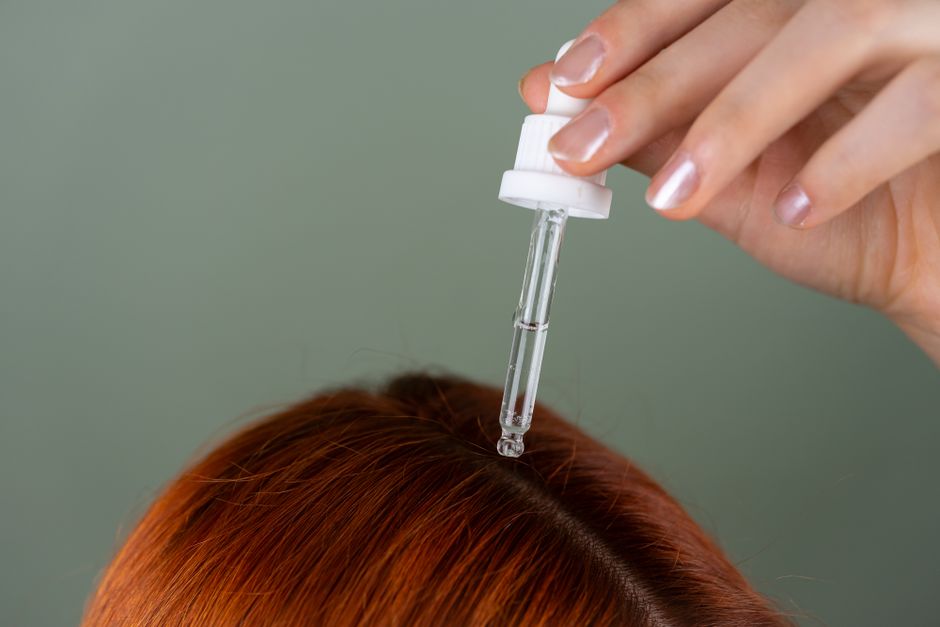
Hair grows about half an inch per month, and no product changes that fundamental rate. What you can do is remove the things slowing it down, support the biology it depends on, and treat any underlying condition that has shifted hairs into a resting or shedding phase. Most people who feel their growth has stalled are dealing with one of those three problems, not a genuinely slow scalp.
How Fast Does Hair Normally Grow?
Scalp hair grows roughly 0.35 millimeters per day, which works out to about half an inch per month or six inches per year. That figure comes from decades of trichology research and is about as settled as anything in this field.
Each follicle cycles through three phases. The growth phase, called anagen, lasts two to seven years for scalp hair. Then comes a short transition phase, and finally telogen, a resting phase of roughly three months before the hair sheds and the cycle restarts. At any given time, most of your hair is in anagen. That is why you do not shed everything at once.
Two things follow from this. First, the length you can grow is largely set by how long your personal anagen phase lasts, which is genetic. Second, if a large number of follicles get pushed into telogen at the same time, you will see a shed roughly three months later. That delay is why people often cannot connect a stressful event to their hair loss.
What Actually Slows Hair Growth?
The most common causes are nutritional deficiencies, thyroid problems, hormonal shifts, and a group of conditions that cause inflammation or scarring of the follicle. Identifying which one applies to you matters more than any topical product.
- Iron deficiency — ferritin levels at the low end of normal have been linked to telogen effluvium and to slower regrowth, particularly in women.
- Thyroid dysfunction — both an underactive and overactive thyroid can cause diffuse shedding.
- Protein and calorie restriction — severe dieting or very low protein intake shifts follicles into resting phase.
- Telogen effluvium — a stress response to illness, surgery, childbirth, or major emotional stress that typically appears about three months after the trigger.
- Androgenetic alopecia — pattern hair loss driven by genetics and hormones, which gradually shrinks follicles rather than stopping growth outright.
- Alopecia areata — an autoimmune condition causing patchy loss.
- Traction and chemical damage — tight hairstyles and repeated chemical processing can damage follicles over time.
One clarification worth making: shedding and slow growth are not the same problem. If you are losing more hair than usual, the issue is usually cycle disruption. If your hair is growing but breaking, the issue is the hair fiber itself, not the follicle. Those need different solutions.
Can You Actually Make Hair Grow Faster?
No product has been shown to increase the rate at which a healthy follicle produces hair beyond its genetic set point. What treatments can do is shorten the resting phase, extend the growth phase, or reverse follicle miniaturization.
Minoxidil is the most studied topical option. It is available over the counter and has evidence supporting its use in androgenetic alopecia. It appears to prolong the growth phase and widen the follicle. It does not work for everyone, results take several months to appear, and hair loss typically returns if you stop using it.
Prescription treatments for pattern hair loss include oral medications that affect androgen signaling. These require a clinician’s involvement because of side effects and because they are not appropriate for everyone, including people who may become pregnant. Finasteride is not for use in women of childbearing potential.
Low-level laser devices have some supporting evidence for pattern hair loss, though study quality varies and results are generally modest. Platelet-rich plasma injections are used in some dermatology practices. The evidence base is growing but still not strong enough to call it a first-line treatment.
What does not have evidence: biotin supplements in people who are not deficient, most “hair growth” shampoos, and scalp massage devices marketed with specific growth claims. Biotin deficiency is rare in people eating a normal diet, and taking extra biotin does not speed growth in someone with normal levels. High-dose biotin can also interfere with certain lab tests, including some thyroid and cardiac assays, which is a real clinical concern.
What Role Does Diet Play?
Nutrition matters most when you are deficient. Correcting a deficiency can restore normal growth. Adding nutrients you already have enough of generally does not.
The nutrients with the clearest links to hair cycling are iron, zinc, vitamin D, and adequate protein. Vitamin B12 and folate matter as well, particularly for people with restricted diets or absorption problems. The evidence for these is strongest in the context of correcting documented deficiencies rather than as general growth boosters.
Severe calorie restriction is a common and often overlooked cause. When the body is underfed, it prioritizes functions more immediately important than hair production. Hair shedding after rapid weight loss is well documented.
If you suspect a deficiency, testing matters more than guessing. Ferritin, a complete blood count, thyroid function, vitamin D, and B12 are reasonable starting points. Which of these your clinician orders should depend on your history.
Does Stress Really Affect Hair Growth?
Yes, and the mechanism is well established. Psychological or physical stress can push follicles into the resting phase prematurely. The shed appears roughly three months later, which is why the connection is often missed.
This type of shedding, telogen effluvium, is usually temporary. Once the trigger resolves, hair typically returns to its normal cycle over several months. It can take six to twelve months for density to feel normal again. That timeline is frustrating but it is the honest one.
Chronic stress is a different story. Ongoing stress, poor sleep, and the associated changes in eating and self-care can compound the problem. There is also research suggesting stress hormones influence the hair follicle directly, though the details are still being worked out.
When Should You See a Doctor?
See a clinician if you notice sudden or patchy hair loss, loss accompanied by scalp pain, scaling, or redness, or hair loss that continues for more than a few months without an obvious cause.
Patchy loss, in particular, warrants evaluation. It can indicate alopecia areata or a scarring form of hair loss, and scarring alopecia can be permanent if not treated early. That is the main reason not to wait and see.
For pattern hair loss, earlier treatment generally produces better results because the goal is to preserve follicles that are still functioning. Once a follicle has fully miniaturized, treatments are much less likely to restore it.
If you are pregnant, breastfeeding, or trying to conceive, do not start any hair treatment without talking to your clinician first. Options are limited in these groups, and some medications are contraindicated. No clinical guidelines currently support most hair-growth supplements during pregnancy or breastfeeding.
What Helps and What Does Not
| Approach | What the evidence shows |
|---|---|
| Treating a diagnosed deficiency (iron, zinc, vitamin D, B12) | Restores normal growth when a deficiency is present |
| Minoxidil (topical) | Evidence supports use in pattern hair loss; results take months and reverse on stopping |
| Prescription oral treatments | Evidence supports use in specific forms of pattern hair loss; requires medical supervision |
| Low-level laser therapy | Some supporting evidence; results generally modest |
| PRP injections | Growing but limited evidence; not a first-line option |
| Biotin in non-deficient people | No evidence of benefit; can interfere with lab tests |
| Most growth shampoos and serums | No clinical evidence of increased growth rate |
The pattern here is consistent. Effective approaches either correct a specific problem or act on the follicle cycle through a known mechanism. Products that promise faster growth without addressing either are not supported by evidence.
What About Gentle Hair Care?
Gentle handling will not make hair grow faster, but it prevents breakage that makes growth look slower than it is. If your hair is breaking at the ends, you will never see the length you are capable of growing.
Avoid tight styles that pull at the roots, especially braids, tight ponytails, and extensions worn continuously. Limit heat styling and chemical treatments. These steps protect the hair you have rather than changing the rate at which it grows.
Regular trims do not speed growth either, despite the common belief. What they do is remove split ends before they travel up the shaft, which can make hair look fuller and prevent length loss from breakage.
Frequently Asked Questions
Can you speed up hair growth naturally?
You cannot change the genetic growth rate of a healthy follicle, but correcting a deficiency, managing stress, and eating enough protein can restore growth that has slowed. If nothing is wrong, there is no natural method shown to make hair grow faster than its set rate.
Does biotin make hair grow faster?
No evidence shows biotin speeds hair growth in people who are not deficient, and deficiency is rare in people eating a normal diet. High-dose biotin can also interfere with certain lab tests, so tell your clinician if you take it.
How long does it take to see results from hair growth treatment?
Most treatments take several months before visible change, because the follicle cycle moves slowly. Telogen effluvium from a stress trigger typically resolves over six to twelve months once the trigger is gone.
Does cutting your hair make it grow faster?
No. Trimming removes split ends and can prevent breakage, but it has no effect on the rate at which hair grows from the follicle.
