
Let’s get straight to the facts. A fully grown adult horse typically measures between 15 and 20 inches (about 38 to 50 centimeters) in length when erect, and roughly 1.5 to 2 inches in diameter. That is genuinely large by any human comparison, but the popular internet figure of “two feet” or more is an exaggeration. The real answer is more modest and more interesting than the viral claims.
How Big Is A Horse Cock?
The most reliable figures come from veterinary anatomy and equine reproduction literature, not from internet rumor. Across most adult horse breeds, erect length falls in the 15 to 20 inch range, with some large draft breeds reaching slightly beyond that and smaller pony breeds measuring less.
Diameter is where the horse differs most from human anatomy. The stallion’s penis is thick and expands noticeably at the head during erection, because the tissue there is erectile and swells when blood fills it. That flared, mushroom-shaped end is called the glans penis, and it plays a real role in mating.
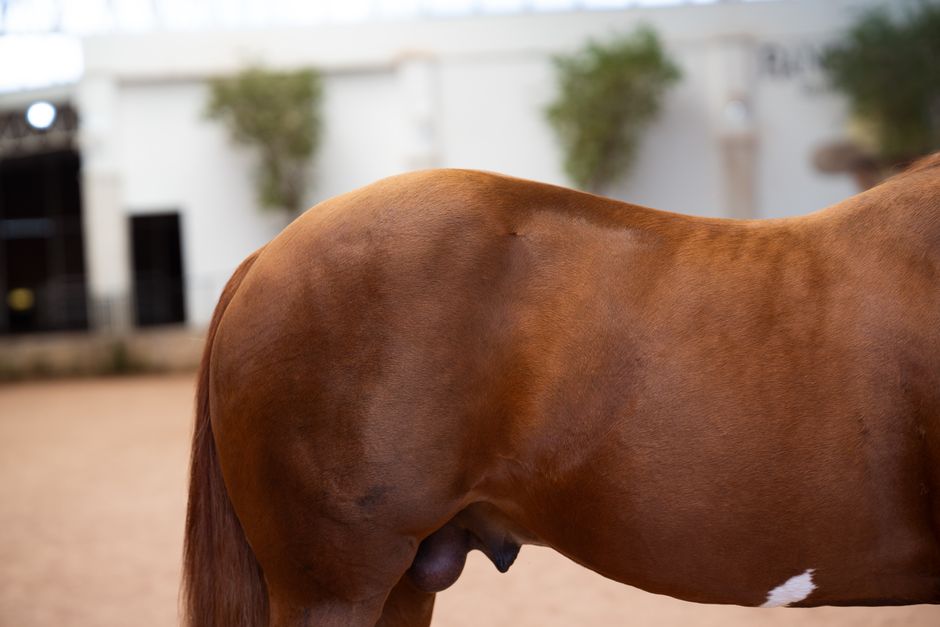
One point that surprises people: the horse penis is not stored outside the body. It rests inside a sheath called the prepuce, and only emerges when the horse is sexually aroused, urinating, or sometimes just relaxed. A horse walking around normally is not showing anything close to its full size.
This is a genuine clarification worth making. Much of what people picture when they ask this question is based on stallions in a state of arousal, which is not the everyday state. A relaxed horse looks very different from the anatomy described in the figures above.
Is the “Two Feet” Claim About Horse Size True?
No. The widely shared claim that a horse’s penis reaches two feet or more is not supported by veterinary measurements. The figure appears to have grown through repetition online rather than from any anatomy study.
That does not mean the number is impossible in every case. Very large draft breeds such as Clydesdales and Shires are bigger animals overall, and a large individual could measure toward the upper end of the range. But treating two feet as a typical or average figure is simply wrong.
Some of the confusion comes from mixing up different measurements. Length measured along the curve of the penis is longer than a straight-line measurement. Reports that quote one figure and reports that quote another may both be honest but are measuring differently. The 15 to 20 inch range reflects standard straight-line measurement in the erect state.
Why Did Horses Evolve Such Large Anatomy?
The size is a product of body scale and mating biology, not a special adaptation for display. Larger animals generally have proportionally larger reproductive organs, and the horse is a large animal.
The shape matters more than the raw size. The flared glans and the volume of ejaculate are adaptations related to how horses reproduce. A stallion deposits semen deep within the mare’s reproductive tract, and the swelling at the tip is thought to help with that process. The anatomy is built for the mechanics of equine reproduction, which is a different system from the human one.
It is easy to assume bigger means more impressive in some general sense. In biology, reproductive anatomy is shaped by what works for that species, and there is no meaningful comparison to be drawn between how a horse is built and how a human is built. They are solving different problems.





How Does Horse Size Compare to Human Anatomy?
The gap is substantial but often overstated in popular discussion. Average human erect length is well documented in medical literature, and the horse figure runs several times larger in both length and girth.
A comparison table helps show the difference clearly. These are general ranges from anatomy and veterinary sources, not precise measurements for any individual.
| Measure | Human (average adult) | Horse (adult, erect) |
|---|---|---|
| Length | Roughly 5 to 6 inches | Roughly 15 to 20 inches |
| Diameter | Roughly 1.5 inches | Roughly 1.5 to 2 inches |
| State at rest | External | Retracted inside the prepuce |
Notice that diameter is closer than length. The horse is dramatically longer, but the difference in girth is smaller than many people assume. Length is where the two diverge most sharply.
Human figures vary by individual and by how they are measured, and the same is true for horses. Averages hide a wide range. Anyone quoting a single number as if it applies to every individual is oversimplifying.
What Should You Know About Horse Anatomy and Health?
The horse’s reproductive anatomy is also a site of real veterinary concern. Because the penis stays inside the prepuce most of the time, problems can develop that owners do not notice right away.
One common issue is the buildup of a waxy substance called smegma inside the sheath. It is normal in small amounts, but heavy accumulation can cause irritation or discomfort. Some horses develop swelling of the sheath, discharge, or difficulty urinating. These are signs that a veterinarian should examine the horse, not something to treat at home with guesswork.
Another condition vets see is paraphimosis, where the penis cannot retract back into the sheath. This can happen after swelling or injury and is a medical concern that needs prompt veterinary attention. Priapism, a persistent erection that does not resolve, is also a recognized problem in horses.
These are not rare curiosities. They are part of routine equine health care, and owners are often advised to check the sheath area periodically. The exact cleaning schedule and method are best discussed with a veterinarian, because improper cleaning can cause more harm than good.
Why Does This Question Get So Much Attention?
Curiosity about animal anatomy is normal, and the internet has amplified it. The horse question circulates widely because the numbers sound extreme and because the topic is a bit taboo, which makes it memorable.
What gets lost in the sharing is accuracy. Exaggerated figures spread faster than measured ones, and a claim repeated enough times starts to feel true. That is how a 15 to 20 inch range becomes “two feet” in popular retelling.
There is also a tendency to treat animal anatomy as a benchmark for human anatomy. That comparison does not hold up. Horses and humans have different body sizes, different reproductive systems, and different evolutionary pressures. The horse’s anatomy is suited to the horse, and it says nothing meaningful about human bodies.
If you came here with a genuine question about horses, whether for writing, curiosity, or animal care, the honest figures are the ones above. The dramatic versions floating around online are not backed by veterinary measurement.
Frequently Asked Questions
How long is a horse’s penis when erect?
Most adult horses measure roughly 15 to 20 inches in length when erect, based on veterinary anatomy sources. Very large draft breeds may reach slightly beyond this range.
Is a horse penis really two feet long?
No, the common “two feet” claim is an exaggeration not supported by veterinary measurements. The typical range is closer to 15 to 20 inches.
Is a horse’s penis always visible?
No, it normally stays retracted inside a sheath called the prepuce and only emerges during arousal, urination, or relaxation. A relaxed horse does not display its full anatomy.
Do horses have health problems with their sheath?
Yes, smegma buildup, swelling, and conditions where the penis cannot retract are recognized veterinary concerns. Owners should have a veterinarian check any discharge, swelling, or difficulty urinating.
