
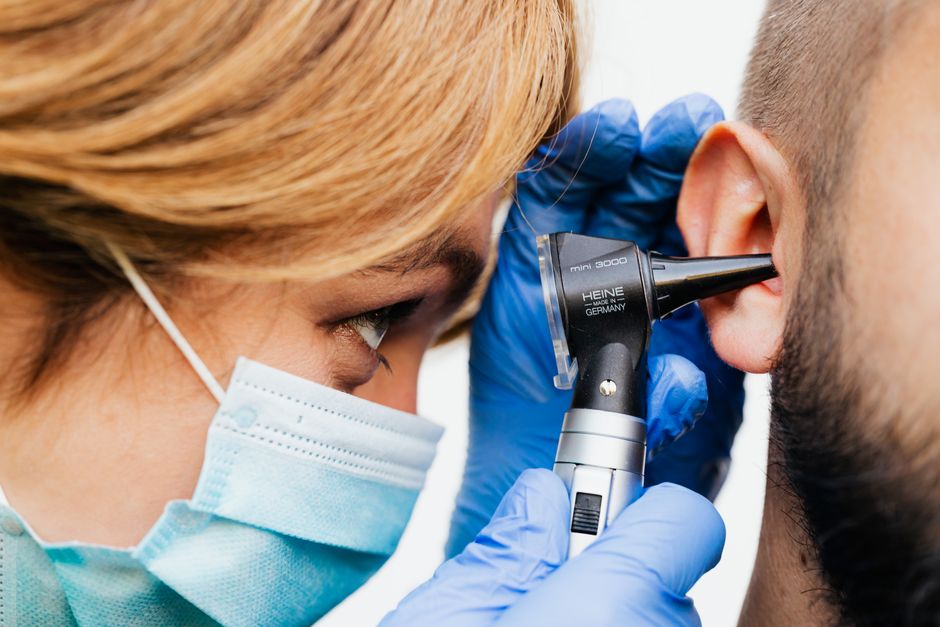
If you or your child struggles to understand speech in noisy rooms, follow spoken directions, or learn to read, you may be wondering about auditory processing disorder. Audiologists test for auditory processing disorder using a battery of specialized listening tests that evaluate how the brain interprets sound, not just how well the ears hear it. The process takes two to three hours and requires a person to be alert and cooperative, which is why testing is typically reserved for children aged 7 and older and adults.
What Happens Before the Auditory Processing Test
An auditory processing evaluation does not start with the listening tests. It starts with a comprehensive hearing exam to rule out a traditional hearing loss. If the ears cannot detect sound normally, the brain cannot be tested fairly.
The audiologist will check your hearing thresholds, middle ear function, and the inner ear’s ability to send signals to the brain. These baseline tests ensure that any difficulty you have with complex listening is not caused by a simple hearing problem. Only after standard hearing is confirmed to be normal or properly managed does the actual APD testing begin.
You will also complete a case history interview. The audiologist asks about when symptoms started, where they appear, and what specific situations cause trouble. This information shapes which tests get chosen and what the results mean.
The Core Tests Used in an APD Evaluation
Auditory processing disorder is not a single condition. It is an umbrella term for difficulties in how the central auditory nervous system handles sound. Because of that, no single test can diagnose it. Audiologists use a group of tests, each designed to stress a different part of the auditory pathway.
A typical test battery includes several of the following categories:
- Auditory discrimination tests — These check whether you can tell the difference between similar sounds, like “ba” versus “da.”
- Temporal processing tests — These measure how well you detect gaps in sound, the order of tones, or rapid changes in pitch.
- Binaural integration tests — These present different sounds to each ear at the same time to see how well the two sides of the brain work together.
- Binaural separation tests — These present one message to one ear and a competing message to the other ear, testing your ability to focus on the target.
- Monaural low-redundancy tests — These degrade the speech signal by speeding it up, adding background noise, or filtering out certain frequencies to make listening harder.
Each test produces a score that is compared to age-based norms. A significant weakness in one or more areas, combined with your reported symptoms, points toward a diagnosis.
How the Tests Are Administered
Testing takes place in a sound-treated booth. You wear headphones and respond to what you hear, usually by repeating words, pushing a button, or pointing to a picture. The audiologist controls the tests from outside the booth and watches through a window.
The session is long. Many audiologists split the evaluation into two appointments to prevent fatigue. A tired brain performs poorly on these tests, and fatigue can produce false failures. If your child is being tested, the audiologist will also watch for attention and motivation during the session because those factors directly affect the results.
Every test is calibrated to a specific intensity level. That means the volume is set precisely for each ear. The audiologist is measuring how the brain handles the information at a comfortable listening level, not how loud the sound needs to be for you to hear it.




What the Test Results Actually Tell You
After the evaluation, the audiologist compares your scores to normative data for your age group. The key finding is not one low score. It is a pattern of weaknesses across related tests that matches a recognized profile of auditory processing difficulty.
Some results point to a specific type of APD. For example, difficulty with binaural integration tests suggests problems with the corpus callosum, the bridge between the brain’s two hemispheres. Poor performance on temporal processing tests points to a different area of the auditory system.
However, the results do not tell you why the problem exists. APD can be associated with a history of ear infections, head injury, neurological conditions, or it can appear without any known cause. The evaluation identifies the processing weakness. It does not identify the underlying cause.
Who Is Qualified to Diagnose APD
Only audiologists with specialized training in central auditory processing can diagnose APD. General hearing tests performed by any audiologist do not qualify as APD evaluations. The testing requires specific equipment, calibrated stimuli, and knowledge of the normative data for each test.
Other professionals may screen for APD or identify related difficulties, but they cannot make the formal diagnosis. Psychologists, speech-language pathologists, and educators may suspect APD based on behavior, but the diagnosis comes from the audiologic test battery.
This matters because other conditions can mimic APD. Attention deficit hyperactivity disorder, language delays, and even hearing loss can produce similar symptoms. The audiologic testing is designed to isolate the auditory processing component from these other possibilities, but it is not perfect. A child with severe attention problems may perform poorly on APD tests for reasons unrelated to auditory processing.
Limitations and Controversies in APD Testing
Auditory processing disorder testing has real limitations that you should understand before the evaluation. The field does not have a single gold-standard test. Different clinics use different test batteries, and two audiologists may not agree on the same case.
There is also ongoing debate about whether some children diagnosed with APD actually have a primary attention or language problem instead. Research has not fully separated these conditions. The tests are designed to minimize the influence of attention and language, but they cannot eliminate it entirely.
Another limitation is the age of the norms. Most tests have solid normative data for children aged 7 to 12 and for adults. The data for teenagers is thinner, and testing children under 7 is generally not reliable because their auditory system is still developing and attention spans are too short.
Some research suggests that certain APD tests may over-identify the disorder in children with dyslexia or specific language impairment. This does not mean the tests are useless. It means the diagnosis should be made carefully, with input from multiple professionals.
What to Do After an APD Diagnosis
An APD diagnosis is not a prescription for medication. There is no drug approved to treat auditory processing disorder. Instead, treatment focuses on three areas: environmental modifications, compensatory strategies, and auditory training.
Environmental modifications include things like preferential seating in the classroom, reducing background noise, and using FM systems that transmit the teacher’s voice directly to the student’s ears. These changes are practical and can be implemented immediately.
Compensatory strategies teach the person to advocate for themselves, ask for repetition, and use visual cues to support listening. These skills are useful regardless of whether the diagnosis is APD, ADHD, or a language disorder.
Auditory training programs attempt to strengthen specific processing skills through repeated practice. The evidence for these programs is mixed. Some studies show improvement on the trained tasks, but it is less clear whether the gains carry over to real-world listening. Be cautious about expensive computer-based training programs that promise to “rewire” the brain. No program has consistently proven that it cures APD.
Frequently Asked Questions
How long does auditory processing testing take?
A full APD evaluation takes two to three hours, often split across two appointments to prevent fatigue.
Can a child under 7 be tested for auditory processing disorder?
Testing is not reliable before age 7 because the auditory system is still developing and attention spans are too short for valid results.
What is the difference between a hearing test and an APD test?
A hearing test measures how well the ears detect sound, while APD tests measure how well the brain interprets that sound.
Does insurance cover auditory processing disorder testing?
Coverage varies widely, and many plans classify APD testing as educational rather than medical, so check with your insurer before scheduling.
