
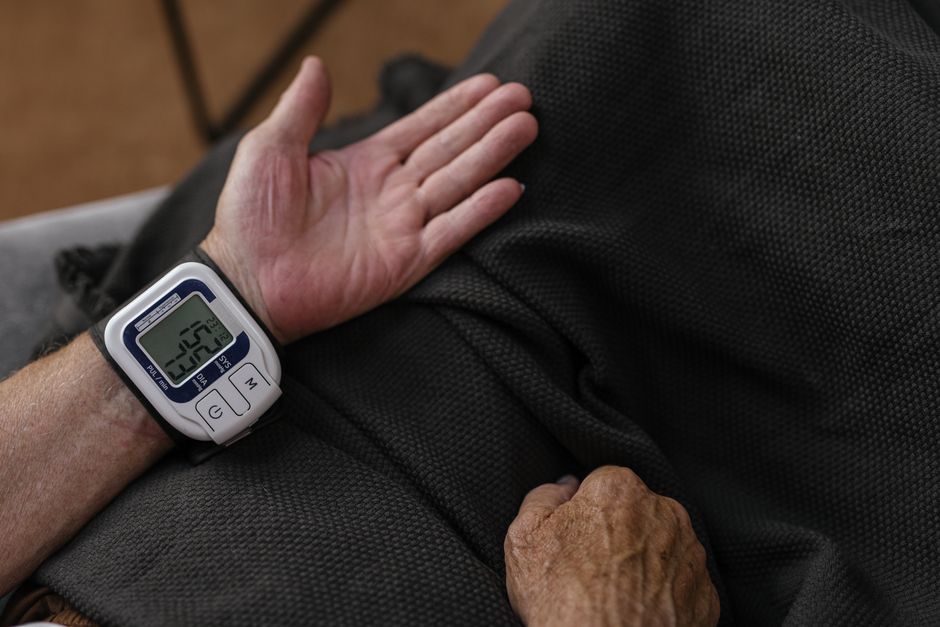
Wrist blood pressure monitors can give accurate readings, but only when they are used correctly. Research comparing wrist and upper-arm devices has generally found that wrist monitors read somewhat less accurately on average, and the gap widens with improper positioning. The upper arm remains the standard most clinicians trust. Wrist monitors are not useless — they are just easier to get wrong.
How Accurate Are Wrist Blood Pressure Machines Compared With Arm Cuffs?
Upper-arm monitors are the reference standard for home blood pressure measurement. Wrist devices measure the same thing — the pressure inside your arteries — but from a smaller, more mobile artery that sits farther from your heart.
That distance matters. The radial artery in your wrist is roughly 10 centimeters below heart level when your arm hangs at your side. Blood pressure changes with height. If your wrist sits below your heart, the reading comes out higher. If it sits above, the reading comes out lower. Each centimeter of vertical difference shifts the reading by roughly 0.8 mmHg. Hold your wrist 15 centimeters too low and you may see a number that is about 12 mmHg too high.
Accuracy also depends on the device itself. A wrist monitor must be validated before it can be trusted. Validation means independent researchers tested it against a standard mercury or aneroid reference using a published protocol, such as the one from the Association for the Advancement of Medical Instrumentation, the European Society of Hypertension, or the International Organization for Standardization. Devices that pass these protocols are listed in public registries. Devices that have never been validated may be sold anyway. There is no law requiring a home blood pressure monitor to prove its accuracy before it reaches the shelf.
When a validated wrist monitor is used at heart level, studies have found it performs reasonably well in most adults. The problem is that “at heart level” is easy to say and hard to hold. Arm-cuff monitors remove that variable because the cuff sits at heart level by design when you rest your arm on a table.
Why Does Wrist Position Matter So Much?
Hydrostatic pressure is the reason. Fluid pressure rises with depth. Your circulatory system is a fluid system, so the pressure your wrist artery feels depends on how far below your heart it sits.
Think of a column of water. The deeper you go, the more pressure the water exerts. Blood behaves the same way. Your heart generates the pressure, but gravity adds or subtracts from it depending on where you measure.
This is not a small effect. A wrist held at heart level and the same wrist held 10 centimeters lower can differ by around 8 mmHg. That is enough to move someone from a normal reading into the elevated range, or from stage 1 hypertension into stage 2.
For context, current American College of Cardiology and American Heart Association categories define normal blood pressure as below 120/80 mmHg, elevated as 120–129 systolic with diastolic under 80, stage 1 hypertension as 130–139 over 80–89, and stage 2 as 140/90 or higher. A positioning error of 8 to 12 mmHg can shift a person across one or two of those categories without anything about their actual health changing.
This is why clinicians who do support wrist monitors for home use are strict about technique. The wrist must be supported at heart level. The arm should rest on a table or a firm surface. The monitor should be at the same height as the heart, not held up in the air or left in the lap.
Who Should Not Rely on a Wrist Monitor?
Some people are poor candidates for wrist measurement regardless of technique.
- People with irregular heart rhythms, such as atrial fibrillation. Many wrist monitors use oscillometric detection, which can struggle to interpret irregular pulses. Readings may be unreliable or fail entirely.
- People with very large or very small wrists. Cuff size must match wrist circumference. A cuff that is too small reads high. One that is too large reads low.
- People with tremor, Parkinson’s disease, or conditions that make it hard to hold the wrist still at heart level.
- People with peripheral artery disease or significant vascular disease in the arms.
- People who are obese, particularly with a large upper arm. Some wrist devices have not been validated in this group.
- People taking blood pressure medication who need to track subtle changes. Small measurement errors matter more when you are adjusting treatment.
For these groups, an upper-arm monitor is the better choice. It is also the better choice for anyone whose doctor is using home readings to make treatment decisions.
How Do You Use a Wrist Monitor Correctly?
Technique is not optional with a wrist monitor. It is the difference between a usable number and a misleading one.
Sit quietly for five minutes before measuring. Do not exercise, smoke, or drink caffeine in the 30 minutes before. Sit with your back supported and both feet flat on the floor. Do not cross your legs.
Rest your forearm on a table so your wrist sits at heart level. Your heart sits roughly at the middle of your chest, near the sternum. If your wrist is lower than that point, the reading will run high. If it is higher, the reading will run low.
Wrap the cuff snugly around your bare wrist. Clothing under the cuff adds error. Keep your palm facing up and relax your hand. Do not make a fist or tense your arm.
Press start and stay still. Do not talk. Talking can raise a reading. Do not move your arm.
Take two readings one minute apart and average them. If the two readings differ by more than 5 mmHg, take a third and average the last two. This is standard practice for home monitoring.
Measure at the same times each day. Blood pressure follows a daily rhythm. Morning and evening readings are typically recommended, and your doctor may want both.
What Does the Research Actually Show?
The evidence on wrist versus arm monitors is mixed but leans in one direction. Some studies have found that validated wrist monitors, used correctly, produce readings close to arm-cuff results in most adults. Others have found clinically meaningful differences, especially when positioning is not carefully controlled.
A recurring finding is that wrist monitors tend to read higher than arm monitors when the wrist is below heart level, and lower when it is above. When position is held constant, the gap narrows considerably.
What the research does not show is that any wrist monitor is as forgiving as an arm monitor. The arm monitor’s design removes a major source of error. The wrist monitor’s design introduces one.
There is also the question of validation. Not every wrist monitor on the market has been independently tested. Some manufacturers publish validation data. Others do not. A device that has never been validated against a reference standard has no evidence behind its numbers, regardless of what the packaging says.
If you want to check whether a specific device has been validated, look for a published validation study or a listing in a recognized registry of validated blood pressure monitors. If you cannot find one, that is information in itself.
When Should You Trust the Reading?
A single wrist reading is not a diagnosis. Neither is a single arm reading. Blood pressure varies throughout the day, and one high number does not mean you have hypertension.
What matters is the pattern. Home readings taken consistently, at the same times, with the same technique, give your doctor a picture that a single office reading cannot. Office readings can be affected by the setting itself — some people run high in a clinic and normal at home. Others run normal in a clinic and high at home.
If your wrist monitor consistently gives numbers that differ from your arm monitor or from your doctor’s readings, the wrist monitor is the one to question. Bring both devices to an appointment if you can. Your doctor can compare them against a clinical reference.
Do not adjust medication based on home readings alone. Do not stop or start a medication because a wrist monitor gave you a number you did not expect. Talk to your doctor first.
If you are using a wrist monitor because an arm cuff is uncomfortable or hard to use, that is a reasonable reason to consider one. Just understand what you are trading. You are trading convenience for a device that demands more from your technique.
Frequently Asked Questions
Are wrist blood pressure monitors as accurate as arm monitors?
Generally no. Validated wrist monitors used correctly can be reasonably accurate, but upper-arm monitors are the reference standard and are less sensitive to positioning errors. Most clinical guidelines favor arm-cuff measurement for home monitoring.
Why does my wrist blood pressure monitor read higher than my arm cuff?
Most often because your wrist is below heart level. Each centimeter of vertical difference shifts the reading by roughly 0.8 mmHg, so a wrist held several centimeters low can read noticeably high. Rest your forearm on a table at heart level and measure again.
Can I use a wrist blood pressure monitor if I have atrial fibrillation?
Wrist monitors are generally not recommended for people with irregular heart rhythms, because oscillometric devices can struggle to interpret irregular pulses. An upper-arm monitor, or a device specifically validated for atrial fibrillation, is a better choice.
How do I know if my wrist monitor is accurate?
Check whether the specific model has been validated in an independent study or listed in a recognized registry of validated monitors. If you cannot find validation data, the accuracy of the device has not been established.
