
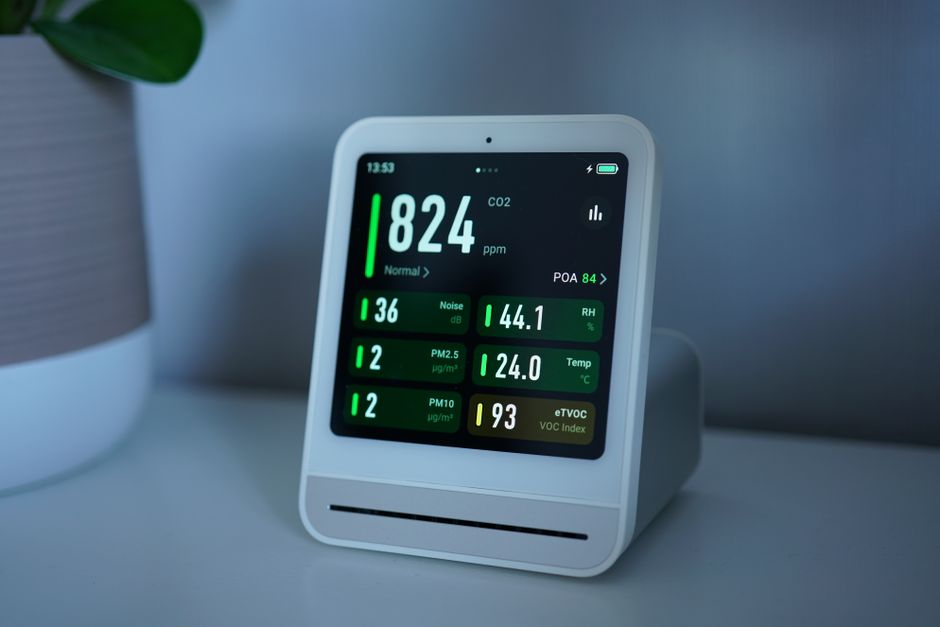
Formaldehyde is a colorless gas with a sharp smell that can irritate the eyes, nose, and throat. It is common in building materials, furniture, and some household products. A formaldehyde sensor is a device that detects this gas in the air and gives a reading, usually in parts per million (ppm) or parts per billion (ppb). Most consumer sensors work by triggering a chemical or electrical change when formaldehyde molecules touch a sensing surface, and that change is converted into a number on a screen. Their reliability varies widely. Some sensors are useful for spotting trends, but many low-cost models are not accurate enough to tell you whether your air meets a specific safety limit.
What Is Formaldehyde and Why Does It Matter Indoors?
Formaldehyde is a volatile organic compound (VOC) that becomes a gas at room temperature. It is used in resins and adhesives that hold together pressed-wood products like particleboard, plywood, and medium-density fiberboard. It also appears in some paints, coatings, insulation, and even tobacco smoke.
Indoor levels are usually higher than outdoor levels because these materials release the gas slowly over time. This release is called off-gassing, and it tends to be highest when products are new and when the space is warm and humid. The World Health Organization has classified formaldehyde as a known human carcinogen, linked mainly to nasal cancer with long-term inhalation at higher levels.
Short-term exposure to elevated levels can cause eye, nose, and throat irritation, coughing, and worsening of asthma symptoms. The concern is not usually a single reading but ongoing exposure in a poorly ventilated space.
How Does a Formaldehyde Sensor Actually Work?
Most sensors turn a chemical interaction into an electrical signal. The exact method depends on the sensor type, and each has strengths and weaknesses.
Electrochemical sensors are the most common type for detecting formaldehyde specifically. Inside is a small cell with electrodes and an electrolyte. When formaldehyde reaches the sensing electrode, it reacts and produces a tiny electric current. The size of that current is proportional to how much formaldehyde is present. These sensors can be selective for formaldehyde, but they age over time and can drift.
Metal oxide semiconductor (MOS) sensors use a heated metal oxide surface, often tin dioxide. When formaldehyde molecules land on the hot surface, they change the material’s electrical resistance. That resistance change becomes the reading. MOS sensors are cheap and durable, but they are not very selective. Other gases and even humidity can trigger a response, which leads to false readings.
Photoionization detectors (PIDs) use ultraviolet light to knock electrons off gas molecules, creating a current. PIDs measure total VOCs rather than formaldehyde alone, so they cannot tell you how much formaldehyde is present unless paired with a separation method.
Colorimetric and passive badges use a chemical that changes color when it reacts with formaldehyde. These give an average exposure over time rather than a live reading, and they are often used for workplace monitoring.
What Makes Formaldehyde Sensors Difficult to Get Right?
Formaldehyde is hard to measure accurately at low levels, and that is the core problem. The levels that matter for health are often in the low parts per billion range, and detecting a single gas at that concentration in a mix of hundreds of other compounds is genuinely difficult.
Cross-sensitivity is the biggest issue. Many sensors respond to other chemicals that happen to be in the air, including alcohols, cleaning products, and even humidity. A sensor that reacts to these will report formaldehyde that is not there. This is why a cheap MOS sensor can spike when you use a scented cleaner.
Temperature and humidity also shift readings. Many sensors need calibration and compensation to account for this, and consumer devices often do neither well.
Drift is another factor. Over months, the sensing element changes, and a reading that was once accurate can slowly become wrong. Without recalibration, a sensor can lose accuracy without any warning.





How Reliable Are Consumer Formaldehyde Sensors?
Reliability depends heavily on the sensor inside and how it is calibrated. There is a wide gap between low-cost consumer monitors and professional-grade instruments.
Independent testing has found that many inexpensive air quality monitors do not measure formaldehyde accurately. Some report plausible-looking numbers that do not track real concentrations. A few use MOS sensors that respond to total VOCs and then estimate formaldehyde, which is not a direct measurement at all.
Higher-quality electrochemical sensors, when properly calibrated, can give useful readings. But even these need regular calibration with a known reference gas to stay trustworthy. Professional instruments used in industrial hygiene cost far more and are calibrated against standards.
Here is the practical takeaway: a consumer sensor can show you a trend, such as whether levels rise when you close windows or bring in new furniture. It is far less reliable for telling you whether your air is safe or unsafe at a specific moment.
What Do Sensor Readings in ppm and ppb Actually Mean?
Sensor readings use two units, and mixing them up leads to confusion. One part per million equals one thousand parts per billion. So a reading of 0.1 ppm is the same as 100 ppb.
Different organizations set different reference levels, and these are guidelines rather than sharp safety lines. The table below shows commonly referenced values. These are not interchangeable, because each was set for a different purpose.
| Reference | Level | Context |
|---|---|---|
| WHO indoor air guideline | 0.1 mg/m³ (about 80 ppb) averaged over 30 minutes | Long-term indoor air quality |
| US occupational limit (8-hour) | 0.75 ppm | Workplace exposure over a full shift |
| US occupational short-term limit | 2 ppm over 15 minutes | Brief workplace peaks |
These numbers come from established regulatory and health references. A consumer sensor that claims to detect down to a few ppb may not actually resolve differences that small, even if the display shows them.
How Can You Use a Sensor More Wisely?
If you already own a monitor, treat it as a rough guide, not a verdict. Watch for patterns rather than fixating on single numbers. If levels consistently rise after you bring in new furniture or seal up the house, that is a useful signal even from an imperfect sensor.
You can also reduce formaldehyde exposure without any sensor at all. These steps are supported by general indoor air quality guidance:
- Increase ventilation by opening windows and using exhaust fans, especially in new or renovated spaces.
- Let new pressed-wood furniture and building materials air out before heavy use.
- Keep indoor temperature and humidity moderate, since heat and moisture increase off-gassing.
- Choose low-emission or labeled products when buying furniture and building materials.
- Avoid smoking indoors, since tobacco smoke is a formaldehyde source.
If you are concerned about a specific health symptom or a workplace exposure, a sensor reading is not a substitute for professional air testing or medical advice.
What Should You Look For in a Formaldehyde Sensor?
The most important thing to check is what the sensor actually measures. If the product description says it detects “total VOCs” or “air quality” rather than formaldehyde specifically, it is not a formaldehyde sensor in the strict sense.
Look for a stated sensor type. An electrochemical cell designed for formaldehyde is more selective than a general MOS sensor. Check whether the device can be calibrated and whether replacement or recalibration is offered, because an uncalibrated sensor drifts.
Be skeptical of very low price points paired with very precise-sounding claims. Accurate formaldehyde measurement at low levels requires hardware that costs more to make. A device that shows two decimal places of ppb does not necessarily measure that precisely.
Finally, remember that no consumer sensor replaces professional testing when accuracy truly matters, such as after a renovation or in a workplace.
Frequently Asked Questions
How accurate are home formaldehyde sensors?
Accuracy varies widely, and many low-cost monitors do not measure formaldehyde reliably. Higher-quality electrochemical sensors can give useful readings when they are properly calibrated.
Can a formaldehyde sensor detect other chemicals by mistake?
Yes, cross-sensitivity is common, especially with metal oxide sensors that respond to other gases and humidity. This can cause readings that show formaldehyde when little or none is present.
Do I need to calibrate a formaldehyde sensor?
Yes, sensors drift over time and need periodic calibration to stay accurate. Many consumer devices do not offer easy calibration, which limits how much you can trust their numbers.
Is a low sensor reading a guarantee that my air is safe?
No, a low reading from an uncalibrated or low-cost sensor does not confirm safe air. Sensor limits, cross-sensitivity, and drift all mean a single reading should not be treated as proof.
