
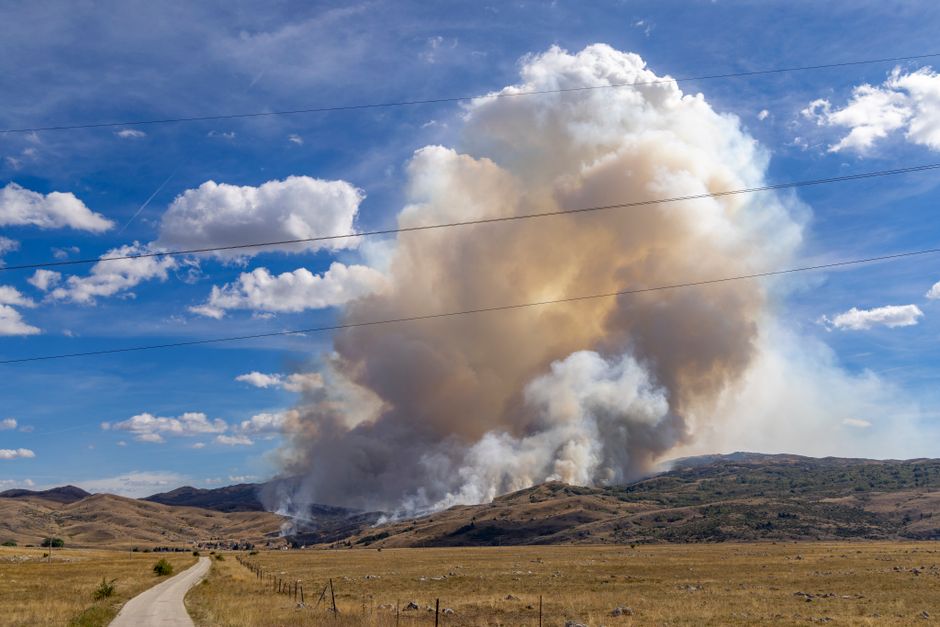
Wildfire smoke does not directly block or weaken cell phone signals. Radio waves used by cell networks pass through smoke particles with almost no loss. What smoke can do is damage or overload the equipment that carries your calls, and that is where reception problems actually come from.
If your signal drops during a nearby fire, the cause is usually physical damage to a tower, a power outage, or a sudden surge in network traffic. Smoke itself is not the culprit in the way most people assume.
Does Wildfire Smoke Affect Cell Phone Reception?
No. Smoke particles are far too small to interfere with the radio frequencies cell phones use.
Cell networks operate on radio waves in the range of roughly 600 megahertz to 39 gigahertz, depending on the technology and carrier. The wavelengths involved range from about half a meter down to under a centimeter. Smoke particles are measured in micrometers — millionths of a meter. That is thousands of times smaller than the wavelength of the signal.
For a particle to block or scatter a radio wave in a meaningful way, it needs to be comparable in size to the wavelength. Smoke simply is not. This is the same reason fog does not stop FM radio and clouds do not stop satellite TV. Visible particles and radio waves operate on completely different scales.
Even heavy, dense smoke that turns the sky orange does not attenuate cellular signals in any measurable way. The color you see is smoke scattering visible light, which has a wavelength of roughly 400 to 700 nanometers. Radio waves are millions of times longer.
Then Why Does My Signal Drop During a Wildfire?
When cell service fails during a wildfire, the cause is almost always infrastructure, not the smoke in the air.
Here are the real reasons reception drops:
- Power outages. Towers need electricity. If the grid goes down and backup generators run out of fuel or fail, the tower goes offline.
- Physical damage. Fire can destroy towers, melt cables, or take down the fiber lines that connect towers to the broader network.
- Network congestion. When thousands of people evacuate at once, everyone calls and texts simultaneously. A tower that handles a few hundred calls at a time can be overwhelmed by thousands.
- Backhaul failure. Even a tower that survives the fire is useless if the fiber optic cables carrying its traffic to the core network are burned.
- Fuel resupply problems. Crews may not be able to reach a tower to refuel its generator when roads are closed or dangerous.
The congestion problem is often the biggest one during the first hours of a major fire. It is not that the network is broken. It is that too many people are trying to use it at once.
What About Smoke and Internet or Satellite Service?
Satellite internet and satellite phones are affected by weather, but not by smoke in the way people expect.
Satellite signals travel from a dish or phone up to a satellite in orbit. The signal path passes through the atmosphere, including any smoke layer. Because the wavelengths are long compared to smoke particles, the signal passes through. Heavy rain can degrade satellite signals because raindrops are large enough to absorb and scatter the higher frequencies used. Smoke does not have that effect.
What can affect satellite service during a wildfire is the same thing that affects cell service: power loss at your location, damage to your dish, or congestion on the provider’s network if many people in the region are relying on it at once.
Fixed internet over cable or fiber is vulnerable in a different way. Those lines are physical. If fire burns the poles or the cables, service goes down regardless of what is happening in the air.





Is There Any Way Smoke Indirectly Hurts Your Signal?
There is one indirect path worth knowing about, and it is about heat and electricity, not radio physics.
Extreme heat and fire can damage the electronic equipment at a cell site. If a tower’s equipment cabinet overheats or the site loses cooling, components can fail. This is a hardware failure caused by the fire’s heat, not by smoke blocking the signal.
There is also the matter of how fires affect the power grid. When transmission lines are shut down as a safety measure, or when they are damaged, the outages ripple outward. A tower miles from the fire line can go dark because its power source went down.
So the honest summary is this: smoke is not the problem. Heat, fire damage, power loss, and network congestion are.
How Can You Stay Connected During a Wildfire?
Since the risk is infrastructure failure, the practical steps focus on having backups and reducing demand on the network when it matters.
- Text instead of call. Text messages use far less network capacity than voice calls and often get through when calls fail.
- Keep phones charged. Charge every device before an evacuation warning. Have portable power banks ready.
- Know your alert systems. Sign up for local emergency alerts, which may reach you through multiple channels, not just cell service.
- Have an offline plan. Agree on a meeting place and a contact person outside the area who can relay messages if local service fails.
- Consider a backup communication method. In some regions, amateur radio or satellite messengers can work when cell networks are down, though these require equipment and in some cases licensing.
None of these steps change how smoke interacts with radio waves. They simply account for the fact that the network itself is the fragile part.
Why the Smoke-and-Signal Myth Persists
The belief that smoke blocks cell signals makes intuitive sense. Smoke blocks light. It blocks your view. It seems reasonable that it would block other things too.
But radio waves and visible light are both electromagnetic radiation. They differ only in wavelength, and that difference is enormous. Visible light has wavelengths around 400 to 700 nanometers. Cell signals have wavelengths measured in centimeters or tens of centimeters. That is a difference of roughly a million times.
When a physical barrier is much smaller than a wave’s wavelength, the wave passes around it. This is why you can hear a bass note through a wall that blocks higher sounds. The long wavelength of the bass diffracts around the obstacle. The same principle applies to smoke and radio waves, just at a vastly larger scale.
So when your signal drops during a fire, the smoke in the sky is a coincidence, not a cause. The tower down the road lost power, or the fiber line burned, or ten thousand people picked up their phones at the same moment.
Does Wildfire Smoke Affect Cell Phone Reception in Any Measurable Way?
No measurable effect has been documented from smoke itself.
Engineers who study radio propagation have long understood that particles below a certain size relative to wavelength have negligible impact. Smoke falls firmly in that category. If you want to test the principle yourself, notice that your phone works fine in fog, in heavy rain, and inside a dusty building. Smoke is no different.
What does show up in the data after major wildfires is a pattern of outages tied to power loss, physical damage, and traffic spikes. Those are the variables that matter. If you are trying to understand why your service failed during a fire, look at the grid and the network, not the sky.
Frequently Asked Questions
Can wildfire smoke block cell phone signals?
No. Smoke particles are far too small to interfere with the radio wavelengths cell networks use. Signal loss during a fire comes from power outages, damaged towers, or network congestion.
Why does my cell service go out during a wildfire if smoke isn’t the cause?
Cell towers need electricity and working connections to the broader network, and both can fail during a fire. When thousands of people try to call at once, the network can also become overloaded.
Does smoke affect WiFi or satellite internet?
Smoke does not block WiFi or satellite signals for the same reason it does not block cell signals. Service problems during a fire usually trace back to power loss or physical damage to equipment.
What should I do if my cell service drops during a wildfire?
Try texting instead of calling, since texts use less network capacity and often get through when calls fail. Rely on local emergency alerts and any backup communication plan you have in place.
