
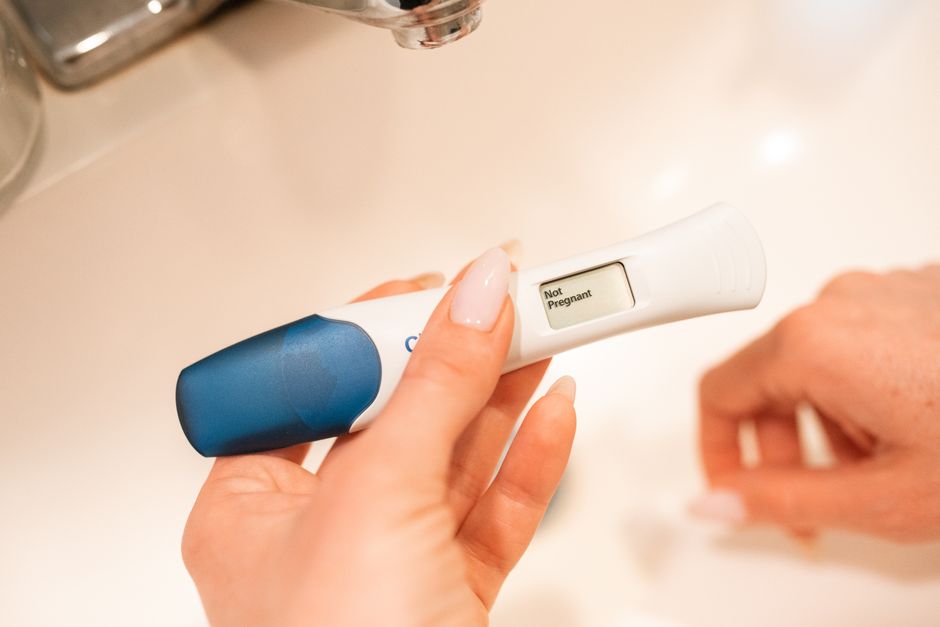
An ovulation test cannot confirm pregnancy. It detects luteinizing hormone (LH), the hormone that triggers egg release. Pregnancy tests detect human chorionic gonadotropin (hCG), a hormone the body makes only after a fertilized egg implants. These are two different hormones, and each test is built to find only one of them.
That said, the two hormones share a similar molecular structure. Because of that overlap, an ovulation test can sometimes turn positive if you are pregnant. It is not a reliable pregnancy test, and no test maker designs it for that purpose. If you think you might be pregnant, use a pregnancy test.
Why Do Ovulation Tests and Pregnancy Tests Detect Different Hormones?
Ovulation tests look for LH in your urine. LH surges about 24 to 36 hours before an egg is released from the ovary. That surge is the signal the test is designed to catch, so you know your most fertile window.
Pregnancy tests look for hCG. The cells that form the placenta start making hCG after a fertilized egg attaches to the uterine lining. This usually happens about 6 to 12 days after ovulation. hCG then rises quickly in early pregnancy.
So the two tests answer different questions:
- An ovulation test asks: “Is an LH surge happening soon?”
- A pregnancy test asks: “Is hCG present, which would mean implantation has occurred?”
LH and hCG are both glycoprotein hormones. They share the same alpha subunit and have a similar beta subunit. This structural overlap is the reason a pregnancy can occasionally trigger a positive ovulation test. The LH test’s antibodies can cross-react with hCG when hCG levels are high enough.
Can an Ovulation Test Detect Pregnancy at All?
It can turn positive, but it cannot tell you that you are pregnant. A positive result on an ovulation test is not a diagnosis of pregnancy. The test is simply reading a hormone it was built to find, and hCG can sometimes set it off.
Here is the problem. A positive ovulation test is normal and expected during a healthy menstrual cycle. It happens every month around ovulation. So a positive result gives you no way to separate “I am about to ovulate” from “I might be pregnant.”
Ovulation tests are also not calibrated to measure hCG. They are set to detect the LH surge at a specific threshold. hCG levels in very early pregnancy may be too low to trigger a positive ovulation test, even when a pregnancy test would already read positive. This means a negative ovulation test tells you nothing about pregnancy.
Put simply: a positive ovulation test is not proof of pregnancy, and a negative one is not proof you are not pregnant. The test is being used outside its design.
How Early Can an Ovulation Test Show a Pregnancy?
There is no reliable timeline, because ovulation tests were never designed or validated for this use. Any claim about how early they can detect pregnancy is guesswork.
What we do know comes from how the hormones behave. hCG becomes detectable in urine around the time of a missed period, and sometimes a few days before. Standard pregnancy tests are built to detect hCG at the levels typical of early pregnancy. Ovulation tests are not.
Because ovulation tests are not standardized for hCG, the result depends on the brand, the amount of hCG in your urine, how hydrated you are, and how concentrated your urine is. That is too many variables to trust. If you want to know whether you are pregnant, a pregnancy test is the right tool, and testing after a missed period gives the most reliable result.




Why Would an Ovulation Test Be Positive During Pregnancy?
The most likely reason is hormone cross-reactivity. As hCG climbs in early pregnancy, it can reach a level where the ovulation test’s antibodies bind to it and produce a positive line.
There are other reasons a positive ovulation test can be misleading:
- Normal ovulation. You may simply be in your fertile window, which is what the test is meant to show.
- PCOS and other conditions. Polycystic ovary syndrome and some other hormonal conditions can cause elevated LH, leading to frequent positive ovulation tests.
- Perimenopause. Changing hormone levels during perimenopause can affect LH and cause unpredictable results.
- Medications. Some fertility medications contain hormones that can interfere with test results.
If you get several positive ovulation tests in a row and you are not sure why, a pregnancy test is the clearer answer. Persistent positives can also point to a hormonal issue worth discussing with a clinician.
What Is the Difference Between an Ovulation Test and a Pregnancy Test?
The core difference is the hormone each test targets and the question each one answers. The table below lays out the main distinctions.
| Feature | Ovulation Test | Pregnancy Test |
|---|---|---|
| Hormone detected | Luteinizing hormone (LH) | Human chorionic gonadotropin (hCG) |
| What it signals | An LH surge, meaning ovulation is likely soon | hCG present, meaning implantation has occurred |
| Designed for pregnancy | No | Yes |
| Best time to use | Mid-cycle, to find the fertile window | After a missed period for the most reliable result |
| Reliability for pregnancy | Not reliable; can cross-react with hCG | Designed and validated to detect hCG |
One practical note: both types of test read urine, and both can be affected by how diluted your urine is. First-morning urine tends to be more concentrated, which is why many people use it for pregnancy testing.
What Should You Do If You Think You Might Be Pregnant?
Use a pregnancy test. That is the straightforward answer. A home pregnancy test is designed to detect hCG, and it is the appropriate tool for the question you are asking.
A few things help you get an accurate result:
- Wait until after your missed period. Testing too early can give a false negative, because hCG may not be high enough yet.
- Test with first-morning urine when possible, since it is more concentrated.
- Follow the package instructions exactly, including the timing window for reading the result.
- If the result is negative but your period is still late, wait a few days and test again.
If you get a positive pregnancy test, contact a healthcare provider to confirm and begin prenatal care. If you have symptoms like severe pain, heavy bleeding, or dizziness, seek medical care promptly, as these can signal a problem that needs attention.
Do not rely on an ovulation test to decide whether you are pregnant. It was built for a different job, and using it this way can lead to confusion, false hope, or missed early pregnancy care.
Frequently Asked Questions
Can an ovulation test be used as a pregnancy test?
No, it is not designed or reliable for that purpose. It detects LH, not hCG, and any positive result cannot confirm pregnancy.
Why did my ovulation test turn positive while I was pregnant?
LH and hCG have a similar molecular structure, so hCG can sometimes cross-react with an ovulation test and trigger a positive line. This is not a reliable sign of pregnancy.
How early can an ovulation test detect pregnancy?
There is no reliable timeline, because these tests are not validated for detecting hCG. Use a pregnancy test, ideally after a missed period, for an accurate result.
Can a negative ovulation test mean I am not pregnant?
No, a negative ovulation test says nothing about pregnancy. It only means no LH surge was detected at that moment.
