
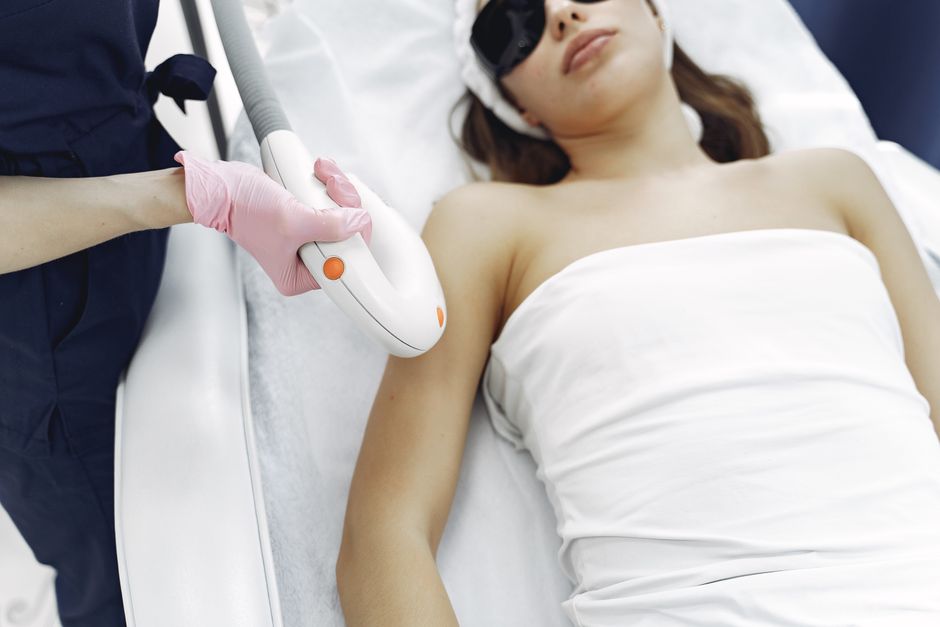
Laser hair removal does not affect male fertility. The lasers used for hair removal target pigment in hair follicles and do not reach the testicles, and they do not produce the type of radiation that damages sperm-producing cells. There is no established biological pathway by which a standard course of laser hair removal on the face, back, chest, or other body areas would change sperm count, sperm quality, or hormone levels.
The confusion usually comes from mixing up different technologies. Laser hair removal is not the same as radiation therapy, and it is not the same as the intense heat some people associate with testicular damage. Understanding why the two are unrelated clears up most of the worry.
Does Laser Hair Removal Affect Male Fertility?
No. The evidence and the underlying physics both point the same way. Laser hair removal devices emit non-ionizing light at wavelengths absorbed mainly by melanin, the pigment in hair. That light penetrates only a few millimeters into the skin — enough to reach the hair bulb, not enough to reach deeper structures.
Fertility in men depends on the testes producing sperm and testosterone. The testes sit in the scrotum, outside the body cavity, and are not in the path of a laser aimed at the skin surface of the face, back, or chest. Even when laser treatment is done on the pubic area or scrotum, the light energy is absorbed in the upper layers of skin and hair follicles. It does not travel into the testicle itself.
The distinction that matters most is ionizing versus non-ionizing radiation. Ionizing radiation — the kind used in some cancer treatments and imaging — carries enough energy to damage DNA, and it is well established that significant exposure to the testes can impair sperm production. Laser hair removal uses non-ionizing light. It cannot break chemical bonds or damage DNA the way ionizing radiation does. That is a fundamental difference in how the two types of energy behave, not a matter of degree.
How Does Laser Hair Removal Actually Work?
Laser hair removal works through a principle called selective photothermolysis. The device delivers a concentrated beam of light at a specific wavelength. Melanin in the hair shaft and follicle absorbs that light and converts it to heat. The heat damages the follicle enough to slow or stop future hair growth, while the surrounding skin is largely spared.
This is why the treatment works best on people with dark hair and lighter skin — the contrast lets the laser target the pigment. It is also why the light has to reach the follicle, which sits just below the skin surface. The energy is spent in that shallow zone. It does not continue downward into muscle, organs, or reproductive tissue.
Some people describe the sensation as a rubber band snapping against the skin. The skin may be warm or pink afterward. These are surface effects. They say nothing about what is happening deeper in the body, because nothing is happening deeper in the body.
Is There Any Radiation Risk From Laser Hair Removal?
There is no ionizing radiation involved in laser hair removal. This is the point where misinformation does the most damage. The word “radiation” gets used loosely, and it makes people picture X-rays or nuclear exposure. Those are ionizing. Laser hair removal is not.
Non-ionizing radiation includes visible light, radio waves, microwaves, and the lasers used for hair removal and skin treatments. These forms of energy do not have enough energy per photon to ionize atoms or damage DNA. The main safety concerns with laser hair removal are skin-related — burns, blistering, changes in skin pigment, and eye exposure if protective eyewear is not used. These are real risks worth taking seriously, but they are not fertility risks.
This is the clarification that often gets lost: a treatment can carry genuine safety considerations and still have nothing to do with fertility. The two questions are separate. Laser hair removal has documented skin risks. It does not have a documented effect on male fertility.





What Actually Affects Male Fertility?
If you are concerned about fertility, the factors with real evidence behind them are worth your attention. Heat is one of them. The testes function best a few degrees below core body temperature, which is why they sit outside the body. Sustained heat exposure — from frequent long hot tubs or saunas, for example — has been studied as a possible influence on sperm production, though the evidence on how much it matters in practice is not fully settled.
Other established influences on male fertility include:
- Smoking, which is associated with lower sperm quality
- Heavy or chronic alcohol use
- Obesity, which is linked to changes in sperm and hormone levels
- Certain medications, including some used for cancer, infections, and other conditions
- Varicocele, an enlarged vein in the scrotum, which is a recognized and treatable cause of male infertility
- Significant exposure to ionizing radiation or certain industrial chemicals
- Age, which is associated with gradual changes in sperm quality
None of these overlap with laser hair removal. If you are trying to conceive and have concerns, a conversation with a doctor — and possibly a semen analysis — is far more useful than worrying about a cosmetic treatment.
Can Laser Hair Removal on the Pubic Area or Scrotum Affect Fertility?
There is no evidence that it does. Some men have laser hair removal in the pubic region, including near the scrotum, and wonder whether treating that area is different. The physics does not change. The laser energy is absorbed in the skin and hair follicles. It does not penetrate into the testicle.
That said, the scrotal skin is thin and sensitive, and treating it requires care. Burns and skin damage are a genuine risk in this area, and some clinics are cautious about or decline to treat the scrotum directly. This is a skin-safety consideration, not a fertility one. Protective eyewear, patch testing, and a qualified practitioner matter here more than anywhere else on the body.
If a provider tells you that treating the scrotum could affect fertility, ask them to explain the mechanism. There is no established one.
Do Anecdotes About Fertility Changes After Laser Hair Removal Hold Up?
Personal stories about fertility changing after a cosmetic treatment are hard to interpret. Fertility varies naturally, and couples often start trying to conceive around the same time they make other lifestyle changes. When a pregnancy happens or does not happen, it is easy to draw a line to the most recent new thing — even when no line exists.
The same applies to the reverse. Some men report no change in fertility after laser hair removal, which also proves little on its own. Anecdotes cannot establish cause and effect in either direction. What matters is whether a plausible mechanism exists and whether controlled evidence supports a link. For laser hair removal and male fertility, neither is present.
What Should You Do If You Are Worried About Fertility?
Talk to a doctor rather than trying to rule out causes on your own. A primary care physician or a fertility specialist can review your history, medications, and lifestyle factors, and can order a semen analysis if appropriate. That test gives real information about sperm count, movement, and shape.
Laser hair removal is a cosmetic procedure with its own skin-related risks that deserve attention. It is not a fertility treatment, and it is not a fertility threat. If you are planning laser hair removal and have specific health concerns, mention them to the practitioner and to your doctor. But the fear that it will affect your ability to father a child is not supported by how the technology works or by the evidence.
Frequently Asked Questions
Does laser hair removal affect sperm count?
No. Laser hair removal does not reach the testes or produce the kind of energy that damages sperm-producing cells, so it has no established effect on sperm count. Concerns about sperm are better directed at factors like smoking, heavy alcohol use, and certain medical conditions.
Can laser hair removal make a man infertile?
There is no evidence that it can. The laser energy is absorbed in the skin and hair follicles and does not penetrate to the reproductive organs. Infertility has well-documented causes, and laser hair removal is not one of them.
Is laser hair removal safe on the scrotum?
The skin there is thin and sensitive, so burns and irritation are real risks, and some clinics decline to treat the area. This is a skin-safety issue, not a fertility one, and it should be discussed with a qualified practitioner.
Is laser hair removal the same as radiation therapy?
No. Laser hair removal uses non-ionizing light, which cannot damage DNA the way ionizing radiation from X-rays or cancer treatment can. The two are fundamentally different types of energy.
