
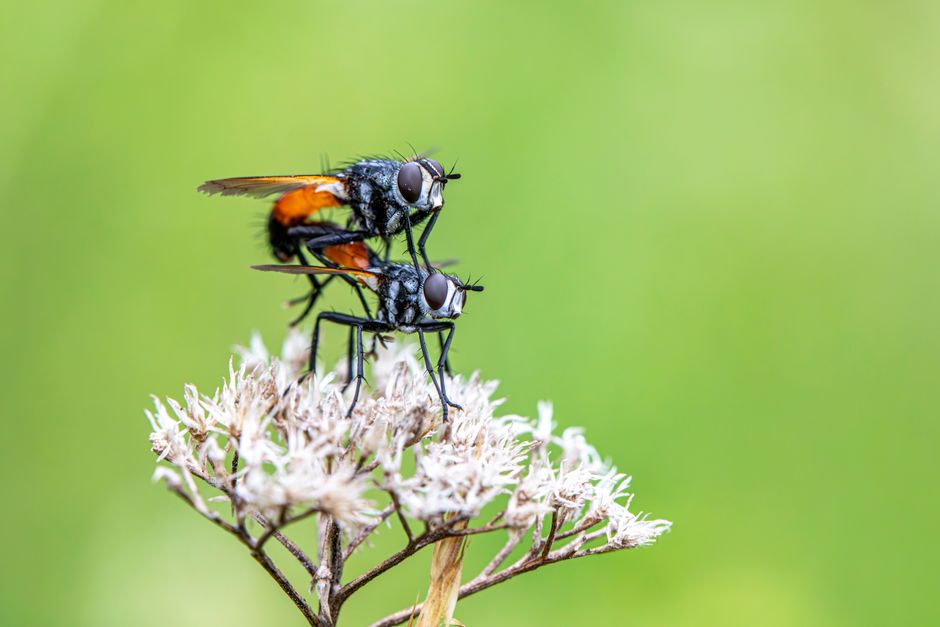
Yes, flies do turn into maggots — but not in the way most people picture. A fly does not transform its own body into a maggot. Instead, an adult female fly lays eggs, and each egg hatches into a maggot, which is the fly’s larval stage. The maggot then feeds, grows, and eventually becomes an adult fly. So maggots are baby flies, and flies are what maggots grow into.
That simple fact clears up a lot of confusion. People often say they “saw a fly turn into maggots,” when what they really saw was a fly laying eggs that hatched a short time later. The two are linked by a life cycle, not by one creature physically morphing into another. This guide walks through that cycle step by step, explains why maggots appear so fast, and covers what it means for your home and your health.
Does Flies Turn Into Maggots, or Do Maggots Turn Into Flies?
Maggots turn into flies. The direction matters, and getting it backward is the source of most of the confusion. A maggot is a young fly — the larval stage — and it does not stay a maggot. It grows, hardens into a pupa, and emerges as a winged adult.
The full cycle has four stages. Biologists call this complete metamorphosis, and it is the same basic pattern seen in butterflies and beetles.
- Egg — a tiny, oval egg laid by an adult female fly, usually in a food source or moist organic material.
- Larva (maggot) — the egg hatches into a legless, worm-like feeding machine.
- Pupa — the maggot stops feeding, its outer skin hardens into a case, and it transforms inside.
- Adult — a winged fly emerges, mates, and the cycle repeats.
No stage turns “into” the one before it. The egg does not become a fly directly, and the fly does not become a maggot. Each stage is a separate form of the same animal, connected by growth and transformation.
Why Do Maggots Appear on Food So Quickly?
Maggots seem to appear out of nowhere because the eggs are almost too small to see. Many fly eggs are only about a millimeter long — roughly the size of a grain of sand — and they are often laid in crevices, folds, or the underside of food where they blend in completely. By the time you notice movement, the eggs have already hatched.
Speed is the other reason. Fly eggs hatch quickly in warm conditions, sometimes within a day, and the newly emerged maggots grow fast because they do almost nothing but eat. A food source like meat, fruit, or garbage is an ideal nursery: moist, nutrient-rich, and safe from most predators. A female fly may lay eggs in batches, so a single visit can produce a crowd of maggots rather than one.
Here is a detail people often miss: seeing maggots does not mean a fly “gave birth” to them on the spot. It means eggs were laid earlier — possibly hours earlier — and the timing simply caught up with you. Warm weather shortens that window, which is why maggots seem to show up faster in summer.
What Do Fly Eggs Look Like, and Where Do Flies Lay Them?
Fly eggs are small, white or cream-colored, and oval. They are usually laid in clusters rather than one at a time. Because they are so tiny and often tucked into dark, moist places, most people never see them before the maggots appear.
Different flies choose different spots, but the common theme is decaying or moist organic material. House flies tend to lay eggs in garbage, animal waste, and rotting food. Blow flies — the metallic blue or green flies — often target meat and dead animals. Fruit flies lay eggs on overripe or fermenting fruit. Some species lay eggs near drains or in damp soil.
This is why cleanliness and moisture control matter. A fly is not choosing your kitchen out of spite. It is looking for a moist food source where its young can survive. Remove the food source and you remove the nursery.
How Long Does It Take for a Maggot to Become a Fly?
The timeline depends heavily on temperature and species, so any single number is only an approximation. In warm conditions, the whole cycle from egg to adult can move quickly — often within a couple of weeks — while cooler temperatures slow each stage down considerably.
The general sequence is consistent even when the timing is not:
- The egg hatches into a maggot, usually within a day or so in warmth.
- The maggot feeds and grows through several molts, which takes several days.
- The maggot stops feeding, finds a drier spot, and forms a pupal case.
- Inside the pupa, the body is rebuilt into an adult fly, which then emerges.
Cold weather can stretch this out dramatically. Some species survive winter as pupae or larvae and resume development when it warms up. That is one reason fly problems return with the first warm days of spring.
Are Maggots Dangerous, and What Should You Do About Them?
Maggots themselves are not usually harmful to touch, but the conditions that attract them are a genuine health concern. Flies and their larvae can carry bacteria from waste and decaying matter onto food and surfaces. The real risk is not the maggot — it is the contamination that comes with it.
The practical response is straightforward:
- Throw away any food that maggots have reached. Do not try to salvage it.
- Clean the area thoroughly and remove the source — garbage, spoiled food, or damp organic material.
- Wash your hands after handling anything contaminated.
- Keep bins closed and food covered to prevent a repeat.
If maggots appear in a wound, that is a different situation and needs medical attention. Some species can infest living tissue, especially in people who cannot care for themselves or who have open wounds. This is uncommon, but it is a reason to take unexplained maggots on the body seriously and seek care rather than ignore them.
One clarification worth making: maggot therapy — using sterile larvae to clean certain wounds — is a real, medically supervised technique used in some settings. That is a controlled clinical use with specially bred, sterilized maggots. It has nothing to do with maggots turning up in your kitchen, and it should never be attempted at home.
How Can You Prevent Flies From Laying Eggs?
Prevention comes down to removing the places flies need to breed. Since flies lay eggs in moist, decaying material, the goal is to make your space an unattractive nursery.
- Take out garbage regularly and keep bins tightly closed.
- Clean up spills and food residue promptly, including under appliances.
- Store food in sealed containers, especially fruit and meat.
- Fix leaks and dry out damp areas, since moisture supports larvae.
- Check for hidden sources like old potatoes, forgotten fruit, or damp compost.
If you find maggots, locating the source matters more than killing the ones you see. The visible maggots are a symptom. The eggs and breeding site are the cause, and that is where the problem will continue unless it is removed.
Common Myths About Flies and Maggots
A few persistent ideas are worth correcting directly. Spontaneous generation — the old belief that maggots simply arise from rotting meat on their own — was disproven centuries ago. Maggots come from eggs laid by flies, full stop.
Another myth is that maggots are a separate kind of creature unrelated to flies. They are not. A maggot is a fly in its early form, just as a caterpillar is a butterfly in its early form. The confusion is understandable because the two stages look nothing alike.
Some people also believe that killing adult flies is enough to solve a maggot problem. It is not. If eggs or larvae are already present in a food source, removing the adults does nothing to stop them. You have to remove the breeding material itself.
Frequently Asked Questions
Does a fly lay eggs that turn into maggots?
Yes. An adult female fly lays eggs, and each egg hatches into a maggot within a short time in warm conditions. The fly itself does not transform into a maggot.
How fast do fly eggs turn into maggots?
In warm conditions, eggs often hatch within about a day, though timing varies by species and temperature. Cooler weather slows hatching considerably.
Are maggots baby flies?
Yes. A maggot is the larval stage of a fly, which later becomes a pupa and then an adult fly. It is the same animal at a different point in its life cycle.
Can maggots appear without any flies around?
No. Maggots come from eggs laid by adult flies, so a fly was present at some point even if you did not see it. The eggs are often too small to notice.
