
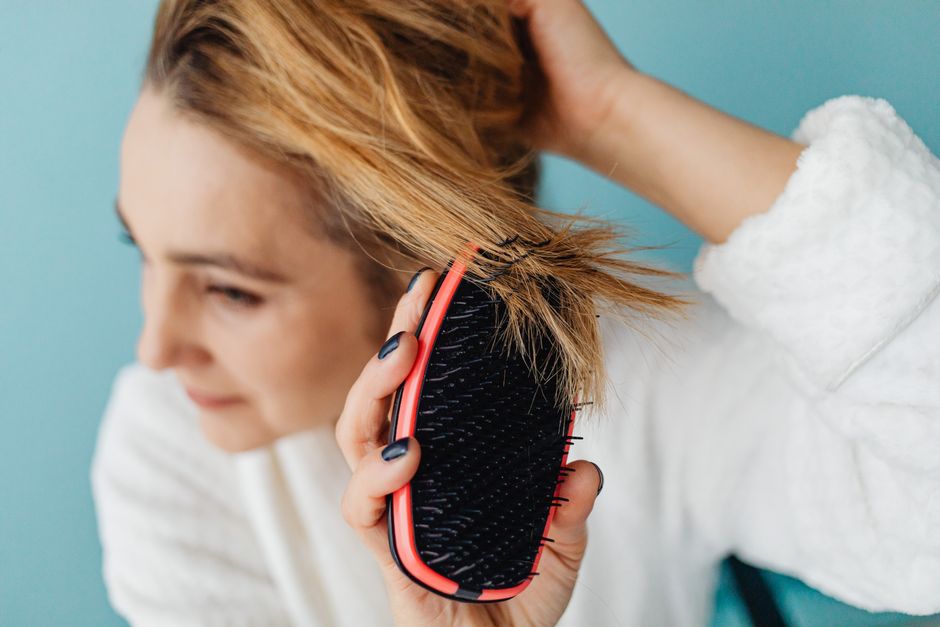
Brushing wet hair does not cause hair loss, but it can cause breakage. Hair loss and hair breakage are two different things, and this distinction matters more than most people realize. Hair loss happens at the follicle under the skin, where hair is made. Breakage happens along the hair shaft above the skin, where hair can snap. Wet hair is more fragile than dry hair, so rough brushing can break strands. It cannot pull a hair out of a healthy follicle that was not already going to shed.
Does Brushing Wet Hair Cause Hair Loss Or Breakage?
The answer depends on which one you mean, because the two are not the same event.
Hair loss means the hair separates from the follicle, the small organ beneath the scalp where each strand is produced. A hair that sheds this way usually has a white or dark bulb at the root. That process is driven by genetics, hormones, illness, medication, or the normal hair growth cycle. Brushing does not create that process.
Breakage means the hair shaft splits or snaps somewhere along its length. You may notice shorter pieces, split ends, or strands of different lengths. This is mechanical damage, and brushing wet hair can contribute to it.
Some shedding during brushing is normal. People lose an estimated 50 to 100 hairs a day as part of the hair cycle, and many of those come out during washing and brushing. That is not damage from the brush. It is hair that had already reached the end of its growth phase.
Why Is Wet Hair More Fragile?
Water changes the physical structure of hair in ways that make it stretch more and break more easily.
Hair is mostly made of a protein called keratin, arranged in bundles. In dry hair, chemical bonds hold those bundles in place and give the strand its strength. Water disrupts some of those bonds. The hair absorbs water, swells, and its outer protective layer lifts slightly. In this state, hair stretches further before it snaps, but it also returns to its original shape less reliably. Pull it too far and it does not spring back. It breaks.
This is why wet hair is often described as being in its most vulnerable state. It is not weaker in the sense of being thinner. It is more elastic and less resilient, which means it tolerates force poorly.
One detail worth knowing: hair does not stay fragile forever after it dries. Once the water evaporates and the bonds re-form, much of the original strength returns. The window of vulnerability is real but temporary.
What Kind Of Brushing Actually Damages Hair?
Force is the problem, not moisture by itself. The same brushing technique that is gentle on dry hair can still damage wet hair because the margin for error is smaller.
Habits that tend to cause breakage include:
- Pulling a brush or comb forcefully through tangles instead of working them out gradually
- Starting at the roots and dragging down through knots
- Using a fine-tooth comb on wet, tangled hair
- Brushing with a stiff-bristle brush that grabs and yanks
- Brushing the same section repeatedly when it is already wet and stretched
- Vigorous towel drying before brushing, which roughs up the surface
The pattern is consistent. Damage comes from friction and tension applied to strands that are already stretched and less able to recover. A slow, patient approach with a wide-tooth comb causes far less stress than a fast, forceful one.



How Can You Reduce Breakage When Brushing Wet Hair?
You can brush wet hair without damaging it if you reduce the force and the friction. The goal is not to avoid the brush. It is to stop pulling hair past what it can tolerate.
Approaches that are widely recommended and make mechanical sense:
- Detangle in the shower with conditioner still in, using your fingers or a wide-tooth comb
- Start at the ends and work upward in small sections, not from the roots down
- Hold the hair above the tangle so the pull is not transmitted to the follicle
- Use a wide-tooth comb or a brush designed for wet detangling
- Pat or squeeze water out with a soft towel instead of rubbing
- Let hair air-dry partway before any vigorous brushing
These steps lower friction and tension. They do not make wet hair as strong as dry hair. They simply keep the force below the level that causes strands to snap.
Can Brushing Wet Hair Cause Permanent Hair Loss?
No. Brushing wet hair does not cause permanent hair loss. Breakage shortens strands and can make hair look thinner over time, but it does not destroy the follicle. Broken hair grows back because the follicle is intact.
There is one exception worth naming. Repeated, forceful pulling on hair can cause a type of hair loss called traction alopecia. This happens when constant tension damages the follicle over time. Tight hairstyles are the usual cause, not brushing alone. If traction continues long enough, the follicle can scar and stop producing hair permanently. This is uncommon from brushing by itself, but it is the mechanism by which sustained pulling becomes a real problem.
If you are noticing genuine hair loss — a widening part, a receding hairline, or large amounts of shedding — brushing is unlikely to be the cause. Those patterns usually point to genetics, hormonal changes, thyroid problems, iron deficiency, medication side effects, or a recent illness or stress event. A doctor can help sort out which one applies.
How Do You Tell Breakage And Hair Loss Apart?
The two look different if you know what to check.
| Feature | Breakage | Hair loss (shedding) |
|---|---|---|
| Where it happens | Along the hair shaft | At the follicle under the skin |
| What you see | Short pieces, split ends, uneven lengths | Full-length strands, often with a white or dark bulb at the root |
| Scalp | Usually normal | May show thinning, a wider part, or patches |
| Reversible | Yes, hair regrows from the follicle | Depends on the cause; some types are permanent |
If the strands you find are short and do not have a root bulb, that points to breakage. If they are full length with a bulb, that is shedding. This single check tells you which problem you are actually dealing with.
Keep in mind that some shedding is expected and not a sign of anything wrong. The hair cycle naturally releases strands every day. The concern is a change from your normal pattern, not the presence of shedding itself.
Does Wet Hair Break More Easily Than Dry Hair?
Yes, wet hair breaks more easily under the same amount of force. This is a well-established property of the hair shaft, not a myth.
When hair absorbs water, it swells and its internal bonds loosen. It stretches further before breaking, but that stretch is not fully reversible. Pull it beyond a certain point and the structure fails. Dry hair resists stretching more, so it holds its shape better under normal brushing.
The practical takeaway is not to fear water. Washing and conditioning are fine, and conditioner actually reduces friction and helps detangle. The issue is combining wet hair with force. Handle wet hair gently and the fragility stops being a problem.
Frequently Asked Questions
Does brushing wet hair cause hair loss?
No. Brushing wet hair does not cause hair loss because it cannot remove hair from a healthy follicle that was not already shedding. It can cause breakage along the hair shaft, which is a different problem.
Why does my hair break when I brush it wet?
Wet hair absorbs water, swells, and its internal bonds loosen, which makes it stretch more and recover less. Force from brushing then snaps the strand instead of passing through it.
Is it better to brush hair wet or dry?
Many people find detangling wet hair easier with conditioner and a wide-tooth comb, but wet hair is more fragile under force. If you brush wet, use slow, gentle strokes starting at the ends.
Can breakage from brushing cause permanent hair loss?
No. Breakage does not damage the follicle, so the hair grows back. Permanent hair loss requires damage to the follicle itself, which brushing alone does not cause.
