
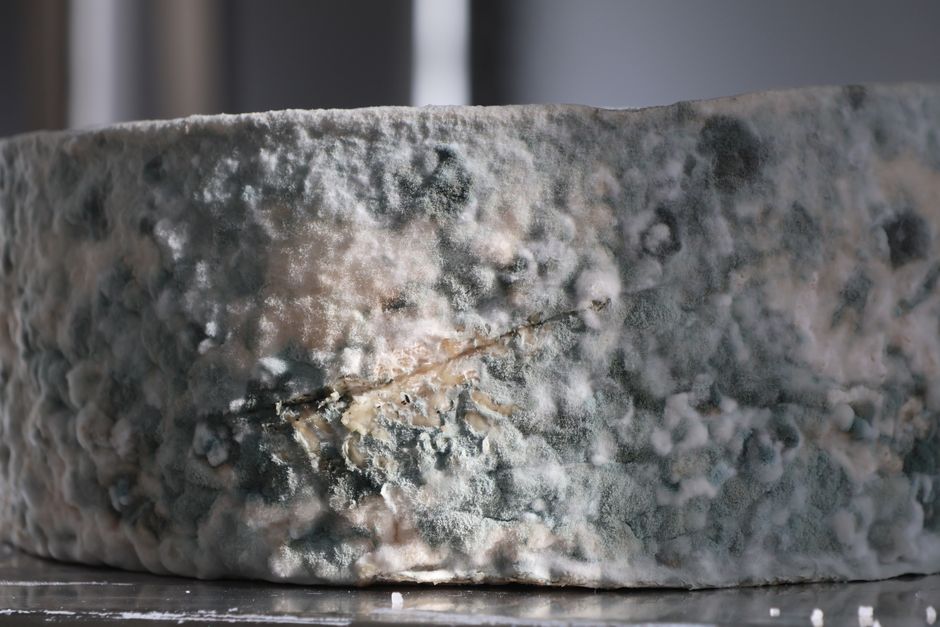
Yes, Brie has mold — and that white fuzzy rind is supposed to be there. The mold on Brie is a specific, edible type called Penicillium camemberti, and it is what gives the cheese its soft, creamy interior and earthy flavor. It is safe to eat.
What is not safe is the mold that shows up later: green, blue, or black patches, or fuzzy spots that were not part of the original rind. That is spoilage mold, and it is a different situation entirely. The short version: white rind, fine. Other colors, toss it.
What Is the White Rind on Brie Actually Made Of?
The white coating on Brie is a living mold culture that was deliberately introduced during cheesemaking. It belongs to the same genus as the mold used to make Camembert, and it has been part of French cheesemaking for centuries.
Here is how it works. During production, the cheesemaker either sprays the surface of the fresh curd with Penicillium camemberti spores or adds them to the milk. As the cheese sits in a temperature- and humidity-controlled room, the mold grows across the surface and forms that characteristic bloomy rind.
The mold does more than sit on top. It changes the cheese from the outside in. As it grows, it produces enzymes that break down proteins and fats. This is why a young Brie is firm and chalky in the center, while a ripe one becomes soft and runny near the rind. The rind is doing active work on the cheese.
That white rind is sometimes called a “bloomy rind,” which is the technical term for this style of cheese. It is not a sign of spoilage. It is the intended product.
Does Brie Have Mold and Is It Safe to Eat?
The mold on Brie is safe to eat for most healthy adults. It is a food-grade mold, not a contaminant, and it has a long history of human consumption.
That said, “safe for most people” is not the same as “safe for everyone.” The mold itself is generally well tolerated, but there are two separate concerns worth understanding.
The first is the mold. Penicillium camemberti is not the same species as the mold that produces penicillin antibiotics, though they share a genus name. People with a penicillin allergy are sometimes advised to be cautious with mold-ripened cheeses, though reactions are uncommon and the evidence is not clear-cut. If you have a serious penicillin allergy, talk to your doctor before eating the rind.
The second concern is not the mold at all — it is the cheese. Soft cheeses like Brie are more likely to carry Listeria than hard cheeses, because they are moist, less acidic, and not aged long enough for the environment to become hostile to bacteria. This matters enormously for certain groups. More on that below.
When Is Mold on Brie a Problem?
Mold becomes a problem when it is the wrong mold. The rind you want is white, thin, and evenly distributed. Anything else is a warning sign.
Watch for these:
- Green, blue, black, or orange patches on the rind or in the paste
- Fuzzy growth that looks different in texture from the original rind
- Pink or reddish slime
- A strong ammonia smell, which can indicate over-ripening or spoilage
- Any mold growing on cut surfaces of the cheese
Here is the part many people get wrong. You cannot simply cut the mold off soft cheese and eat the rest. On hard cheeses like cheddar or Parmesan, you can cut away an inch around the mold and the remainder is usually fine, because hard cheese is dense and mold spreads slowly. Brie is soft and moist. Mold roots can extend well beyond what you can see, and invisible threads may already have spread through the cheese.
If spoilage mold appears on Brie, throw the whole piece away. Do not try to salvage it.
Who Should Avoid Eating Brie Rind?
Some people should avoid soft mold-ripened cheeses entirely, rind and all. This is not about the mold. It is about Listeria monocytogenes, a bacterium that can cause serious illness.
The groups at higher risk include:
- Pregnant women
- Adults over 65
- People with weakened immune systems
- Infants and young children
For pregnant women, public health agencies in the United States and other countries advise avoiding soft cheeses like Brie, Camembert, and feta unless the label clearly states they are made with pasteurized milk. Even pasteurized soft cheese carries some risk, because contamination can happen after pasteurization. Many clinicians advise avoiding soft mold-ripened cheese during pregnancy altogether. This is established guidance, not a gray area.
Listeria is rare, but it is dangerous. In pregnant women it can cause miscarriage, stillbirth, or serious infection in a newborn. In older adults and immunocompromised people, it can lead to bloodstream infection or meningitis. The risk from any single serving is low. The consequences when it happens are severe enough that public health guidance takes a cautious stance.
If you are in one of these groups and you want a definitive answer for your situation, ask your doctor. Guidance can vary based on individual health factors.
How Should You Store Brie to Keep It Fresh?
Proper storage slows spoilage but does not stop it. Brie is a perishable cheese with a limited window.
Wrap Brie in wax paper or parchment, then loosely in plastic wrap, or place it in a paper bag inside a plastic container. The goal is to let it breathe slightly while keeping it from drying out. Tight plastic wrap traps moisture and can encourage the wrong kinds of mold and bacteria.
Keep it in the refrigerator, ideally in a drawer where the temperature is more stable. Take it out about 30 minutes before serving — Brie tastes best closer to room temperature.
Once cut, Brie keeps for roughly a week to two weeks in the refrigerator, depending on how ripe it was when you bought it. After that, the rind may darken, the texture may become ammoniated, and spoilage risk climbs. Use your senses. If it smells sharply of ammonia, looks discolored, or has developed any fuzzy growth beyond the original white rind, discard it.
Brie does not freeze well. The texture breaks down and becomes grainy after thawing.
Can You Eat the Rind, or Should You Cut It Off?
You can eat the rind. It is meant to be eaten, and in most traditional French serving, it is. The rind is edible and contributes flavor and texture.
That said, plenty of people prefer to cut it off, and that is fine too. There is no rule. Some find the rind slightly bitter or chewy. Others think the cheese is incomplete without it. It comes down to preference.
One practical note: if you are serving Brie to guests, especially anyone pregnant, older, or immunocompromised, it is worth mentioning what is on the plate. Not everyone knows that soft cheese carries a higher listeria risk, and some guests may want to pass on it for that reason.
Does Cooking Brie Make It Safer?
Heat kills Listeria and spoilage organisms, so baked Brie is generally considered lower risk than raw Brie for people in higher-risk groups. The cheese needs to reach a sufficient internal temperature for the bacteria to be destroyed, which happens well before the cheese would burn or break down.
This is why some clinicians tell pregnant women that thoroughly cooked soft cheese is a safer option than raw. The caveat is that you cannot always be sure how evenly a piece of baked Brie has heated through, especially in a large wheel. If you are pregnant and considering baked Brie, ask your doctor rather than relying on a general rule.
Cooking does not make spoiled cheese safe. If Brie has developed spoilage mold or an off smell, heat will not fix that. Throw it out.
The Bottom Line
The white rind on Brie is edible mold, and it is supposed to be there. It is safe for most healthy adults. Green, blue, black, or fuzzy mold is spoilage, and soft cheese cannot be salvaged by cutting the mold away.
If you are pregnant, over 65, or immunocompromised, the concern is not the mold — it is Listeria. Established public health guidance advises avoiding soft mold-ripened cheeses in these situations unless you have confirmed with your doctor that it is appropriate for you.
Frequently Asked Questions
Is the white mold on Brie safe to eat?
Yes, the white rind is an edible mold called Penicillium camemberti and is safe for most healthy adults. It is intentionally added during cheesemaking and is not a sign of spoilage.
Can you cut mold off Brie and eat the rest?
No. Soft cheeses like Brie allow mold roots to spread invisibly through the cheese, so cutting away visible mold does not make the rest safe. If spoilage mold appears, discard the whole piece.
Can pregnant women eat Brie?
Public health guidance advises pregnant women to avoid soft mold-ripened cheeses like Brie because of Listeria risk, even when made with pasteurized milk. Ask your doctor for guidance specific to your situation.
What does bad mold on Brie look like?
Spoilage mold appears as green, blue, black, orange, or pink patches, or as fuzzy growth that looks different from the original white rind. A strong ammonia smell is another sign the cheese should be discarded.
