
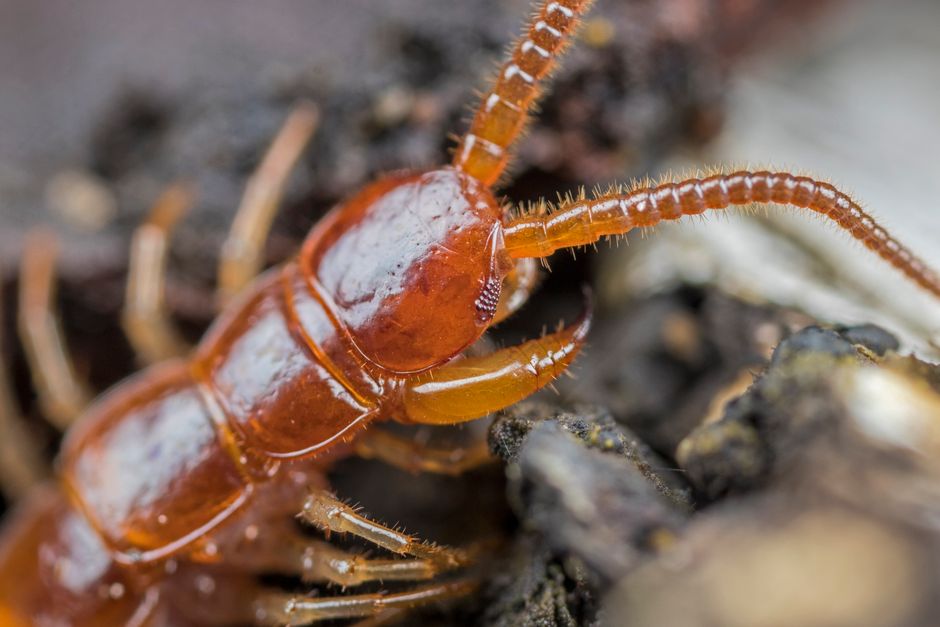
A house centipede can bite, but it rarely does. Its fangs are usually too weak to break human skin, and the animal would rather run away than fight. When a bite does happen, it typically causes mild redness and swelling that clears up on its own.
House centipedes look alarming. Long legs, fast movement, a body that seems to ripple across the bathroom floor at night. But the gap between how threatening they look and how dangerous they actually are is enormous. Here is what the evidence shows.
What Is a House Centipede?
The house centipede is a distinct species, Scutigera coleoptrata. It is not a millipede and not an insect. It belongs to a group called centipedes, which are arthropods with one pair of legs per body segment.
An adult house centipede has 15 pairs of legs. That is 30 legs total. They are long, thin, and banded with dark stripes. The body is tan to grayish-yellow, usually about 1 to 1.5 inches long, though the legs make it appear much larger.
One feature sets it apart from other centipedes. House centipedes have evolved legs that detach when grabbed. A predator ends up with a wiggling leg while the centipede escapes. This is called autotomy, and it is one reason the animal survives so well indoors.
House centipedes are nocturnal. They hunt at night and hide during the day in dark, damp places. Basements, bathrooms, closets, and behind baseboards are common. They are fast. A house centipede can move at roughly 1.3 feet per second, which is why they seem to appear and vanish in an instant.
Does a House Centipede Bite Humans?
Yes, a house centipede is capable of biting a human. But it rarely does, and most encounters never result in a bite.
The reason comes down to anatomy. A house centipede’s fangs, called forcipules, are modified front legs used to inject venom into prey. Compared to larger centipede species, these fangs are small and relatively weak. In most cases, they cannot penetrate human skin. When they can, the bite is shallow.
House centipedes are also not aggressive toward people. They have no reason to bite a human. They cannot eat us. Their venom evolved to subdue small insects, not to defend against large mammals. When threatened, their first response is to flee. They will only bite if trapped, squeezed, or pressed against skin.
This is the key point. Most reported house centipede bites happen when someone rolls over onto one in bed, puts on a shoe that has one inside, or picks one up barehanded. Accidental contact, not attack.
What Does a House Centipede Bite Feel Like?
If a bite does occur, most people describe it as similar to a mild bee sting or an ant bite. There may be a sharp pinch at the moment of the bite, followed by redness and a small raised area.
The venom of a house centipede is not considered medically significant to humans. It is designed for small invertebrates. In the rare cases where a bite breaks the skin, symptoms are usually limited to:
- Redness around the bite site
- Mild swelling
- A small puncture mark or two tiny dots
- Local itching or a brief stinging sensation
These symptoms typically resolve within a few hours to a couple of days. Some people may notice nothing at all beyond a red spot.
There is one important caveat. Individual reactions vary. A person with allergies to insect venoms could have a stronger response. Anyone who experiences swelling that spreads well beyond the bite, difficulty breathing, chest tightness, or a widespread rash should seek medical attention. That said, severe reactions to house centipede bites are not well documented in the medical literature, and anaphylaxis from this species is considered rare.
If you are unsure what bit you, and the wound is growing, becoming very painful, or showing signs of infection like pus or increasing heat, see a doctor. That advice applies to any bite, not just centipedes.


Are House Centipedes Dangerous?
No. House centipedes are not dangerous to humans in any meaningful way. They are not venomous in the sense that a black widow or brown recluse is venomous. Their venom is real but weak against large animals, and their fangs usually cannot deliver it through human skin.
The bigger risk from a house centipede is not the bite. It is the startle. People who discover one on their arm or leg often jerk or fall, and that reaction can cause more harm than the animal itself.
There is also no evidence that house centipedes transmit disease to humans. They do not carry pathogens the way ticks or mosquitoes do. They are not known to spread illness through bites.
For context, other centipede species around the world are a different story. Large tropical centipedes in the genus Scolopendra can deliver painful bites that cause significant swelling, and in rare cases more serious symptoms. Those are not house centipedes. Scutigera coleoptrata is a much milder animal.
Do House Centipedes Actually Help in the Home?
This is where the story gets interesting. House centipedes are predators, and their prey is other household pests.
They eat cockroaches, silverfish, ants, bed bugs, termites, spiders, and carpet beetles. They are one of the few predators that will actively hunt silverfish and cockroach nymphs in the dark corners of a home. A single house centipede can consume several pests per week.
Some pest control professionals consider them beneficial. Killing every house centipede may lead to more of the pests they were controlling. This is a genuine trade-off, not a marketing claim.
That said, having house centipedes usually signals something else. They need moisture and food. If you are seeing many of them, there is likely a population of other insects and a damp environment supporting both. Addressing the underlying moisture and the prey insects is more effective than chasing the centipedes themselves.
How Do You Avoid Getting Bitten?
Avoiding a house centipede bite is mostly about avoiding accidental contact. The animal will not seek you out.
- Shake out shoes, slippers, and clothing before putting them on, especially if stored on the floor.
- Check bedding if you live in a home with known centipede activity.
- Do not pick up a house centipede with bare hands. Use a cup and a piece of paper if you need to move one.
- Reduce clutter and moisture in basements and bathrooms, which reduces both centipedes and their prey.
- Fix leaky pipes and improve ventilation in damp areas.
If you do get bitten, wash the area with soap and water. A cool compress can ease swelling. Over-the-counter hydrocortisone or an antihistamine may help with itching. Most bites need nothing more than that.
Do not try to suck out venom or cut the wound. Those methods do not work and can cause infection.
Should You Be Worried About House Centipedes?
No. A house centipede is a harmless houseguest in almost every practical sense. It looks frightening, moves fast, and has far too many legs for most people’s comfort. But its bite is rare, weak, and rarely breaks the skin.
The honest summary is this. House centipedes can bite, but the odds of being bitten are low, and the consequences are usually minor. If you see one, you have a choice. Let it hunt the pests you cannot see, or move it outside. Either way, it is not a threat to your health.
Frequently Asked Questions
Does a house centipede bite?
Yes, a house centipede can bite, but it rarely does and its fangs usually cannot break human skin. Bites typically happen only when the centipede is trapped or pressed against skin.
Is a house centipede bite dangerous?
No, a house centipede bite is not considered medically dangerous to humans. Symptoms are usually mild redness and swelling that clear up on their own within a short time.
What does a house centipede bite look like?
It usually looks like a small red spot or a minor raised bump, sometimes with two tiny puncture marks. Most people describe the sensation as similar to a mild ant bite.
Do house centipedes bite in bed?
Bites in bed are possible but uncommon, and they almost always happen when someone rolls onto a centipede by accident. House centipedes do not seek out people to bite.
