
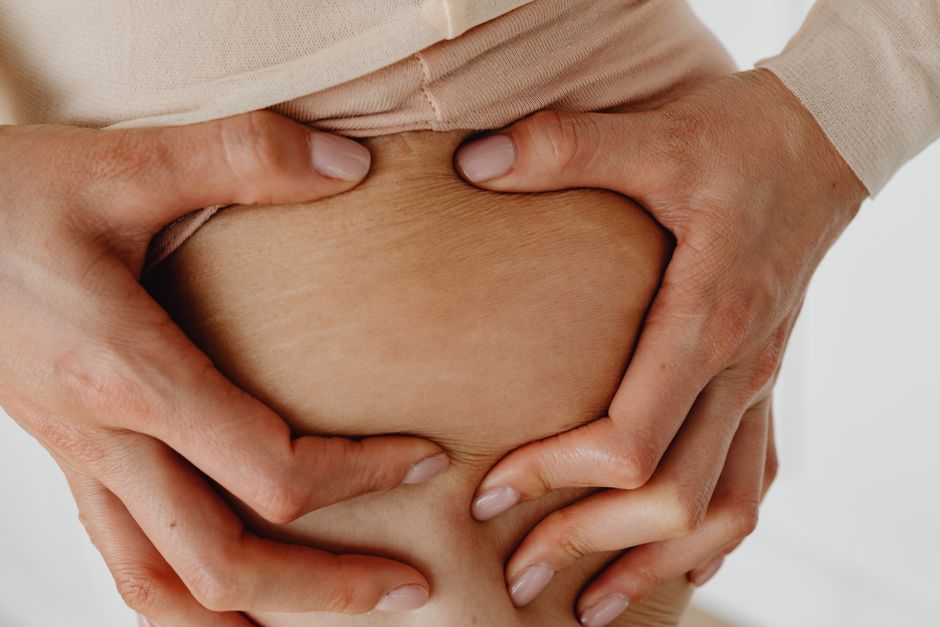
Stretch marks do not go away when you lose weight. Weight loss can make them less noticeable, but it will not erase them. Stretch marks are a permanent change in the deeper layers of your skin, and losing weight does not remove the scar tissue that creates them.
What Causes Stretch Marks in the First Place?
Stretch marks form when your skin stretches faster than it can keep up with. This happens most often during rapid growth, pregnancy, or quick weight gain. The middle layer of your skin, called the dermis, tears when it is pulled too hard too quickly.
Those tears heal as scar tissue. That scar tissue looks different from the rest of your skin. It starts out red, purple, or pink because blood vessels are still forming in the damaged area. Over time, those blood vessels shrink, and the marks fade to a lighter, often silvery or white color.
Weight gain is only one trigger. Hormones also play a role. Cortisol, the stress hormone, can weaken the skin’s elasticity. This is why stretch marks can appear during puberty or with certain medical conditions even without significant weight change.
Why Weight Loss Does Not Remove Stretch Marks
Losing weight reduces the size of your fat cells, but it does not repair the tears in your dermis. The scar tissue is already formed. Shrinking the fat underneath does not rebuild the collagen fibers that broke.
Think of it like a tear in a fabric. If you remove the stuffing from a cushion, the tear in the fabric does not sew itself back together. The damage to the material remains. The same principle applies to your skin.
Weight loss can change how stretch marks look. When the skin is less stretched, the marks may appear closer together. They may also become less prominent against a smaller surface area. But the marks themselves stay.
Do Stretch Marks Go Away When You Lose Weight? What Actually Changes
The short answer is no, but the appearance can improve. Weight loss often makes stretch marks less obvious for a few reasons.
First, the skin around the marks becomes looser. This reduces the tension that can make marks look deep or wide. Second, as you lose weight, the contrast between the mark and the surrounding skin may soften. This is especially true if the marks are still in the red or purple stage.
There is a catch. Losing weight very quickly can create new stretch marks. Rapid weight loss is often accompanied by muscle loss and skin laxity. The skin may sag, and new stretch marks can form if the skin is still being stressed during the process.
Slow, steady weight loss is easier on your skin. It gives the skin time to adapt. But even with gradual loss, existing stretch marks will not disappear.





How Long Do Stretch Marks Take to Fade?
Stretch marks change over time, but the timeline varies from person to person. Fresh marks, the red or purple ones, typically fade to a lighter color over several months to a couple of years. This fading is a natural process, not a cure.
The color change happens because the blood vessels in the scar tissue eventually shrink. Once a mark turns white or silver, it has reached its final stage. At this point, it is unlikely to change much on its own.
Your age and genetics influence how quickly this happens. Younger skin tends to heal faster and may show more dramatic fading. Older skin, or skin that has been damaged by sun exposure, may take longer. But no timeline guarantees complete disappearance.
Treatments That Can Reduce the Appearance
If you want to reduce the look of stretch marks, some treatments have evidence behind them. None of them remove marks completely, but they can improve texture and color.
Topical creams containing tretinoin, a prescription retinoid, have shown some benefit in clinical studies. Tretinoin works by promoting collagen production in the skin. It is most effective on newer, red or purple marks. It is not recommended during pregnancy because of potential risks to the baby.
Laser therapy is another option. Vascular lasers target the blood vessels in newer marks, which can speed up fading. Fractional lasers work on older, white marks by stimulating new collagen growth. Results vary, and multiple sessions are usually needed.
Microneedling is a procedure where tiny needles create controlled micro-injuries in the skin. This triggers a healing response that produces collagen. Some studies suggest it can improve the texture of stretch marks, but the evidence is not as strong as it is for lasers or tretinoin.
Here is what the evidence does not support:
- Cocoa butter
- Olive oil
- Almond oil
- Vitamin E oil
These are widely marketed for stretch marks. Research has not confirmed that any of them prevent or reduce stretch marks. They can moisturize the skin, which may improve its overall feel, but they do not repair scar tissue.
Can You Prevent Stretch Marks During Weight Loss?
You cannot fully prevent stretch marks, but you can reduce your risk. The key is avoiding rapid changes in your body size.
Losing weight at a steady pace, about 1 to 2 pounds per week, gives your skin time to adjust. Crash diets and extreme calorie restriction put you at higher risk for new marks. The skin simply cannot keep up with sudden changes.
Staying hydrated helps your skin maintain its elasticity. Dehydrated skin is less flexible and more prone to tearing. Drinking enough water is a simple step, but it is not a guarantee against stretch marks.
Strength training during weight loss can help. Building muscle fills out the skin from underneath, which may reduce the loose, sagging appearance that often accompanies fat loss. More muscle mass also supports the skin’s structure.
There is no cream, oil, or supplement that has been proven to prevent stretch marks. If a product claims otherwise, it is not backed by solid science.
When to See a Dermatologist
Stretch marks are harmless. They do not pose any health risk. But if they bother you, a dermatologist can help you understand your options.
See a dermatologist if your stretch marks appeared suddenly without a clear cause. In rare cases, marks that spread rapidly can be a sign of an underlying condition like Cushing’s syndrome, which involves high cortisol levels. This is uncommon, but worth checking.
A dermatologist can also tell you which treatment, if any, is right for your skin type. Not every treatment works for every person. A professional evaluation is the best way to avoid wasting money on products that will not help.
The Bottom Line on Stretch Marks and Weight Loss
Stretch marks are permanent. Weight loss will not make them go away. It can make them less noticeable, especially if they are still in the early stages, but the scar tissue remains.
Accepting that stretch marks are a normal part of having skin is often the healthiest approach. Most adults have them. They are not a sign of poor health or failed weight loss.
If you choose to pursue treatment, do so with realistic expectations. The goal is improvement, not elimination. And if you are losing weight, do it gradually. That is the single most effective thing you can do to avoid adding new marks while the old ones fade.
Frequently Asked Questions
Will stretch marks fade after weight loss?
They can become less noticeable, but they will not disappear. Weight loss reduces skin tension, which can make marks look less prominent over time.
Do old white stretch marks ever go away?
No, white stretch marks are fully formed scar tissue and will not go away on their own. Treatments like fractional lasers may improve their appearance, but they cannot remove them completely.
Can losing weight fast cause new stretch marks?
Yes, rapid weight loss can create new stretch marks. Quick changes in body size stress the skin and can cause additional tearing in the dermis.
What actually works to reduce stretch marks?
Prescription tretinoin cream and laser therapy have the strongest evidence for improving appearance. These treatments work best on newer marks and require multiple sessions or months of use.
