
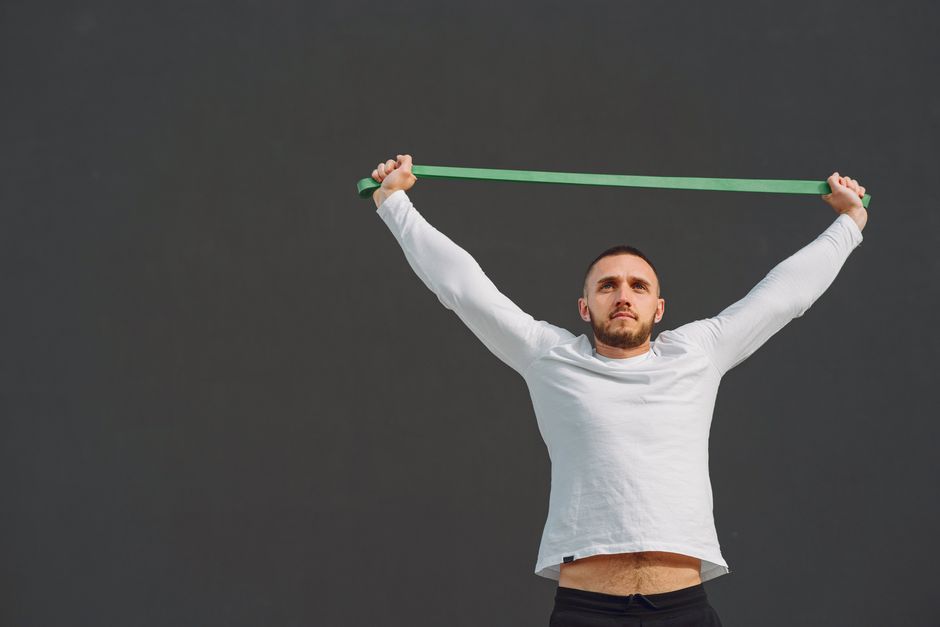
Yes, resistance bands can build muscle. Research consistently shows that when you take a muscle close to fatigue, it grows regardless of whether the resistance comes from weights, machines, or bands. The key is tension, not the tool itself.
Bands provide a unique type of resistance that gets harder as you stretch them. This is different from dumbbells, where the weight feels the same throughout the movement. Understanding this difference helps you train smarter and get real results.
How Do Resistance Bands Actually Build Muscle?
Muscle growth happens when muscle fibers experience tension they are not used to. This tension causes microscopic damage. Your body repairs that damage, and the muscle grows back slightly stronger and larger.
Resistance bands create this tension through elasticity. As you stretch the band, it pulls harder. This is called progressive resistance. The more you stretch, the more force you must produce to complete the movement.
Studies have found that training with resistance bands produces similar muscle growth to traditional weight training when the exercises are performed with similar effort. The muscle does not know whether the resistance comes from iron or rubber. It only knows tension and fatigue.
Does Band Tension Differ From Free Weights?
Yes, and this matters for how you train. A dumbbell has a constant load. The hardest part of a bicep curl with a dumbbell is usually the middle, where leverage is weakest. With a band, the hardest part is at the end of the movement, where the band is most stretched.
This means bands train the “lockout” portion of an exercise more intensely. For pressing movements like chest presses or shoulder presses, this is beneficial. The end range is often where you are strongest with free weights, so bands can challenge that position effectively.
However, bands provide less resistance at the start of a movement. The first few inches of a band exercise feel easy. You must focus on slow, controlled reps to keep tension on the muscle throughout the entire range of motion.
What Does the Research Say About Band Training?
Several studies have compared resistance band training directly to conventional weight training. The results are consistent: both methods produce significant increases in muscle strength and size when the training is matched for effort.
One key finding is that the total time under tension matters more than the type of resistance. If you perform a set of band squats until your legs burn and you cannot do another rep, you have stimulated growth similarly to a set of barbell squats done to the same point of fatigue.
Some research suggests that bands may be slightly less effective for maximal strength gains in advanced lifters. This makes sense. Advanced lifters need heavy loads to continue progressing. Bands have a limit to how much resistance they can provide, especially for large muscle groups like the legs and back.
For beginners and intermediate lifters, bands are highly effective. For advanced lifters, bands work best as a supplement to heavy weights or as a tool for high-repetition training.





Do Resistance Bands Build Muscle as Fast as Weights?
For a new lifter, yes. The initial phase of muscle growth is driven by your nervous system learning to activate muscle fibers. Bands provide enough stimulus for this adaptation to occur.
Research indicates that untrained individuals gain muscle at a similar rate whether they use bands or dumbbells over a period of several weeks. The body responds to the new demand placed on it.
However, weights have an advantage over time. You can add small increments of weight easily. With bands, you must switch to a thicker band or double up bands to increase resistance. This is less precise. The jump in resistance between band levels can be significant, which may slow your progress slightly.
That said, you can still make consistent progress with bands for years. You just need to be creative. Using multiple bands, slowing down your reps, and pausing at the hardest point of the movement all increase difficulty without adding more bands.
How Should You Train With Bands for Muscle Growth?
Muscle growth requires you to push your muscles close to failure. This is non-negotiable. The last few reps of a set are the ones that signal your body to grow muscle.
Choose a band that makes the final reps of your set very difficult. If you can perform 15 reps easily, the band is too light. You should struggle to complete the last two or three reps with good form.
Aim for 8 to 15 repetitions per set. This repetition range is well established for muscle growth. Perform 3 to 4 sets per exercise. Rest for 60 to 90 seconds between sets.
Focus on the eccentric, or lowering, phase of the movement. Lower the band slowly over three seconds. This increases time under tension and causes more muscle damage, which stimulates growth.
Which Muscles Can You Train Effectively With Bands?
You can train every major muscle group with bands. The key is anchoring the band properly. You can step on a band for bicep curls and shoulder presses. You can attach it to a door anchor for chest flies and tricep pushdowns.
Lower body exercises work exceptionally well with bands. Squats, hip thrusts, and glute bridges all respond well to band resistance. The band adds the most tension at the top of these movements, which is where your glutes and quads are fully engaged.
Back exercises require a door anchor or a sturdy post. Seated rows and lat pulldowns work well with bands. You can also loop a band around a pole for horizontal pulls.
One limitation is grip strength. Bands do not challenge your grip the way heavy dumbbells do. If grip strength matters to you, incorporate some free weight work or use a grip strengthener separately.
What Are the Limits of Resistance Bands?
Bands cannot provide the same maximum load as a barbell loaded with hundreds of pounds. If your goal is maximal strength in squatting or deadlifting, bands alone will not get you there.
For muscle size, the limits are less clear. Some research suggests that muscle growth can be achieved with relatively light loads as long as you train to fatigue. Bands fit this model well. You may not lift as heavy, but you can still stimulate growth.
Another limitation is measuring progress. With weights, you know exactly how much you lifted. With bands, resistance depends on how far you stretch them. This makes it harder to track improvement objectively. You must judge progress by how the exercise feels and how many reps you can complete.
Are Bands Enough for a Complete Workout?
Yes, for most people. A full-body routine using bands can build muscle effectively. You need a set of bands with varying resistance levels, a door anchor, and a flat surface to stand on.
Research supports the use of bands as a standalone training tool. Studies have shown significant strength and muscle gains in people who used only bands for their training. This includes both upper and lower body exercises.
The main concern is progression. As you get stronger, you will need thicker bands or multiple bands used together. This is manageable, but it requires planning. A good band set includes light, medium, and heavy bands that can be combined.
Frequently Asked Questions
Can you build muscle with just resistance bands?
Yes, you can build muscle using only resistance bands. Studies show that training with bands produces similar muscle growth to weights when you train with enough effort.
How long does it take to see results from resistance bands?
You may notice strength improvements within a few weeks. Visible muscle growth typically takes about 8 to 12 weeks of consistent training.
Are resistance bands as good as weights for muscle growth?
For beginners and intermediate lifters, bands are comparable to weights for muscle growth. Advanced lifters may need heavier loads that bands cannot provide.
How many reps should I do with resistance bands to build muscle?
Performing 8 to 15 repetitions per set is effective for muscle growth. The last few reps of each set should be challenging to complete.
