
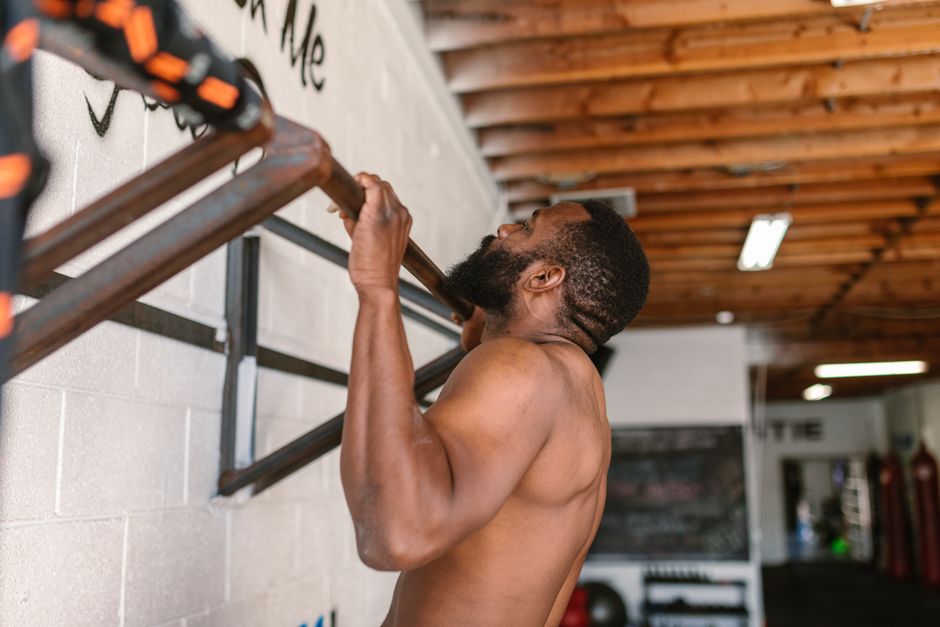
Pull ups are one of the best upper-body exercises you can do, but they are not a chest-building exercise in the way most people mean it. They work the chest a little, mostly the lower portion, while doing far more for your back and arms. If your goal is a bigger, stronger chest, pull ups alone will not get you there.
The confusion comes from the fact that pull ups and push ups sound similar and both work the upper body. They do very different things. Understanding which muscles each one actually targets helps you build a training plan that matches your goals.
What Muscles Do Pull Ups Actually Work?
Pull ups are a back exercise first. The prime movers are the latissimus dorsi, the large muscles that run down the sides of your back and give it width. Alongside them, the teres major, rhomboids, and trapezius all contribute to pulling your body up toward the bar.
Your biceps and forearms work hard too. Every pull up is also a biceps curl with your bodyweight as the load. That is why people who do a lot of pull ups often develop impressive arm strength without ever touching a dumbbell.
The chest does get involved, but as a supporting player. Specifically, the lower portion of the pectoralis major, called the sternal head, assists with the movement. The upper chest, the clavicular head, contributes very little because the angle of a standard pull up does not load it well.
This is the key point. A muscle can be active during an exercise without being trained hard enough to grow. Research using electromyography, which measures electrical activity in muscles during movement, consistently shows the lats and biceps doing most of the work in a pull up, with the chest contributing at a much lower level.
Do Pull Ups Work Chest? The Honest Answer
Pull ups work the chest, but not enough to build it. The pectoralis major is active during a pull up, mainly to help stabilize the shoulder and assist with bringing your upper arm down and back. That is a real contribution, but it is not the kind of load that drives meaningful chest growth.
Think about what builds a muscle. To grow, a muscle needs to be challenged near its limits through a full range of motion, repeatedly, over time. During a pull up, your chest is not the limiting factor. Your back and arms fatigue first. That means the chest never gets pushed close to its own limit, which is what triggers growth.
There is also a range-of-motion problem. The chest’s main job is to push your arms forward and across your body. Pull ups move your arms in the opposite direction, pulling them down and back. The chest assists this, but it is not the movement pattern the chest is built for.
So the accurate statement is this: pull ups involve the chest, but they do not train it in a way that produces significant growth. If you only do pull ups, your chest will not develop the way your back will.
Why Pull Ups and Push Ups Are Not Interchangeable
These two exercises are opposites, and that is exactly why they work well together. Pull ups are a pulling movement. Push ups are a pushing movement. Your chest is a pushing muscle.
During a push up, your pectoralis major is the primary mover. Your arms push away from your body and the chest does the heavy lifting, with help from the front shoulders and triceps. That is the movement pattern your chest is designed for.
Pull ups reverse the direction. You pull your body toward the bar, and the back and biceps take over. The chest plays a minor supporting role.
This is why a balanced upper-body program includes both. Relying on one direction and skipping the other creates imbalances. Too much pulling and not enough pushing can contribute to posture issues and uneven development. Too much pushing and not enough pulling is a common problem among people who only bench press and do push ups.





Can You Build Chest With Pull Ups Alone?
No. If your goal is chest development, pull ups alone will not get you there. This is not a matter of doing more of them or trying harder. It is about the mechanics of the movement.
You could do hundreds of pull ups and your back and arms would grow, but your chest would lag behind. The stimulus simply is not there. Muscle growth follows the specific demand placed on it, and pull ups do not place enough demand on the chest.
That said, pull ups are still extremely valuable. They build a wide, strong back, improve grip strength, and train your biceps hard. A strong back supports good posture and helps with many other lifts. Pull ups earn their place in almost any program. They just are not a chest exercise.
If you want to build your chest, you need pushing movements. Push ups, bench presses, dumbbell presses, dips, and chest fly variations all load the chest directly. These are the exercises that drive chest growth.
Do Any Pull Up Variations Hit the Chest More?
Some variations shift a little more work toward the chest, but none turn a pull up into a true chest builder. The change is modest.
Wide-grip pull ups change the angle slightly and can increase chest involvement a bit compared with a narrow grip. Chin ups, where your palms face you, emphasize the biceps more and the chest about the same or less. Weighted pull ups increase the load on everything, including the chest, but the back and arms still do most of the work.
None of these variations change the fundamental direction of the movement. The chest is still assisting rather than driving. If you enjoy pull ups and want to add chest work, the better move is to add pushing exercises rather than trying to reinvent the pull up.
One related exercise worth knowing is the dip. Dips are a pushing movement, and leaning your torso forward during a dip shifts more load onto the chest. Dips are far closer to a chest exercise than any pull up variation.
How to Train Your Chest and Back Together
The simplest approach is to pair pulling and pushing movements in the same program. This keeps your upper body balanced and covers all the major muscles.
- For your back: pull ups, chin ups, rows, and lat pulldowns
- For your chest: push ups, bench press, dumbbell press, dips, and chest fly variations
- For your shoulders: overhead pressing and lateral raises
- For your arms: the pulling and pushing work above already trains biceps and triceps
If you are new to pull ups, do not be discouraged if you cannot do one yet. Assisted versions using a band or a machine, and negative reps where you lower yourself slowly from the top, are common ways to build toward your first full pull up. These are widely used in training, though how quickly any one person progresses varies a lot.
If your goal is a stronger chest, prioritize pushing movements and use pull ups to build the back that supports them. The two work together. They just do not do the same job.
Frequently Asked Questions
Do pull ups build chest muscle?
Pull ups involve the chest but do not build it significantly, because the back and arms do most of the work and fatigue first. For chest growth, pushing exercises like push ups and presses are far more effective.
Which part of the chest do pull ups work?
Pull ups mainly involve the lower portion of the pectoralis major, called the sternal head, as a supporting muscle. The upper chest contributes very little because of the angle of the movement.
Are pull ups or push ups better for chest?
Push ups are far better for chest development because your chest is the primary mover in a pushing motion. Pull ups are a pulling exercise that mainly trains your back and biceps.
Can I build a big chest with only pull ups?
No. Pull ups alone will not build significant chest muscle because the movement does not load the chest heavily enough. You need pushing exercises to develop your chest.
