
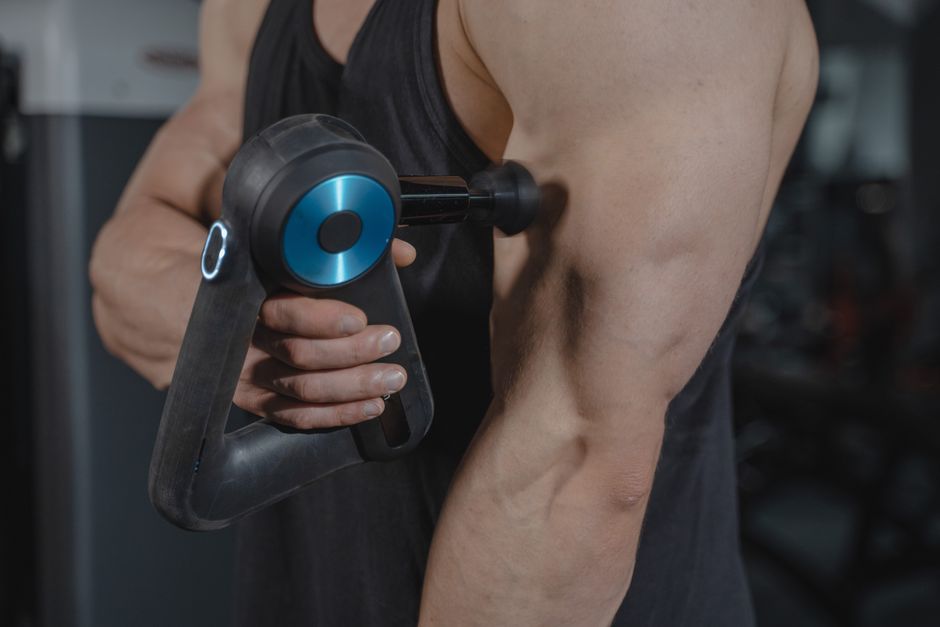
Massage guns are handheld devices that deliver rapid, repetitive pulses of pressure into muscle tissue. They have become one of the most popular recovery tools in gyms and homes, and the marketing around them is loud. The honest answer: they can produce real, short-term relief from muscle soreness and tightness, but the evidence for lasting benefits like faster recovery, injury prevention, or performance gains is limited and mixed.
What Does a Massage Gun Actually Do?
A massage gun uses a motor to drive a padded head back and forth at high speed, typically somewhere between roughly 1,200 and 3,200 percussions per minute depending on the device and setting. The head presses into your skin and the tissue beneath it, creating a mechanical vibration and pressure that travels into the muscle.
That mechanical force is the whole mechanism. It is not electrical stimulation, it is not ultrasound, and it does not “break up” scar tissue or flush toxins. The vibration stimulates sensory receptors in the muscle and surrounding tissue, which appears to be the main reason people feel looser and more comfortable after using one.
This is a meaningful distinction. Many product claims describe effects that would require the device to do something physically different from what it does. When a claim sounds like it involves changing tissue structure or chemistry, that claim usually outruns the mechanism.
Do Massage Guns Really Relieve Soreness?
For short-term relief of delayed onset muscle soreness, the evidence is encouraging but not overwhelming. Some studies suggest percussion therapy reduces how sore people feel in the days after exercise compared with doing nothing, though the quality and size of these studies vary.
The relief is real for many people. It is also temporary. Soreness typically eases on its own within a few days, and a massage gun does not appear to shorten that window dramatically. What it may do is make the sore period more tolerable.
Part of the effect may be what researchers call a gate-control response. The vibration and pressure from the device send signals along the same nerve pathways that carry pain, and those competing signals can dampen how much pain you perceive. This is a well-established principle in pain physiology, and it helps explain why many people feel better during and shortly after use.
That also means some of the relief is about how the tissue feels, not necessarily about what has changed inside it. Feeling better is a legitimate outcome. It just is not the same as faster tissue repair.
Can Massage Guns Speed Up Recovery or Improve Performance?
This is where the marketing runs well ahead of the science. Claims that a massage gun flushes lactic acid, accelerates muscle repair, or boosts athletic performance are not well supported by strong human trials.
Lactic acid is a good example of a myth worth correcting. Lactate clears from muscle within roughly an hour after intense exercise on its own, through normal metabolism. It is not sitting in your muscle waiting to be massaged out. A device applied to the surface of the skin would not be the thing clearing it anyway.
Some small studies have looked at whether percussion devices affect range of motion or perceived readiness. Results are mixed. Some show modest improvements in how flexible or ready people feel, and others show little difference from a light warm-up or simply resting. The evidence is not strong enough to say a massage gun improves performance in any reliable way.
Where it may help is in how you feel going into a workout or how you feel the day after. That is a real benefit for some people, even if it is not the physiological overhaul the ads suggest.




Are There Real Risks to Using One?
For most healthy adults using a massage gun on large muscle groups, the risk of serious harm appears low. But “low risk” is not “no risk,” and there are places you should not use one.
Avoid using a massage gun on:
- Your neck, especially the front and sides, where major blood vessels and nerves sit close to the surface
- Your spine and the bony points of your back
- Any area with an open wound, bruise, swelling, or recent injury
- Joints, where there is little muscle to cushion the impact
- Areas with numbness or loss of sensation, where you might not feel damage occurring
There are groups who should talk to a clinician before using one at all. That includes people who are pregnant, people with a history of blood clots, people taking blood-thinning medication, people with nerve conditions, and anyone recovering from surgery or a fracture. The evidence on safety in these groups is limited, and the stakes of getting it wrong are higher.
Applying a massage gun directly over a blood vessel or nerve is a specific concern. The front of the neck is the clearest example. Pressure there is not something to experiment with.
How Do You Use One Sensibly?
If you are going to use a massage gun, a few general principles apply. Move the head slowly over the muscle rather than holding it in one spot. Keep the pressure comfortable, not painful. Start on a lower setting and increase only if it feels right.
Spend a short time on each area rather than a long session. There are no established clinical guidelines specifying exact durations or frequencies for massage gun use, so any specific number you see presented as a rule is not backed by strong evidence. A few minutes per muscle group is a common approach, but it is not a clinical standard.
Use it on muscle, not on bone, joints, or the front of the neck. Stop if you feel sharp pain, tingling, or numbness. Those are signals to stop, not to push through.
One non-obvious point: a massage gun is not a substitute for addressing why you are sore or tight in the first place. If you have recurring tightness in the same spot, the device may manage the symptom without touching the cause. That is worth noticing.
How Do Massage Guns Compare to Other Recovery Methods?
Massage guns sit alongside foam rollers, manual massage, stretching, and simply resting. None of these has a strong, decisive evidence base for dramatically speeding recovery. The differences between them are mostly about convenience, cost, and personal preference.
| Method | Typical Use | Evidence Strength |
|---|---|---|
| Massage gun | Targeted, portable, self-applied | Limited; some short-term soreness relief |
| Foam roller | Broad areas, self-applied | Limited; some short-term soreness relief |
| Manual massage | Whole body, requires a therapist | Limited; short-term relaxation and soreness relief |
| Stretching | Flexibility and range of motion | Mixed; best for range of motion, not soreness |
| Rest and sleep | General recovery | Well established as foundational |
The one thing on that list with the strongest evidence behind it is the least exciting: sleep and adequate rest. Recovery is largely a biological process that happens on its own, and no recovery tool replaces the basics.
A massage gun can be a reasonable addition if you find it helps you feel better. It is not a fix for a training problem, a substitute for sleep, or a treatment for an injury.
Do Massage Guns Help With Injuries or Chronic Pain?
There is no strong evidence that massage guns treat injuries or chronic pain conditions. Some clinicians use percussion devices as part of a broader treatment plan, but that is different from saying the device itself resolves a condition.
If you have an injury, persistent pain, or a condition like a pinched nerve, a massage gun is not the tool to reach for first. It could make some problems worse, particularly if you apply it over an inflamed or damaged area. Pain that lasts, pain that is sharp, or pain that comes with numbness or weakness deserves a medical evaluation, not a self-treatment device.
For everyday muscle tightness after exercise, using one is a low-stakes choice for most healthy adults. For anything beyond that, the evidence thins out quickly and the risk of missing a real problem goes up.
Frequently Asked Questions
Do massage guns actually work?
They can provide real short-term relief from muscle soreness and tightness for many people. The evidence for lasting benefits like faster recovery or improved performance is limited and mixed.
How long should you use a massage gun?
No clinical guidelines specify exact durations, so any precise number presented as a rule is not backed by strong evidence. A few minutes per muscle group is a common approach, but keep pressure comfortable and stop if you feel pain or numbness.
Can you use a massage gun on your neck?
You should avoid the front and sides of the neck, where major blood vessels and nerves sit close to the surface. Using one there carries a risk that is not worth taking.
Do massage guns flush out lactic acid?
No. Lactate clears from muscle on its own within roughly an hour after intense exercise through normal metabolism. It is not sitting in your muscle waiting to be massaged out.
