
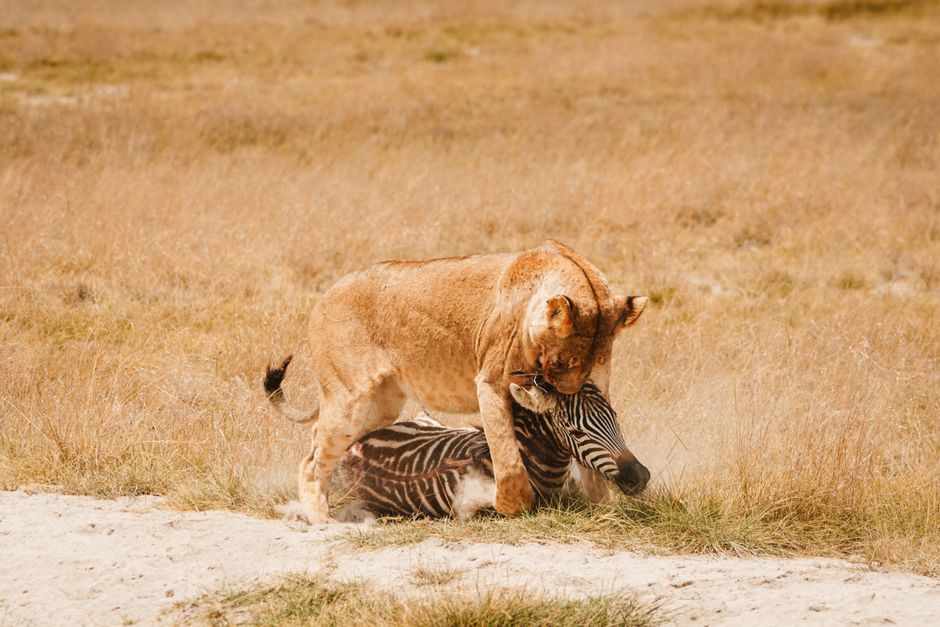
Lions attack humans, but it is far less common than many people believe. The reality is that most lions avoid people entirely. When attacks do happen, they usually fall into a few specific patterns that researchers have documented for decades.
How Often Do Lions Attack Humans Each Year?
Reliable numbers are hard to find because reporting varies by country. But the best estimates come from Tanzania, where researchers have tracked lion attacks for years. A study published in the journal Nature found that between 1990 and 2004, lions killed about 563 people in Tanzania. That averages to roughly 40 deaths per year in just that one country.
Other regions with lion populations report far fewer incidents. In South Africa, where lions live in fenced reserves and national parks, attacks on humans are rare. Most occur when people enter restricted areas or ignore safety rules. Across Africa as a whole, lions kill an estimated 100 people per year. That number is small compared to other causes of death on the continent, but it is not zero.
For context, hippos kill more people annually. So do crocodiles and elephants. Lions are not the deadliest large animal in Africa despite their reputation.
Why Do Lions Attack Humans in the First Place?
Lions do not see humans as normal prey. Research on lion behavior shows they prefer medium to large hoofed animals like zebras, wildebeest, and buffalo. Humans are not on their usual menu. Attacks typically happen for one of three reasons.
The first and most common reason is defense. A lion that feels cornered, threatened, or surprised will attack to protect itself or its cubs. This happens most often when people accidentally stumble into thick bush where a lion is resting. Farmers who walk through tall grass at dawn or dusk are at higher risk for this reason.
The second reason is injury or old age. A lion that cannot hunt its normal prey may turn to easier targets. Livestock is one option. Humans, especially children or small adults, can become another. The famous Tsavo man-eaters of 1898 were later found to have dental injuries that made normal hunting difficult. That pattern holds true in modern cases too.
The third reason is prey depletion. When lions cannot find enough wild animals to eat, they may venture closer to villages and farms. Livestock becomes a target first. If people try to defend their animals, attacks can follow. This is a growing problem in parts of Africa where human populations are expanding into lion habitat.
| Attack Cause | How Common | Typical Victim |
|---|---|---|
| Defensive (surprise encounter) | Most common | Farmers, herders, hikers |
| Injured or old lion | Less common | People near protected areas |
| Prey depletion | Growing problem | Villagers near reserves |
Where Do Most Lion Attacks on Humans Happen?
Lion attacks are not spread evenly across Africa. They cluster in specific regions where people and lions live close together. Tanzania has the highest documented number of attacks. The Rufiji district alone accounted for a large portion of those cases in the Nature study. Mozambique also reports frequent incidents, especially in rural areas near national parks.
India is the only country outside Africa where lions still live in the wild. The Asiatic lion population in Gujarat’s Gir Forest has grown in recent decades. As the lions expand beyond park boundaries, conflicts with nearby villages have increased. Between 2010 and 2020, there were several reported attacks, though deaths remain rare.
In national parks and game reserves where tourists visit, attacks are extremely rare. When they do happen, it is almost always because someone got out of a vehicle, approached too close, or entered a closed area. Park rangers enforce strict rules for good reason.





What Should You Do If a Lion Approaches You?
Most advice you find online about lion encounters comes from mountain lion territory in North America. African lions are different. They live in prides and are far larger. The same strategies do not always apply.
If a lion approaches you and shows no immediate aggression, stand your ground. Do not run. Running triggers a chase response in almost all predators. Back away slowly while facing the lion. Make yourself look as large as possible. Raise your arms above your head. Open your jacket if you are wearing one. Speak in a loud, firm voice.
If the lion charges, the situation changes. Some experts recommend throwing rocks or sticks at the lion’s face. Others say to shout and wave your arms aggressively. The goal is to convince the lion you are not easy prey. There is no guarantee this works. A lion that is determined to attack will not be easily deterred.
If you are attacked, fight back with everything you have. Use rocks, sticks, your fists, or anything nearby. Aim for the eyes and nose. Lions are powerful but they do not like pain or resistance. Playing dead does not work with lions the way it sometimes does with bears. You must fight.
Do Lions Attack Humans in Captivity?
Captive lions attack humans more often than wild lions do, relative to the number of people who interact with them. This is a fact that surprises many people. Zoos, sanctuaries, and private facilities around the world have reported incidents where lions injured or killed handlers.
The reasons are straightforward. Captive lions retain their natural instincts. They are still large, powerful predators. A lion that has been hand-raised or trained for performances is not tame. It is habituated. Habituation means it is comfortable around people, not that it has lost its predatory nature.
Many attacks in captivity happen during what experts call “routine interactions.” A keeper enters an enclosure to clean or feed the lion. Something startles the animal. A door is left open. A visitor reaches through a barrier. The lion reacts as a lion would. The consequences are often severe.
There is no evidence that any lion can be fully trusted in close contact. Facilities that allow direct interaction with lions, such as cub petting operations, carry inherent risk. Several high-profile incidents have involved lions that were raised from cubs and had never shown aggression before.
Common Misconceptions About Lion Attacks
One widespread myth is that lions attack humans because they are hungry and see us as food. Research shows this is rarely the case. Most lions that attack humans do not eat them. Defensive attacks end quickly once the perceived threat is gone. Even in cases where a lion does eat a person, it is often an old or injured animal that could not catch normal prey.
Another myth is that lions are afraid of fire and will always stay away from it. This is not reliable. Lions in areas with heavy human activity have learned that fire means people are nearby. Some lions have been observed approaching campfires, especially at night when they are hungry or curious. Fire is not a guarantee of safety.
A third misconception is that lion attacks are becoming more common because lions are becoming more aggressive. The evidence does not support this. Attacks are increasing in some areas, but that is because human populations are growing and expanding into lion territory. The number of lions is decreasing. The problem is proximity, not aggression.
- Most lions do not see humans as prey
- Defensive attacks are more common than predatory ones
- Captive lions attack more often than wild ones per interaction
- Fire does not reliably deter lions
- Lion populations are declining, but human-lion contact is increasing
What Does Research on Lion Attacks Show About Risk Factors?
Studies from Tanzania and Mozambique have identified clear patterns in who gets attacked. Young children are at higher risk than adults. One study found that children under 10 made up a disproportionate number of victims in certain regions. Small body size makes them easier targets, and they are less able to run or fight back.
Time of day matters significantly. Most attacks happen between dusk and dawn. Lions are crepuscular, meaning they are most active during twilight hours. People who walk or work outside after dark in lion habitat face the highest risk. Farmers guarding crops at night are a common victim group.
Gender also plays a role, though it varies by region. In some areas, men are attacked more often because they spend more time outside working. In others, women collecting water or firewood at dawn are at greater risk. The common thread is not gender itself but exposure. The more time a person spends in lion habitat, the higher their risk.
Research from the Lion Recovery Fund and Panthera, a wild cat conservation organization, shows that well-lit areas and secure livestock enclosures reduce attack risk significantly. Simple changes to village infrastructure have prevented more attacks than any other intervention.
Frequently Asked Questions
Are lions more likely to attack at night?
Yes. Lions are most active between dusk and dawn, and most attacks on humans occur during these hours.
Do lions attack humans in safari vehicles?
Extremely rarely. Lions generally see vehicles as large, non-threatening objects and do not attack them.
Can you outrun a lion if it chases you?
No. Lions can run up to 50 miles per hour in short bursts, far faster than any human.
Do lions attack humans more than other big cats?
No. Tigers attack and kill more people annually than lions do.
