
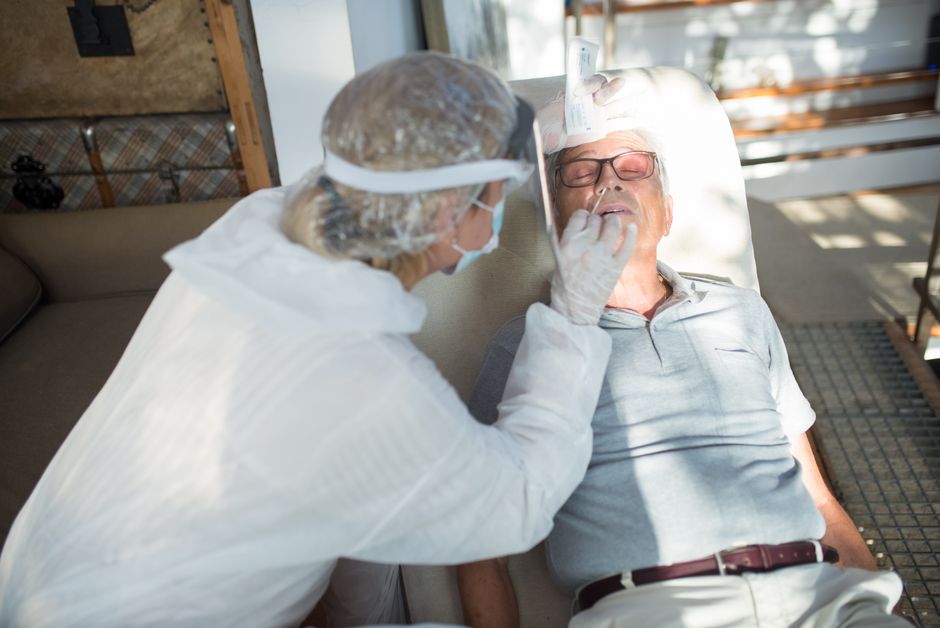
A do-it-yourself COVID test is only as good as the sample you collect. Most false negatives come from testing too early, swabbing too gently, or reading the result at the wrong time. Get the timing and the technique right, and a rapid antigen test gives you useful information within about 15 minutes.
How Do At-Home COVID Tests Actually Work?
There are two main types you can use at home, and they work in completely different ways.
Rapid antigen tests look for proteins from the virus itself. They work much like a pregnancy test: you add your sample to a small strip, and a line appears if viral proteins are present. They are fast and cheap, but they need a fairly high amount of virus in your sample to turn positive. That is why they tend to work best when you have symptoms and your viral load is high.
PCR tests detect the virus’s genetic material and are far more sensitive. Most at-home PCR kits require you to collect a sample and mail it to a lab, so results usually take a day or more. They can pick up much smaller amounts of virus.
One point that surprises people: a negative antigen test does not prove you are not infected. It means the test did not detect viral protein at that moment. Early in an infection, or late in one, there may not be enough virus in your nose for the test to catch. This is a limitation of the test itself, not a sign you did something wrong.
When Should You Take a COVID Test?
Test as soon as you develop symptoms, and test again a day or two later if the first result is negative. This is the single most useful thing you can do to avoid a false negative.
With the Omicron variant and its descendants, symptoms often appear before there is enough virus in the nose to register on an antigen test. Some research suggests antigen tests may lag behind the start of symptoms by a day or more. So a negative test on day one of a sore throat does not rule out COVID. Repeating the test after 24 to 48 hours substantially improves your chance of catching an infection you actually have.
If you have no symptoms but were exposed to someone with COVID, timing is trickier. The virus needs time to build up. Testing immediately after exposure is usually too early. Waiting several days after exposure and then testing — and repeating if the first is negative — is more likely to give a meaningful answer. If you are unsure about current isolation and testing guidance, check your local health department, since recommendations have changed over time.
How Do You Collect a Sample Correctly?
Follow the instructions in your specific kit, because kits differ. The steps below reflect the general approach most rapid antigen tests use, but your kit’s instructions take priority.
- Blow your nose first. Clearing excess mucus helps the swab reach the lining of your nose.
- Wash your hands before you start, and set out the test components on a clean, dry surface.
- Swab the inside of your nostril, not just the entrance. Insert the swab gently and rotate it against the inside wall of your nose. Most kits direct you to swab a specific depth and rotate for a set number of seconds. Follow that number.
- Swab both nostrils if your kit tells you to. Many do.
- Use enough pressure. This is where people go wrong most often. A light, timid swipe near the opening of the nose collects very little. You want to press against the nasal wall firmly enough to gather cells, without causing pain.
- Mix the sample into the liquid exactly as directed, and squeeze the swab as instructed to release the sample.
Do not swab your throat unless your specific test is authorized for throat use. Many at-home tests are validated for nasal samples only, and using them differently can produce unreliable results or cause injury.
Why Do So Many Home Tests Give Wrong Results?
Most inaccurate results trace back to a handful of avoidable mistakes, and timing and swabbing technique are the two biggest.
Testing too early is the most common. As covered above, a test taken on the first day of symptoms can miss an infection that a test two days later would catch.
Swabbing too shallowly is next. The virus settles in the cells lining the nasal passages, and a swab that barely enters the nostril may not pick up enough of it.
Reading the result at the wrong time matters more than people realize. Every test has a defined window — often around 15 to 30 minutes, depending on the brand. Read it too early and the reaction may not have finished. Read it too late and a faint line can appear that is not a true positive. Those late lines are a known cause of false positives. Set a timer and read the result only within the window your kit specifies.
Storage and expiry matter too. Tests kept in a hot car or used past their expiration date may not perform as intended. Check the date on the box.
What Do the Lines on a Rapid Test Mean?
Most rapid antigen tests use two lines: a control line and a test line. The control line tells you the test worked. The test line tells you whether viral protein was detected.
A visible control line plus a visible test line — even a faint one — is generally read as positive. A visible control line with no test line is negative. No control line at all means the test did not work, and you need to use a new one.
Faint lines cause a lot of confusion. A faint test line is still a line, and most manufacturers instruct you to treat it as positive. If you are unsure, the safest step is to treat it as positive and confirm with a second test or a PCR test if you can get one. Do not assume a faint line means you are only mildly infected — line intensity does not reliably reflect how much virus you carry or how sick you will get.
How Accurate Are Home COVID Tests?
Rapid antigen tests are good at confirming COVID when you have symptoms and a decent viral load, and less reliable when you do not. That is the honest summary of the evidence.
Their main strength is speed and accessibility. A positive antigen test in a person with symptoms is generally trustworthy. Their main weakness is false negatives, especially early in infection and in people without symptoms. This is why public health guidance has generally emphasized repeat testing rather than relying on a single negative result.
PCR tests remain the more sensitive option. A negative PCR is more reassuring than a negative antigen test, though no test is perfect.
One thing worth stating plainly: no at-home test tells you which variant you have, and a negative test does not mean you can safely ignore symptoms. If you feel unwell, act as though you could be contagious until you have a clearer picture.
When Should You Seek Medical Care?
A positive test is not, by itself, a reason to panic. Most people recover at home. But some symptoms warrant prompt medical attention regardless of what a test says.
Seek care for trouble breathing, persistent chest pain or pressure, confusion, inability to stay awake, or lips or face turning pale or blue. These are emergency warning signs and should not wait on a test result.
People at higher risk of severe illness — including older adults and those with certain underlying conditions — may benefit from early treatment, and timing can matter. If you test positive and are in a higher-risk group, contact a healthcare provider promptly rather than waiting to see how you feel. Treatment decisions belong with a clinician who knows your history.
Frequently Asked Questions
How soon after exposure should I test for COVID?
Testing immediately after exposure is usually too early, because the virus needs time to build up. Waiting several days after exposure and repeating the test if the first is negative gives a more reliable answer.
Can a faint line on a rapid test mean positive?
A faint test line is generally read as positive by most manufacturers, as long as the control line is also visible. Confirm with a second test or a PCR test if you are unsure.
Why did my home test come back negative when I have symptoms?
Antigen tests can miss early infection when viral levels are still low. Repeat the test a day or two later, and consider a PCR test if symptoms continue.
Should I swab my throat instead of my nose?
Only if your specific test is authorized for throat use. Most at-home tests are validated for nasal samples only, and using them differently can give unreliable results.
