
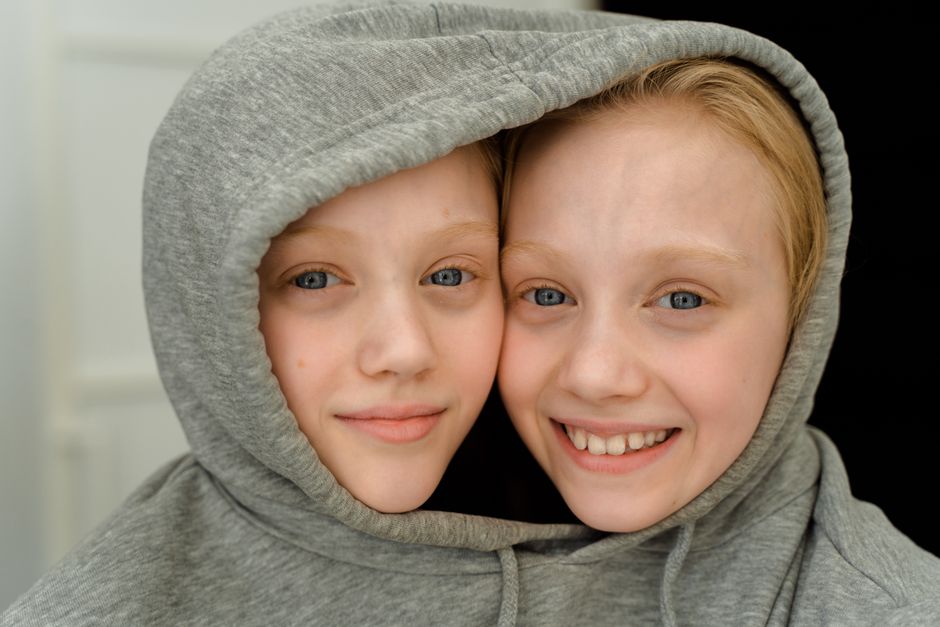
No, identical twins do not look exactly the same. They share the same DNA at conception, but genes are only part of what shapes a face. From the womb onward, small differences in environment, development, and chance push their features in slightly different directions.
Most people can tell identical twins apart once they know them. Strangers may struggle at first. The reason comes down to how identical twins actually form, and why “identical” is a misleading word for what they are.
What Does “Identical” Actually Mean for Twins?
Identical twins come from a single fertilized egg that splits into two embryos. This is why they are called monozygotic — “one zygote.” Because they start from the same egg and sperm, they carry the same genetic code at the moment of splitting.
That shared starting point is real, and it explains why identical twins often look strikingly alike. But sharing a genome is not the same as being a genetic copy of each other. The label “identical” describes their origin, not their final appearance.
Fraternal twins are different. They form from two separate eggs and two separate sperm, so they share roughly half their DNA — the same as any two siblings. Fraternal twins can be different sexes and often look no more alike than brothers and sisters do. The confusion between the two types is common, and it matters for understanding why identical twins still differ.
Why Don’t Identical Twins Look Exactly the Same?
Genes set a range, not a fixed outcome. How that range plays out depends on factors that are never truly identical, even for twins sharing a womb.
Here is the non-obvious part: identical twins are not genetically identical in the way most people assume. Even at birth, their DNA is not a perfect match. Small mutations can occur as cells divide during early development, and those changes can differ between the two embryos after the split. Over a lifetime, more differences accumulate.
Several forces drive the visible differences:
- Epigenetics. Chemical tags on DNA switch genes on or off. These tags can be influenced by environment and change over time, so two people with the same DNA can express it differently.
- Womb position. Each twin occupies a different spot in the uterus, with different access to blood flow and space. This can affect growth and even features like handedness.
- Chance during development. As a face forms, cells migrate and fold in ways that are not perfectly scripted by genes. Tiny random variations add up.
- Life after birth. Sun exposure, dental work, injuries, weight, hairstyle, and how someone holds their face all shape appearance over decades.
None of these factors erases the strong resemblance. They nudge it. The result is two people who look very similar but not the same.
How Alike Are Identical Twins Really?
Very alike — closer than any other pair of people except, in some cases, conjoined twins. Identical twins typically match on the traits most people notice first: eye color, hair color, skin tone, face shape, and body build.
But “very alike” is not “the same.” Differences show up in specific, observable ways:
- Facial asymmetry. Almost no face is perfectly symmetrical, and the small asymmetries differ between twins.
- Height. Identical twins are usually within a small margin of each other, but they are not always the same height.
- Weight and body composition. These can diverge based on diet, activity, and health over time.
- Fingerprints. Identical twins do not have the same fingerprints. Fingerprint patterns form partly from genetic signals but also from random physical forces in the womb, so each twin ends up with a unique set.
- Moles, freckles, and skin markings. These are shaped heavily by sun exposure and chance, not just genes.
The fingerprint point surprises many people. It is one of the clearest illustrations that identical DNA does not produce identical bodies.
Can Identical Twins Be Different Sexes?
Identical twins are almost always the same sex, because they share the same sex chromosomes. Two girls or two boys is the norm for monozygotic twins.
There are rare exceptions. In very unusual cases, a genetic event after the split can leave the twins with different sex chromosome patterns. These situations are uncommon and usually involve specific chromosomal conditions. They do not change the general rule.
The more common mix-up is assuming any boy-girl twin pair is identical. They cannot be. Boy-girl twins are always fraternal, because identical twins from one egg share the same sex chromosomes.
Do Identical Twins Have the Same DNA?
They start with the same DNA but do not stay perfectly identical. This is one of the most misunderstood points about twins.
As the two embryos develop, cells divide and copy their DNA. Copying is not flawless. Small errors can creep in, and these can differ between the twins. Research comparing twins has found that identical twins can carry small genetic differences that arose after the split. The differences are usually minor, but they are real.
On top of genetic differences, epigenetic tags diverge over time. Two people with the same DNA sequence can have genes switched on or off to different degrees. This helps explain why identical twins can develop different health conditions, even ones with a strong genetic component. It also helps explain why they are not perfect stand-ins for each other in medical terms.
The practical takeaway: identical twins are extremely similar genetically, but “same DNA” is a simplification, not a fact.
Why Do Some Identical Twins Look Less Alike Than Others?
Some identical twin pairs are nearly impossible to tell apart. Others are clearly distinguishable at a glance. The difference comes down to how much the non-genetic factors diverge.
Twins who grow up in similar conditions, with similar habits and sun exposure, tend to stay more alike. Twins whose lives pull in different directions — different weights, different hairstyles, one with glasses and one without, different injuries or dental work — look more distinct as adults.
Age plays a role too. Identical twins often look most alike in childhood and diverge more over the decades, as accumulated life experience leaves its marks. Sun exposure alone can create meaningful differences in skin over a lifetime.
There is also a perceptual factor. People who know twins well learn the small cues — a slightly different smile, a different way of standing, a different voice — and those cues make the twins seem far more distinct than a stranger perceives. The differences were always there. Familiarity makes them visible.
What This Means for Telling Twins Apart
For most people, telling identical twins apart is a matter of learning their individual cues. Voice, posture, hairstyle, and small facial differences usually do the job once you know them.
For identification purposes, fingerprints and DNA are reliable because they capture real differences. Fingerprints are unique to each person, including identical twins. DNA testing can distinguish identical twins in most cases, though standard tests may not always separate them cleanly, which is why forensic scientists sometimes need more detailed methods.
The word “identical” is a label for how twins form, not a promise that they are interchangeable. They are two separate people who happen to share a very similar genetic starting point.
Frequently Asked Questions
Do identical twins have the same fingerprints?
No, identical twins have different fingerprints. Fingerprint patterns are influenced by genes but also by random physical forces in the womb, so each twin develops a unique set.
Can identical twins look completely different?
They can look noticeably different, but rarely completely different. Identical twins share strong resemblance in eye color, hair, and face shape, though weight, sun exposure, and lifestyle can make them easier to tell apart over time.
Are identical twins always the same sex?
Almost always, yes. Identical twins share the same sex chromosomes, so they are usually both boys or both girls, with very rare exceptions involving unusual chromosomal events.
Why do identical twins look slightly different?
Small differences come from epigenetics, womb position, random events during development, and life after birth. These factors shape appearance without changing the underlying genetic similarity.
