
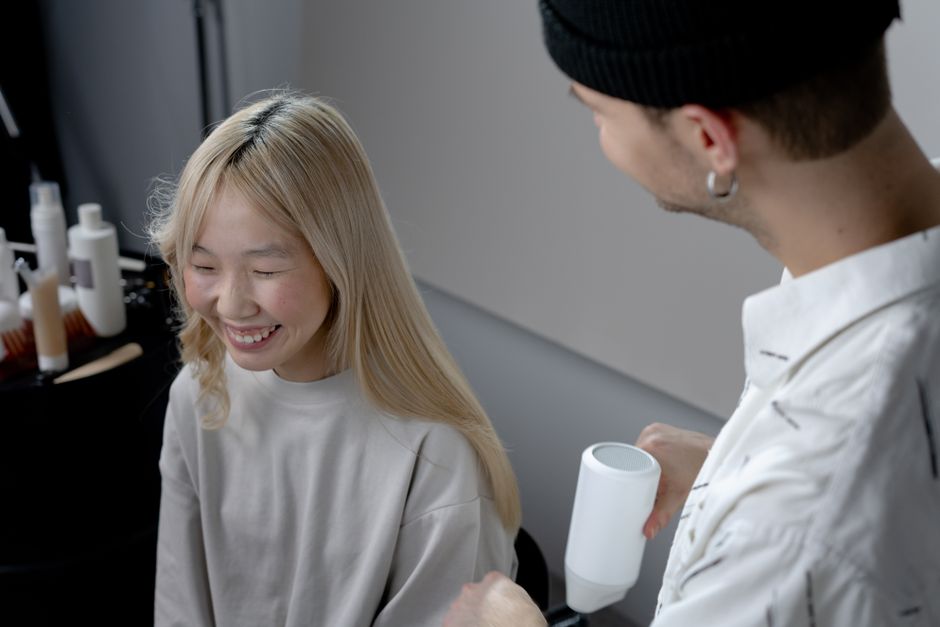
Yes, hair dryers make a real difference — but mostly in speed, styling control, and how much heat your hair absorbs along the way. A blow dryer does not change the structure of your hair permanently. What it changes is how fast water leaves the hair shaft and how much heat stress the cuticle takes during that process. Those two factors explain almost everything people notice about their hair after blow-drying.
Here is the part most people miss. The difference between a good blow-dry and a damaging one is not the brand. It is temperature, distance, and technique. Get those right and a dryer is a useful tool. Get them wrong and you can cause visible damage over time.
What Actually Happens to Hair When You Blow Dry It
Hair is mostly protein, and water sits inside and around each strand in different ways. Some water clings to the outside of the cuticle. Some is bound within the cortex, the inner layer of the hair shaft.
When you air-dry, water leaves slowly from the outside in. When you blow-dry, you speed up the evaporation of surface water first. The cortex — the part that gives hair its strength and shape — stays swollen with water longer than the surface does. That mismatch is why hair feels different after blow-drying versus air-drying.
Heat also rearranges hydrogen bonds inside the hair. These are temporary bonds, not permanent ones. That is why you can set hair into a shape with heat and why the shape falls out when hair gets wet again. Water breaks those bonds and lets the hair return to its natural form.
So a dryer is not changing your hair permanently. It is temporarily reshaping it while removing water faster than room air would.
How Much Heat Is Too Much for Your Hair?
Hair can tolerate a fair amount of heat, but there is a ceiling. Research on hair fibers has found that damage to the cuticle increases as temperature rises, and that repeated high-heat exposure causes cumulative harm. Studies on hair suggest that temperatures well above what feels comfortable on skin — often cited in the range of 150°C (about 300°F) and higher — can cause bubbling and cracking in the hair shaft.
Here is the honest limitation. Most of that research comes from laboratory studies on hair samples, not from long-term trials on real people using dryers in real bathrooms. The direction of the finding is consistent, but the exact temperature where damage begins depends on hair type, how wet the hair is, and how long the heat is applied.
Practical takeaway: lower heat and more airflow is gentler than high heat and less airflow. This is not a marketing claim. It follows directly from how heat transfers to a wet fiber.
Do Hair Dryers Make a Difference for Hair Type?
Yes, and the difference is bigger than most people expect. Hair type changes how much heat and mechanical stress a strand can handle.
- Fine hair dries fast but damages more easily. It has less cortex to absorb heat stress.
- Thick or coarse hair holds water longer, so it usually needs more drying time — which means more total heat exposure.
- Curly and coily hair tends to be more fragile at the bends and can lose moisture quickly when heat is applied. Many people with textured hair find that high heat and rough drying cause more breakage than they see with other hair types.
- Color-treated or chemically relaxed hair is already structurally compromised. It generally tolerates heat less well than untreated hair.
This is why two people can use the same dryer and get very different results. The tool is the same. The hair is not.
Does a More Expensive Dryer Really Work Better?
Price buys features, not magic. A higher-priced dryer usually offers more heat settings, a stronger and more consistent airflow, and better temperature control. Those features matter if you use them.
What price does not do is make heat harmless. A $300 dryer set to high heat still delivers high heat. Some premium dryers use sensors to hold a steady temperature, which can help you avoid accidental spikes. That is a genuine functional difference, not a gimmick.
Ionic dryers are a common selling point. These emit negative ions, which can help reduce static and make hair feel smoother and dry slightly faster by helping water break into smaller droplets. The effect is real but modest, and it varies by hair type. It is not a repair technology.
Ceramic and tourmaline coatings are marketed as distributing heat more evenly. Some users report less hot-spotting. The evidence here is limited and mostly based on how the materials behave, not on controlled trials comparing long-term hair health.
Air Drying vs Blow Drying: Which Is Better?
Air drying is generally gentler than blow-drying because it avoids heat. That part is well established. But air drying is not automatically better in every way.
Hair that stays wet for a long time is more fragile. Wet hair stretches more easily and breaks more readily when combed or handled. So leaving hair wet for hours and then brushing it roughly can cause its own damage.
The useful comparison is not air versus heat. It is gentle handling versus rough handling. A cool or low-heat blow-dry with a wide-tooth comb and minimal tugging can be kinder to hair than a long wet period followed by aggressive detangling.
If you want the lowest-risk approach, air dry most of the way and finish with a short, low-heat pass. That limits both heat exposure and extended wet time.
How to Blow Dry Without Damaging Your Hair
Technique matters more than the device. These practices are widely recommended by dermatologists and hair professionals, and they follow from how heat and water interact with hair.
- Start with hair that is about 70 to 80 percent dry. Towel-dry gently first. Do not rub hard.
- Keep the dryer moving. Holding it in one spot concentrates heat and causes hot spots.
- Hold the dryer at least six inches from your hair. Closer means more heat intensity.
- Point the airflow down the hair shaft, from root to tip. This smooths the cuticle instead of ruffling it.
- Use the lowest heat setting that still dries your hair in a reasonable time.
- Finish with a cool shot to help set the style and close the cuticle.
- Use a heat protectant. These products can reduce heat damage, though they do not make hair heat-proof.
One clarification worth knowing: a heat protectant is not a shield that blocks all damage. It reduces it. No product currently makes high heat completely safe for hair.
When Should You Skip the Dryer Entirely?
There are situations where heat is a poor idea. If your hair is already breaking, splitting, or feels brittle, adding heat usually makes it worse. If you recently bleached or chemically straightened your hair, the cuticle is already compromised and needs time to recover.
If your scalp is irritated, flaking, or painful, heat can aggravate it. In that case, see a dermatologist rather than trying to manage it with styling changes alone.
Hair does not repair itself once the cuticle is damaged. It can only be cut off or managed. That is the honest reality, and it is why preventing heat damage matters more than trying to fix it later.
Frequently Asked Questions
Do hair dryers damage your hair?
They can, mainly through heat and rough handling, especially at high temperatures used repeatedly. Used on low heat with the dryer kept moving and held away from the hair, the risk is much lower.
Is air drying better than blow drying?
Air drying avoids heat, which is gentler on hair. But hair that stays wet for hours is more fragile and breaks more easily when combed, so gentle low-heat drying can be a reasonable middle ground.
Do ionic hair dryers actually work?
They can reduce static and help hair feel smoother, and they may dry hair slightly faster. The effect is real but modest and varies by hair type — it is not a repair feature.
What temperature should I use on my hair dryer?
Use the lowest heat setting that still dries your hair in a reasonable time. There is no single universal safe temperature, since it depends on your hair type and how long heat is applied.
