
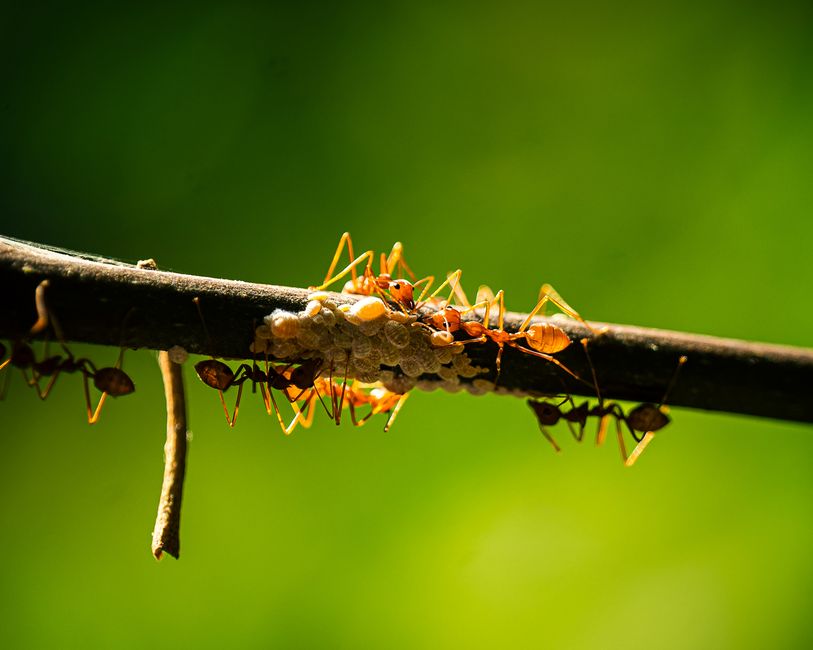
Ants do not have feelings in the way humans understand them. They lack the complex brain structures required for emotions like love, sadness, or guilt. However, their behavior is far from simple. Ants communicate, cooperate, and respond to threats with remarkable precision, driven by chemical signals and hardwired instincts rather than conscious thought.
What Does Science Say About Ant Emotions?
Research consistently shows that insects lack the neurological hardware for emotions. The human emotional experience relies heavily on the limbic system, a set of brain structures ants simply do not possess. An ant brain contains around 250,000 neurons. A human brain contains roughly 86 billion.
That difference matters. Emotions require a level of cognitive processing that ant brains cannot support. When an ant reacts to danger, it is following an instinctual program, not making a choice based on fear. The reaction looks purposeful, but it is automatic.
Some studies suggest insects can learn and even display something resembling optimism or pessimism. However, this is behavioral conditioning, not emotional experience. The scientific consensus remains clear: ants do not feel emotions as humans do.
How Do Ants Communicate Without Feelings?
Ants rely on pheromones, chemical signals that trigger specific behaviors in other ants. These signals are precise and effective. A trail pheromone guides nestmates to food. An alarm pheromone triggers defensive responses. A death pheromone signals that a dead ant needs removal.
This system works without any emotional component. The ant releasing the pheromone is not expressing distress. The ant receiving the signal is not feeling alarmed. Both are responding to chemical triggers the way your body responds to adrenaline, without conscious input.
Ants also communicate through touch and vibration. Antennae tapping conveys information about food quality or colony membership. This tactile communication is another form of instinctual programming, not a conversation.
Why Do Ants Act Like They Are Working Together?
Ant colonies appear highly organized, almost as if every member understands its role. This organization emerges from simple rules, not planning. Each ant follows a narrow set of instinctual responses to local conditions.
When a food source is found, the ant returns to the nest laying a pheromone trail. Other ants follow the trail. More ants means more pheromone, which attracts even more ants. This positive feedback loop creates the appearance of coordinated teamwork.
Biologists call this swarm intelligence. The colony as a whole solves complex problems, like finding the shortest path to food or choosing a new nest site. But no individual ant understands the problem. Each one simply follows its programming.





Do Ants Feel Pain?
Pain is different from emotion. Pain is a sensory response designed to prevent injury. Nociception, the ability to detect harmful stimuli, exists in many simple organisms. Ants do possess nociceptors that respond to damage.
However, feeling pain and experiencing suffering are not the same. Suffering requires consciousness and emotional processing. Ants withdraw from damaging stimuli, but they do not appear to experience the unpleasant, emotional component of pain that humans feel.
Some research on insects, particularly fruit flies, has found responses that resemble pain sensitization. After an injury, the insect becomes more responsive to future threats. This is a protective mechanism. Whether it indicates any form of suffering remains unknown and is considered unlikely by most researchers.
Can Ants Learn or Remember?
Ants can learn, but their learning is limited and tied to survival. Foraging ants learn routes to food sources. They remember visual landmarks and adjust their paths when obstacles appear. Some species can even learn to navigate mazes.
This learning is associative. The ant links a specific cue, like a visual landmark, with a reward, like food. Over time, the association strengthens. But this is not the same as understanding or reasoning. It is a basic form of memory that serves an immediate purpose.
Ants also have a form of collective memory. A colony can remember the location of good food sources from previous seasons. This memory is distributed across the colony through pheromone trails and nest structure, not stored in any single ant’s brain.
What About Ant Death and Mourning?
Ants do not mourn their dead. When an ant dies, it releases a chemical signal, typically oleic acid. Living ants detect this signal and carry the dead ant to a refuse pile. This behavior is purely chemical.
Research has demonstrated this clearly. When researchers coated live ants with oleic acid, other ants treated them as dead. They dragged the living ants to the refuse pile despite their obvious movement and resistance. The signal overrode all other information.
This experiment shows that ant behavior around death is mechanical, not emotional. The ants are not grieving. They are responding to a chemical cue that triggers a disposal program.
Why Do Ants Sacrifice Themselves for the Colony?
Some ants die protecting their colony. Soldier ants may block nest entrances with their heads. Worker ants may sacrifice themselves in defense against predators. This looks like bravery or selflessness, but it is genetic programming.
Ants are eusocial insects. In eusocial colonies, workers are closely related. By sacrificing themselves, they protect the queen and their siblings, who share their genes. This behavior maximizes the survival of their genetic material, even if the individual dies.
Biologists call this kin selection. The ant is not making a conscious choice to sacrifice. Its instincts are shaped by evolution to favor colony survival over individual survival. The behavior is adaptive, not heroic.
Are Some Ant Species More Complex Than Others?
Ant species vary significantly in behavioral complexity. Some species have simple colonies with a few hundred members. Others, like army ants, form massive colonies with millions of individuals and complex coordinated raids.
Certain species demonstrate advanced behaviors like agriculture. Leafcutter ants cultivate fungus gardens. Some ants farm aphids for their honeydew. Others enslave neighboring ant species, forcing them to perform colony tasks.
These behaviors are remarkable, but they remain instinctual. A leafcutter ant does not understand agriculture. It follows chemical and tactile cues that result in fungus cultivation. The complexity is in the system, not in the individual ant’s mind.
Why Do People Think Ants Have Feelings?
Anthropomorphism, attributing human traits to non-human things, drives the belief that ants have feelings. Ant behavior looks purposeful. They appear to care for their young, defend their homes, and work together. It is natural to project human meaning onto these actions.
Popular media reinforces this. Animated films and nature documentaries often portray ants with human-like personalities and motivations. These portrayals are entertaining but scientifically inaccurate.
Understanding the difference between appearance and reality matters. Recognizing that ant behavior is instinctual does not diminish its wonder. The complexity of a colony emerging from simple rules is arguably more fascinating than the idea of emotional ants.
What Is the Difference Between Instinct and Emotion?
Instinct is a fixed pattern of behavior triggered by specific stimuli. It does not require thought or feeling. A sea turtle hatchling moving toward the ocean is following instinct. An ant responding to an alarm pheromone is doing the same.
Emotion requires consciousness. It involves subjective experience, the ability to feel something internally. Humans feel fear, joy, and sadness. We reflect on these feelings and make decisions based on them.
Ants lack this capacity. Their nervous systems are wired for rapid, automatic responses to environmental cues. This wiring is incredibly effective for survival, but it does not produce inner experience. The ant is a biological machine, exquisitely adapted, but not a conscious being.
Frequently Asked Questions
Do ants feel pain when they are stepped on?
Ants detect damage through nociceptors and will withdraw from harmful stimuli, but they do not experience the emotional suffering associated with pain in humans.
Can ants feel sadness or grief?
No, ants lack the brain structures required for complex emotions like sadness or grief, and their behavior around dead nestmates is a chemical response, not mourning.
Are ants self-aware?
No evidence suggests ants have self-awareness or consciousness, and their behaviors are driven by instinctual responses to chemical signals rather than thought.
Do ants have memories?
Ants can learn and remember routes and associations for survival, but their memory is limited and serves immediate practical purposes rather than reflective thought.
