
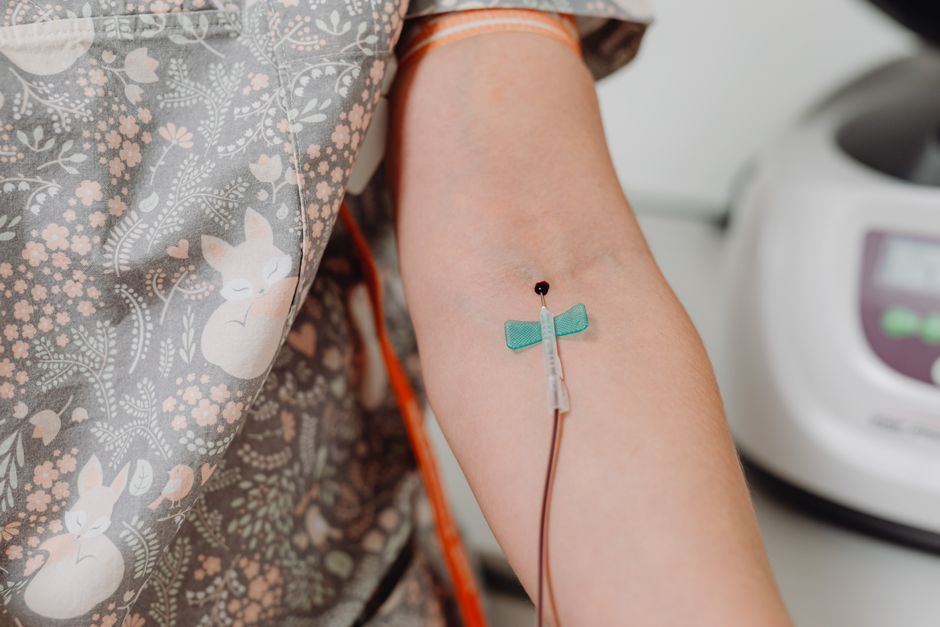
No. A PICC line that will not give a blood return should not be used for anything until a clinician has assessed it. Loss of blood return means the line’s position or patency is in question, and using it anyway risks infusing medication into tissue instead of a vein or, in rare cases, into the wrong vessel. The correct step is to stop, clamp the line, and have it checked.
This is not a rare problem. Nurses see it often, and it is one of the most common reasons a PICC gets evaluated. What matters is understanding why it happens and what the safe response looks like.
What Does It Mean When a PICC Line Has No Blood Return?
It means blood cannot be pulled back into the syringe when the nurse aspirates the line. A working central line should allow this. When it does not, the line may be blocked, kinked, tipped against a vessel wall, or sitting somewhere it should not be.
A PICC is a long, thin catheter threaded through a vein in the upper arm until its tip rests in a large vein near the heart. That tip position is what makes it a central line. It can deliver medications that would damage smaller veins, and it can be used to draw blood. Both functions depend on the tip being in the right place and the tube being open.
Blood return is one sign that both conditions are met. It is not the only sign, and its absence does not always mean something serious is wrong. But it is a warning that has to be taken seriously.
Why Can You Use a PICC Line With No Blood Return? The Short Answer
You can’t, in most circumstances. Clinical guidance on central line care generally treats loss of blood return as a reason to pause and investigate before the line is used for anything that could cause harm if it went into the wrong place.
The reasoning is straightforward. If the tip has migrated out of the large vein and into a smaller one, or if the catheter has developed a split, infusing certain medications could injure surrounding tissue. Some of the drugs given through a PICC are harsh on tissue — certain chemotherapy agents, concentrated electrolytes, and some antibiotics can cause serious damage if they leak outside the vein.
That said, practice varies. Some clinicians will use a line for certain purposes after assessing it and confirming the tip position another way. This is a clinical judgment, not a general rule you should apply yourself. The decision belongs to the care team.
What Causes a PICC Line to Stop Giving Blood Return?
The causes fall into a few broad groups. Some are minor and easily fixed. Others need the line replaced.
Positional and mechanical causes
The most common explanation is simple position. The tip of the catheter can rest against the wall of the vein, and the small opening gets sealed off. Changing the patient’s arm position, having them cough, or asking them to raise the arm can sometimes restore flow.
Kinks in the tubing outside the body, a closed clamp, or a connector that is not fully engaged can also block aspiration. These are quick to check.
Clot and fibrin
Blood can clot at the tip or along the catheter, and a sleeve of fibrin — a protein involved in clotting — can form around the outside. This is one of the more frequent causes of a line that infuses fine but will not pull blood back. A clot can act like a one-way valve.
This pattern matters. A line that flushes easily but gives no blood return is a classic presentation of a tip clot or fibrin sheath. It does not mean the line is open and safe for everything.
Tip migration
The catheter can move. Arm movement, coughing, vomiting, or changes in pressure inside the chest can shift the tip. If it pulls back into a smaller vein, blood return may disappear and the line is no longer central. This is the scenario that carries the most risk if the line is used anyway.
Other causes
Less often, the line may be pinched between structures, or a mechanical problem with the catheter itself may be present. Rarely, a more serious complication such as a clot in the large vein is involved.
What Should a Nurse or Clinician Do Next?
Stop and assess. That is the standard first step. The line should not be flushed forcefully to try to clear it, because pushing against a blockage can dislodge a clot or, in the worst case, damage the catheter.
A typical assessment includes:
- Checking the external tubing for kinks, closed clamps, and loose connections
- Asking the patient to change arm position, cough, or take a deep breath
- Checking whether the line flushes without resistance
- Reviewing whether the tip position has been confirmed recently
If these steps do not restore blood return, the care team decides what happens next. Options may include imaging to confirm tip position, specific flushing or declotting protocols if a clot is suspected, or removal and replacement of the line. Which option applies depends on the situation, the medications involved, and how urgently the line is needed.
Some institutions use specific agents to dissolve clots inside the catheter under a written protocol. This is a clinician-directed procedure, not something to attempt at home or without guidance.
Can You Still Give Medications or Fluids Through It?
This is where the stakes are highest, and the answer depends on what is being given.
Flushing with saline to keep the line open is one thing. Infusing a vesicant — a drug that can severely damage tissue if it leaks out of the vein — is another entirely. Many chemotherapy drugs fall into this category. So do some concentrated solutions and certain antibiotics.
If a line has no blood return and its position has not been confirmed, giving a vesicant through it is generally avoided. The risk of the drug reaching tissue instead of the bloodstream is the reason.
For routine fluids or medications with low risk of tissue damage, some clinicians may proceed after assessment. Again, this is a judgment made by the treating team with knowledge of the specific drug and the patient.
One point worth stating plainly: a line that flushes without resistance is not proof that it is safe. Flushing can succeed even when the tip has moved or a clot is present. Blood return and flushability are two different signals, and neither one alone confirms the line is where it should be.
What Are the Risks of Using a PICC With No Blood Return?
The main risk is that medication goes somewhere other than the bloodstream. If the tip has moved into a smaller vein or the catheter has a defect, infused fluid can leak into surrounding tissue. This is called extravasation.
Extravasation can cause pain, swelling, blistering, and in serious cases, tissue death. The severity depends on the drug and how much leaks. Some extravasation injuries require surgical treatment.
There is also a risk of giving a medication that is meant for a central vein into a smaller peripheral one, where it may irritate or damage the vein wall. And if a clot is present, attempting to force the line open can dislodge it.
These risks are not common when proper precautions are followed, but they are serious enough that the standard response to no blood return is caution rather than assumption.
What Should a Patient Do If They Notice No Blood Return?
Patients often watch their line being used and may notice when a nurse cannot get blood back. The right response is simple: ask. A question like “Is it a problem that you couldn’t get blood return?” is reasonable and appropriate.
You do not need to make a clinical decision. That is the care team’s job. But you are entitled to understand what is happening with a device inside your body.
If you have a PICC at home and are being taught to flush it, follow the instructions your care team gave you exactly. Do not attempt to force a flush if you meet resistance, and report any change in how the line behaves. Home infusion programs generally provide a phone number for exactly these situations.
Any sign of swelling, pain, redness, or leakage around the insertion site or along the arm should be reported right away.
Frequently Asked Questions
Can a PICC line be used if it flushes but has no blood return?
It should be assessed before use, because flushing easily does not confirm the tip is in the right place. A clot or a shifted tip can allow flushing while blocking blood return.
Is no blood return a medical emergency?
Not usually, but it should be reported and the line should not be used until it is checked. The urgency depends on what the line is needed for and whether there are signs of swelling or pain.
Can a PICC line with no blood return be fixed?
Sometimes. Repositioning the arm, relieving a kink, or a clinician-directed declotting protocol can restore function in some cases. If not, the line may need to be replaced.
Who decides whether the line can still be used?
The treating clinical team makes that decision after assessing the line and the medications involved. Patients should not make that call on their own.
