
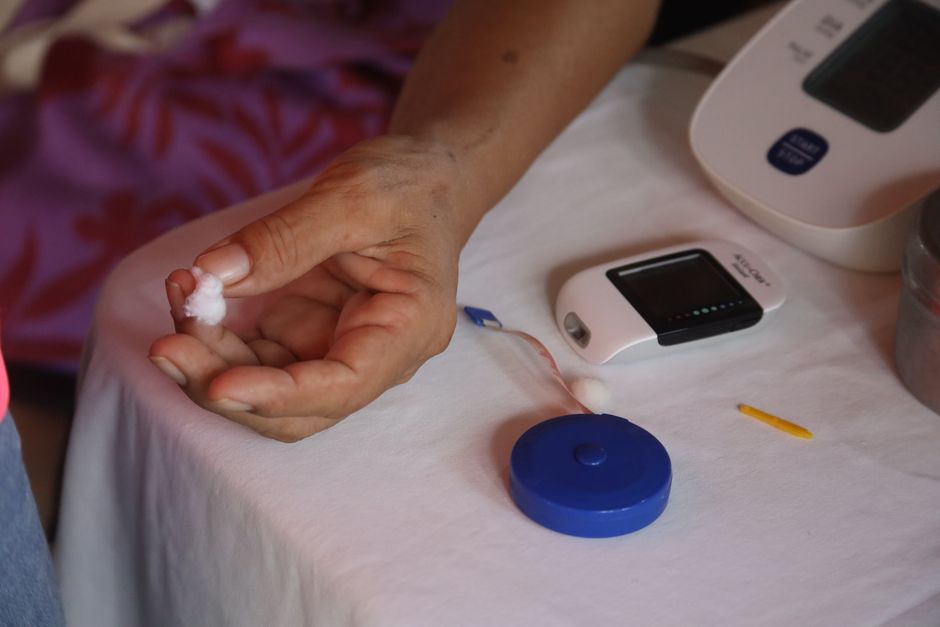
You can prick your finger, your forearm, your thigh, or your upper arm to check blood sugar. But only the finger gives you a reading you can trust for treatment decisions. Every other site is an alternative that measures glucose in different tissue, with different timing and different accuracy. That distinction matters more than most people realize.
The reason comes down to biology. Capillary blood in your fingertip reflects what is happening in your bloodstream right now. The fluid between your cells, called interstitial fluid, lags behind. If you test there, the number you see may not match the number in your blood.
Why Do Different Body Sites Give Different Blood Sugar Readings?
Glucose moves from blood vessels into interstitial fluid through a process called diffusion. This takes time. When your blood sugar is stable, the two compartments eventually equalize. When it changes quickly, they do not.
After a meal, blood glucose rises fast. Interstitial glucose rises more slowly. During exercise or an insulin dose, blood glucose falls fast. Interstitial glucose falls more slowly. This lag can range from several minutes to over twenty minutes depending on the site and the speed of the change.
Fingertip capillary blood sits at the end of a dense network of small vessels. It responds almost immediately to changes in circulating glucose. That is why it remains the standard for decisions about insulin dosing or treating low blood sugar.
Alternative sites sit farther from that vascular network. The glucose there is real, but it represents a delayed picture. For someone with stable blood sugar throughout the day, the difference may be small. For someone with rapidly changing levels, the difference can be clinically significant.
Can You Test Your Blood Sugar Anywhere On Your Body With a Standard Meter?
Most standard glucose meters are approved only for fingertip use. Using them on other sites is called alternative site testing, or AST. Some meters are cleared for AST, but only under specific conditions.
When a meter is approved for alternative sites, the manufacturer typically specifies which sites. Common options include the palm, forearm, upper arm, thigh, and calf. The FDA has cleared certain meters for these uses, but the approval comes with important limitations.
These limitations exist because the lag problem is real. A meter that works accurately on a fingertip may give misleading results elsewhere during rapid glucose changes. The device itself is not different. The tissue being sampled is.
If you use a standard meter on your forearm without checking whether it is approved for that site, you may get a number that does not reflect your actual blood glucose. This is not a minor issue if you use that number to decide how much insulin to take.
When Is Alternative Site Testing Not Safe?
Alternative site testing is not appropriate when you need to know your blood sugar right now. Several situations fall into this category.
- You think your blood sugar is low and you are checking to confirm it
- You have symptoms of hypoglycemia, such as shakiness, sweating, or confusion
- You just took insulin and need to verify your dose is working as expected
- You just ate and need to know how high your glucose has risen
- You exercised and need to check for a delayed drop
- You are sick, stressed, or your routine has changed significantly
- You are unsure whether your blood sugar is rising or falling
In all of these situations, the lag between blood and interstitial fluid can cause you to miss a low or underestimate a high. The consequence of a missed low can be loss of consciousness or seizure. The consequence of an underestimated high can be inadequate insulin dosing.
Some clinicians suggest that alternative sites may be acceptable when your blood sugar is stable and you are not making immediate treatment decisions. This is a clinical judgment, not a universal rule. If you are considering alternative site testing, the conversation belongs with your healthcare provider, not with a product label.




What About Continuous Glucose Monitors?
Continuous glucose monitors, or CGMs, measure glucose in interstitial fluid. They do not measure blood glucose directly. This is a fundamental difference that many users do not fully understand.
Because they sample interstitial fluid, CGMs have the same lag issue as alternative site finger sticks. The lag is typically around 5 to 15 minutes, though it varies by individual and by how quickly glucose is changing. Manufacturers build algorithms into the devices to account for this, but the lag does not disappear.
This is why CGM readings and finger stick readings often do not match exactly. A difference of 10 to 20 percent between the two is not unusual, especially when glucose is moving. The FDA has established accuracy standards for CGMs, but those standards allow for some deviation from reference values.
CGMs remain valuable for tracking trends, identifying patterns, and reducing the number of finger sticks. But most CGM systems still require finger stick confirmation when the reading does not match how you feel, or when you are making treatment decisions based on a rapidly changing number. Some newer systems have reduced or eliminated this requirement, but the underlying physiology has not changed.
How Accurate Are Alternative Site Readings Really?
The accuracy depends on the meter, the site, and the stability of your blood sugar. No single answer covers every situation.
Research has generally found that alternative site readings correlate well with fingertip readings when glucose is stable. During rapid changes, the correlation weakens. Some studies have shown clinically meaningful differences between sites during these periods.
The FDA evaluates meters for alternative site use by comparing results to a laboratory reference method. A meter must meet specific accuracy criteria to be cleared for each site. This means that if a meter is approved for forearm use, it has demonstrated acceptable accuracy in that location under the conditions of the study.
What the studies cannot fully capture is your individual physiology. Blood flow to the skin varies with temperature, hydration, and circulation. Cold hands or poor circulation can affect readings at any site, including the fingertip. This is why warming your hands before testing is a common recommendation.
What Is the Most Reliable Site for Blood Sugar Testing?
The fingertip remains the most reliable site for accurate, real-time blood glucose measurement. This is not a matter of preference. It is a matter of physiology.
Capillary blood in the fingertip reflects arterial blood glucose more closely than any other accessible site. It responds to changes faster. It is the site used to validate meter accuracy in clinical studies. It is the site referenced in treatment guidelines for insulin dosing and hypoglycemia management.
That said, fingertip testing has drawbacks. It can be painful. It can cause calluses over time. Some people find it difficult to get enough blood from a fingertip, especially in cold weather or if they have circulation problems.
If you are considering using an alternative site for comfort or convenience, the decision should be based on when you are testing and what you plan to do with the result. For monitoring trends when glucose is stable, an approved alternative site may be acceptable. For deciding whether to treat a low or adjust insulin, the fingertip is the site that gives you the information you need.
Some people rotate sites to reduce discomfort. This is a reasonable strategy if you understand the limitations. Testing on your forearm when you feel fine and your glucose is stable is different from testing there when you feel shaky and need to know whether you are low.
Does the Type of Meter Change Where You Can Test?
Yes. Not all meters are cleared for alternative site testing. The FDA label for each meter specifies which sites are approved. Using a meter on a site it was not cleared for is an off-label use.
Off-label use is not illegal, but it is not supported by the same evidence. The meter’s accuracy claims apply only to the sites listed in its instructions. If you test on an unapproved site, you are using the device in a way that has not been validated.
Some meters are designed specifically for alternative site testing and include features to improve accuracy at those sites. Others are intended for fingertip use only. The difference is in the testing and validation, not necessarily in the technology itself.
If you want to use an alternative site, check your meter’s instructions first. If the site is not listed, the reading may not be reliable. This is not a reason to panic, but it is a reason to be cautious about how you interpret the number.
Frequently Asked Questions
Can you test your blood sugar on your arm instead of your finger?
Yes, but only if your meter is approved for arm testing and your blood sugar is stable. Arm readings lag behind finger readings when glucose is changing quickly, which can make them unreliable for treatment decisions.
Is blood sugar the same in all parts of your body?
No. Blood glucose is similar throughout the bloodstream, but interstitial fluid glucose, which is what alternative sites and CGMs measure, can differ from blood glucose when levels are changing.
Why do my CGM and finger stick give different numbers?
CGMs measure glucose in interstitial fluid, which lags behind blood glucose by roughly 5 to 15 minutes. A difference of 10 to 20 percent between the two is common, especially when glucose is rising or falling.
Can you use a regular glucose meter on your thigh or calf?
Only if the meter is specifically cleared for those sites. Most standard meters are approved for fingertip use only, and using them elsewhere may give inaccurate results.
