
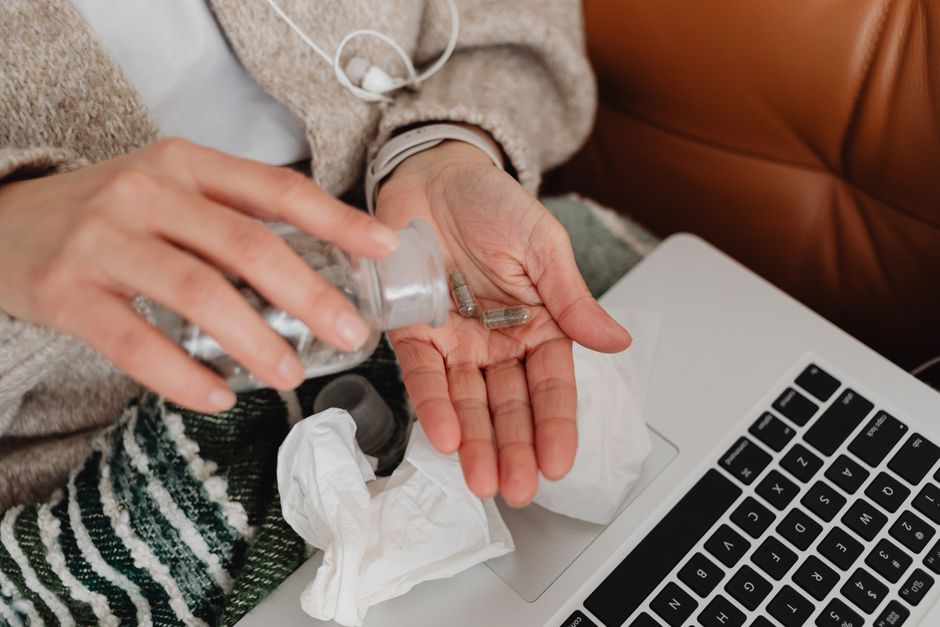
Yes, you can take pills on a plane. Prescription and over-the-counter medications are allowed in both carry-on and checked bags on US flights. The rules that matter most are about how they are packed, what documentation you carry, and a handful of restrictions that apply to liquids and to controlled substances.
Most travelers never have a problem. The trouble usually comes from three things: a liquid medication that exceeds the carry-on limit, a controlled painkiller packed without its prescription label, or a pill organizer with no original packaging. Each of those is easy to handle once you know what TSA and federal law actually require.
Can You Take Pills On A Plane Through TSA?
Yes. TSA does not restrict pills, capsules, or tablets in carry-on or checked baggage. Solid medications are not subject to the 3-1-1 liquids rule because they are not liquids.
The 3-1-1 rule limits carry-on liquids, gels, aerosols, creams, and pastes to containers of 3.4 ounces (100 milliliters) or less, all fitting in one quart-sized bag, one bag per passenger. A pill bottle of any size is not part of that calculation.
You do not need to declare solid pills at the checkpoint. You do not need a prescription for most over-the-counter medications. You can leave them in your bag, and in most cases they will pass through screening without a second look.
One practical note: TSA officers can inspect medication if it triggers an alarm or looks unusual on the X-ray. If your pills are in a jumbled unlabeled container, that inspection takes longer and raises more questions. Keeping pills in their original labeled bottles is not a legal requirement for non-controlled drugs, but it makes the process smoother.
What Are the Rules for Liquid Medications on a Plane?
Liquid medications are allowed in carry-on bags in amounts larger than 3.4 ounces. This is a specific exemption from the 3-1-1 rule, and it applies to prescription and over-the-counter liquid medicines.
TSA’s stated policy allows medically necessary liquids in quantities greater than 3.4 ounces. You should tell the screening officer that you have medically necessary liquids before the screening process begins. They may be screened separately or X-rayed on their own.
Here is where people get tripped up. The exemption covers the medication itself, not unlimited quantities of everything that looks medical. Ice packs needed to keep medication cold are generally allowed if they are still frozen solid at the checkpoint. Once melted, they may be treated as a liquid and subject to the size limit.
For international travel, rules can differ. Some countries apply stricter limits to liquids, and some require advance documentation for certain medications. Check the rules for your destination and any country you are transiting through, not just US rules.
Can You Bring Controlled Substances on a Plane?
Yes, if the medication is legitimately prescribed to you. Federal law allows you to travel with controlled substances as long as they are prescribed by a licensed practitioner and you are the patient.
This is the area where the label matters most. Controlled substances — which include many opioid painkillers, some anxiety medications, and stimulants used for ADHD — are regulated under federal law. Traveling with them in a container that does not match the prescription is where people run into real legal risk, not just a slow checkpoint.
A few things that reduce that risk:
- Keep controlled medications in the original prescription bottle with the pharmacy label showing your name, the drug, and the dose.
- Carry only the amount you reasonably need for the trip.
- Bring a copy of the prescription or a letter from your prescriber if you are traveling with a larger supply or crossing borders.
- Do not consolidate multiple prescriptions into one unlabeled pill organizer for international travel. This is fine for a domestic weekend trip in most cases, but it creates avoidable problems abroad.
Some countries ban medications that are legal in the US. Stimulants used for ADHD and certain pain medications are common examples. If you are flying internationally with a controlled substance, check the destination country’s rules before you book. In some cases a medication that is routine at home is illegal at your destination.





Should Pills Go in Carry-On or Checked Baggage?
Carry-on is the safer choice for anything you cannot afford to lose. Airlines lose checked bags. Bags get delayed. A checked bag can end up in a different city than you.
If your medication is essential — a blood pressure drug, insulin, an anti-seizure medication, a blood thinner — pack it in your carry-on. That way it stays with you even if your luggage does not.
Temperature matters for some medications. Insulin, certain biologics, and some liquid medications need to stay within a specific temperature range. Cargo holds on many aircraft are temperature-controlled, but they are not guaranteed to stay within the narrow range some drugs require. Carrying these in your carry-on gives you more control.
There is a second reason to split your supply. If you are traveling with a large amount of medication, consider putting most of it in your carry-on and a smaller backup supply in checked luggage. If one bag goes missing, you are not cut off from your medication entirely.
Do You Need Documentation for Medication at the Airport?
For most medications, no. You do not need a doctor’s note to carry prescription pills on a domestic US flight. Your prescription bottle with its label is generally enough.
Documentation becomes more useful in specific situations:
- International travel, where customs officers may ask about medications.
- Controlled substances, where a prescriber’s letter can help confirm legitimacy.
- Injectable medications or medical devices, which may need to be declared at screening.
- Travel to countries with strict drug import laws.
A prescriber’s letter does not need to be complicated. It should state your name, the medication, the dose, and that it is prescribed for your medical treatment. Keep it with the medication, not buried in a suitcase.
TSA also offers a free notification card you can download and fill out to discreetly inform officers about a medical condition or medication. It does not replace screening, but it can make the process easier to explain.
How Should You Pack Pills for Air Travel?
Pack pills so they are easy to identify and easy to reach. That is the whole principle. Everything else follows from it.
Keep medications in their original labeled containers. This applies especially to controlled substances and to anything you might need to prove is yours. A weekly pill organizer is convenient at home, but it strips away the label that identifies what the pills are and who they belong to.
If you use a pill organizer for daily doses, consider carrying the original bottles alongside it for the trip. That way you have both convenience and proof.
Pack medication in your personal item or the bag that stays under the seat in front of you, not in an overhead bin. If you need a dose during the flight, you do not want to be digging through a packed overhead compartment.
Bring more than you need. A trip that runs long because of a delay or a missed connection is common. Having a few extra days of medication on hand prevents a real problem.
What About Flying With Injectables and Medical Devices?
Injectable medications are allowed in carry-on bags. This includes insulin, auto-injectors for severe allergic reactions, and other prescribed injectables. You should tell the screening officer that you have injectable medication before screening begins.
Sharps — needles and syringes — are permitted in carry-on when they are for a medical purpose. Used sharps should be stored in a proper sharps container or a hard-sided container. Do not recap or handle loose needles.
If you use an insulin pump, continuous glucose monitor, or another wearable device, you can generally keep it on through screening. You can request a pat-down instead of walking through a metal detector or body scanner if you prefer, and you can ask that the device not be removed or X-rayed. Some device makers advise against sending certain devices through X-ray or body scanners, so check your device’s guidance before you fly.
Keep a copy of the prescription for any injectable medication with you. It is not always required, but it answers questions quickly if they come up.
Frequently Asked Questions
Can you take pills on a plane in your carry-on?
Yes. Solid pills and tablets are allowed in carry-on bags with no size limit and no need to declare them. They are not covered by the 3-1-1 liquids rule.
Do pills need to be in their original bottle to fly?
For most medications, no, but keeping them in the labeled bottle is strongly recommended. For controlled substances, traveling without the original prescription label can create legal risk, not just screening delays.
Can you bring liquid medicine over 3.4 ounces on a plane?
Yes, if it is medically necessary. TSA exempts medically necessary liquids from the 3.4-ounce limit, but you should tell the screening officer before screening begins.
Can you fly with controlled substances like painkillers?
Yes, if they are prescribed to you and you carry them in the original labeled container. For international travel, check the destination country’s rules, because some medications legal in the US are banned elsewhere.
