
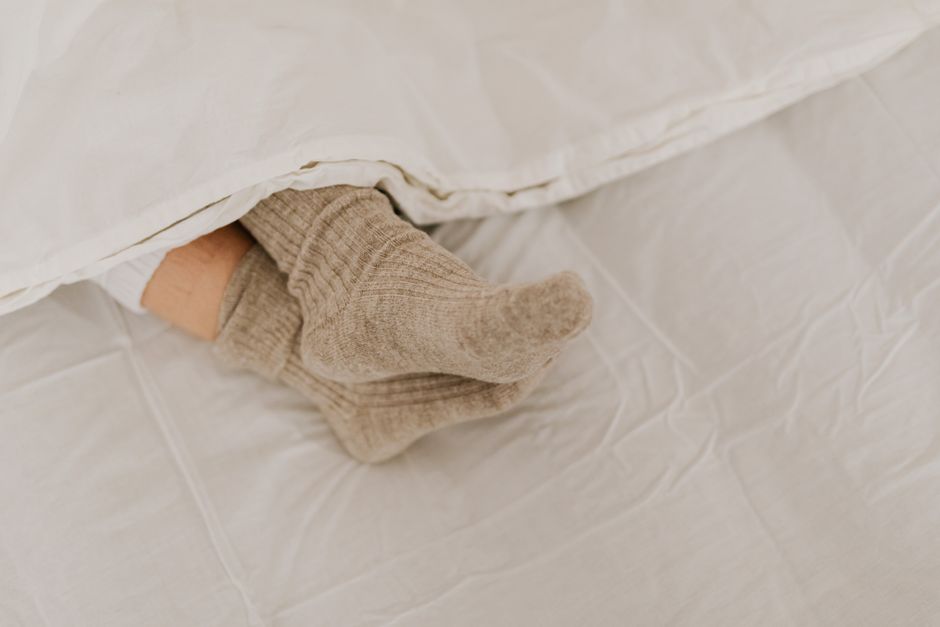
Yes, you can sleep in compression socks, and many people do. Whether you should depends on why you are wearing them and what your doctor has advised. For some people they ease leg discomfort at night. For others, especially those with certain heart or circulation conditions, wearing them overnight without medical guidance can be a problem.
Compression socks are not a single product. They come in a range of pressures, and the pressure matters as much as the timing.
What Do Compression Socks Actually Do?
Compression socks apply gentle, graduated pressure to your legs. The pressure is tightest at the ankle and looser as it moves up the calf. This helps the veins and the calf muscles push blood back toward the heart.
Your veins have to work against gravity. When you stand or sit for long stretches, blood can pool in the lower legs. That pooling is what causes swelling, heaviness, and that dull ache many people feel by the end of the day.
Compression helps in two main ways. It supports the vein walls so they do not stretch as much. It also helps the valves inside the veins close properly so blood moves in one direction instead of slipping backward.
This is well-established physiology. What is less settled is how much compression helps for each specific situation. The evidence is strong for some uses and thin for others.
Can You Sleep With Compression Socks?
You can, and for some people it is helpful. The key question is whether your reason for wearing them applies while you are lying down.
When you lie flat, gravity is no longer pulling blood down into your legs the way it does when you are upright. That changes the picture. Some of the pooling that compression is designed to counter simply is not happening the same way at night.
That does not make overnight compression useless. For people with ongoing vein problems, swelling that does not fully resolve, or a doctor’s specific instruction, nighttime wear can be part of a plan.
For a healthy person with no leg symptoms, there is little reason to wear them overnight. The benefit is likely small, and the evidence for routine overnight use in healthy people is limited.
One point worth clarifying: compression socks are not the same as compression stockings prescribed for medical use. Over-the-counter socks often provide mild pressure. Prescription stockings can provide much higher pressure and are fitted to your leg measurements. The two are not interchangeable.
Who Might Benefit From Wearing Them at Night?
People with certain conditions may be advised to wear compression overnight. This is a decision that should come from a clinician who knows your history.
- People recovering from certain vein procedures, where a doctor has specified overnight wear
- People with chronic venous insufficiency, when a clinician has recommended it
- People with lymphedema, under a treatment plan
- People whose leg swelling does not resolve with elevation alone
In each of these cases, the instruction comes from a clinician, not from a product label. The pressure level, the fit, and the timing all matter, and they vary by person.
If you have been told to wear compression socks and you are not sure whether that includes nighttime, ask. It is a simple question with a specific answer for your situation.





Who Should Be Careful About Overnight Compression?
Compression is not risk-free for everyone. This is where the honest answer gets more serious.
People with peripheral artery disease should be cautious. In this condition, arteries in the legs are narrowed and blood flow to the legs is already reduced. External pressure can make that worse. Compression is generally not recommended for significant arterial disease unless a specialist says otherwise.
People with heart failure need medical guidance. Compression can shift fluid back into the central circulation, and in some people with a weakened heart that shift needs to be managed carefully. This does not mean compression is always off limits. It means it should be a medical decision.
Other situations that call for a doctor’s input include:
- Diabetes with nerve damage or poor circulation in the feet
- Skin infections or open wounds on the legs
- Known blood clotting disorders
- Severe peripheral neuropathy, where you may not feel pressure that is too tight
The common thread is this: if you cannot reliably feel or report what the compression is doing to your legs, or if your circulation is already compromised, get medical advice before wearing them overnight.
How Tight Should They Be, and Does That Change at Night?
Compression is measured in millimeters of mercury, written as mmHg. This is the same unit used for blood pressure.
Over-the-counter socks usually fall in a mild range. Prescription stockings are classified into higher grades, and the grade is chosen based on your condition. A clinician or a certified fitter determines the right level.
Here is the part many people get wrong. A tighter sock is not a better sock. Pressure that is too high can reduce blood flow, cause pain, and in some cases do harm. More pressure is not more benefit.
Fit matters as much as pressure. A sock that bunches, rolls down, or digs in creates uneven pressure. That can be worse than no compression at all. Measure your ankle and calf and follow the sizing chart, or get fitted professionally.
For nighttime wear, the general principle in clinical practice is to use the lowest pressure that manages the problem. Some clinicians recommend taking compression off at night for this reason. Others recommend keeping it on. The right answer depends on the condition being treated.
What About Compression Socks for Better Sleep or Recovery?
You may have seen claims that compression socks improve sleep quality, speed recovery, or boost circulation overnight. It is worth separating what is supported from what is marketing.
There is reasonable evidence that compression helps with leg heaviness and swelling related to standing or travel. That is a daytime, upright problem.
Claims about better sleep quality are weaker. Some studies suggest compression may help people with restless legs or leg discomfort at night, but results vary and the evidence is not strong enough to call it a reliable sleep aid.
Claims about athletic recovery are mixed. Some research points to reduced soreness, other research finds little difference. No study has confirmed that compression socks meaningfully improve recovery for the average person.
If you have a sleep problem, compression socks are not a treatment for it. Talk to a clinician about what is actually disrupting your sleep.
Practical Tips If You Do Wear Them at Night
If you and your doctor decide overnight compression is right for you, a few basics help.
- Put them on in the morning before swelling builds, if that is what your clinician advises
- Check your skin daily for redness, marks, or irritation
- Make sure there are no wrinkles or folds in the fabric
- Replace them when they lose their stretch, since worn-out compression does not work
- Stop and call your doctor if you feel numbness, tingling, pain, or your toes change color
Those warning signs are not minor. Numbness, tingling, or color changes suggest the compression is too tight or that something else is going on. Take the socks off and get advice.
One more practical note. Compression socks need to be washed regularly and replaced over time. Elastic breaks down with wear and washing. A sock that has lost its stretch is no longer doing its job, even if it still feels snug.
The Bottom Line
Sleeping in compression socks is not dangerous for most healthy people. For many, it is simply unnecessary. For people with specific vein or swelling conditions, it can be a useful part of care when a clinician recommends it.
The people who need to be careful are those with artery disease, heart failure, diabetes with circulation problems, or skin wounds on the legs. For them, overnight compression should be a medical decision, not a personal one.
If you are unsure which group you fall into, that is the signal to ask. A short conversation with a doctor or a certified fitter can answer the question for your specific legs.
Frequently Asked Questions
Can you sleep with compression socks on all night?
Yes, some people wear them all night, but it should be based on a medical reason or a clinician’s advice. For healthy people with no leg symptoms, overnight wear is usually unnecessary.
Is it bad to wear compression socks to bed?
For most healthy people it is not harmful, but it may not help either. It can be risky for people with peripheral artery disease, heart failure, or poor circulation, who should get medical clearance first.
What are the signs compression socks are too tight at night?
Numbness, tingling, pain, or toes that change color are warning signs. If any of these happen, remove the socks and contact a doctor.
Do compression socks help you sleep better?
Some studies suggest they may ease leg discomfort that interferes with sleep, but the evidence is not strong enough to call them a reliable sleep aid. If poor sleep is ongoing, talk to a clinician.
